
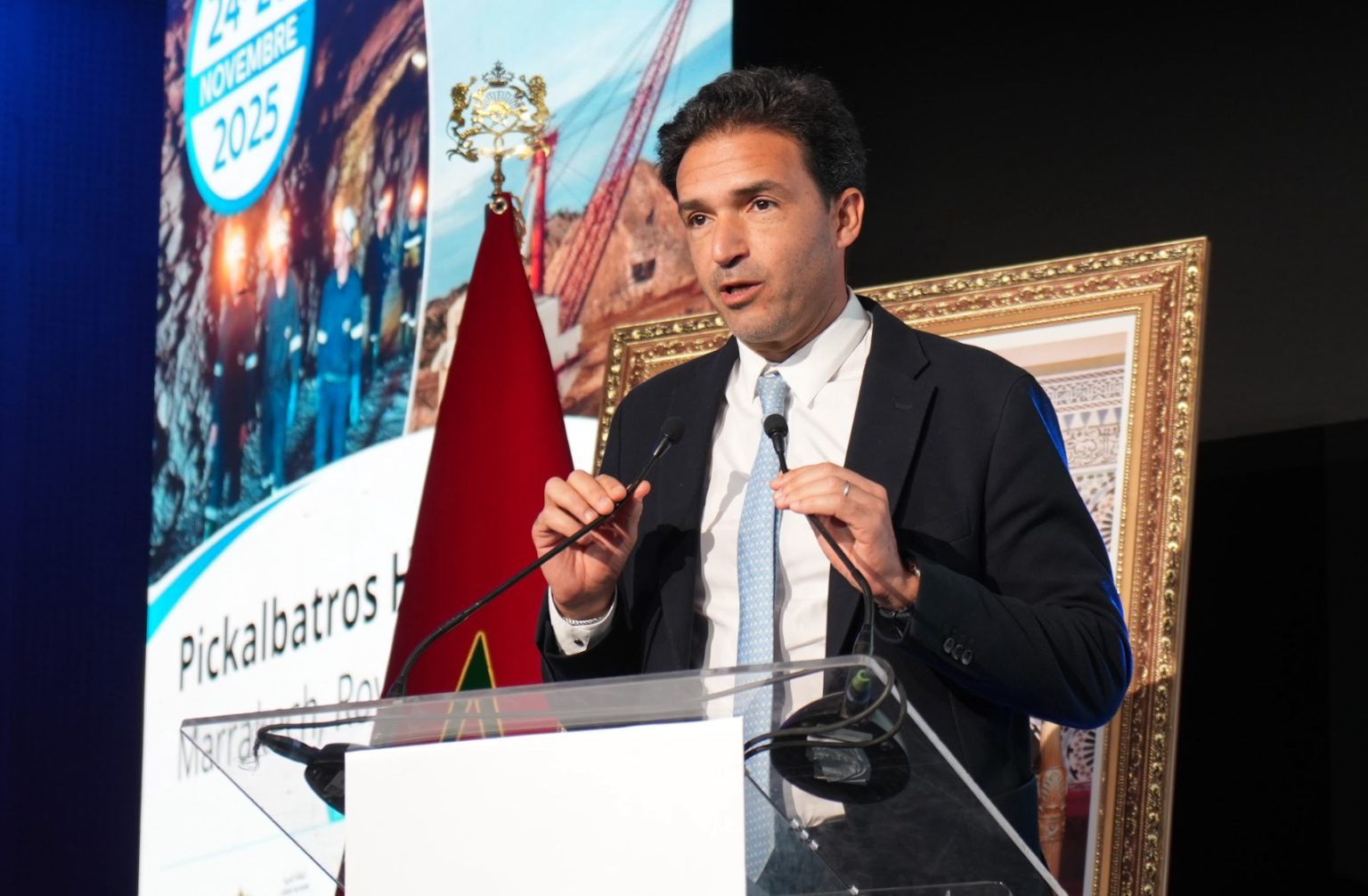
At the second edition of the International Mining Congress of Morocco, held from November 24 to 26 in Marrakech under the theme “Strategic and Critical Metals: Morocco, an Industrial and Technological Hub for Regional and Global Value Creation”, CGEM Vice-President Mehdi Tazi delivered a highly noted speech. Speaking on behalf of the Moroccan private sector, he highlighted the strategic importance of African resources in global energy and industrial transitions, while advocating for a continental model centered on local processing and value creation.
Addressing an international audience of ministers, experts, and industry leaders, Mehdi Tazi stressed that the mining sector is today “at the center of all global discussions”, becoming a pivot in geopolitical balances. In his view, Marrakech’s selection as the host city reflects Morocco and Africa’s growing role in matters related to strategic and critical metals.
Representing an organization that brings together nearly 100,000 companies and accounts for 75% of Morocco’s GDP, the CGEM Vice-President underscored the mining sector’s weight in the national economy: approximately 10% of GDP, one-quarter of exports, and more than 70 minerals currently exploited. He particularly highlighted the example of OCP, which over the past fifteen years has transformed a historically extractive company into a global leader in phosphate processing and value addition. This transformation, made possible by massive investments, has quintupled the value created, demonstrating that “Africa can move from extraction to value-added production.”
Mehdi Tazi also praised OCP Group’s efforts in energy transition, desalination, port infrastructure, and logistics, considering this strategy a model for Africa to assert its mineral sovereignty.
He noted that this momentum aligns with Morocco’s broader vision since 2008. Under the guidance of His Majesty King Mohammed VI, the Kingdom now produces nearly 50% of its electricity from renewable sources—hydraulic, solar, and wind—strengthening its competitiveness in mineral processing industries.
Referring to next-generation infrastructure, he mentioned the Nador West Med port and the future Dakhla Atlantique port, whose commissioning, announced from 2028, will open new industrial and logistics corridors toward West Africa. According to Tazi, these projects are reshaping the map of African flows of processed minerals and will provide strategic access to multiple countries across the continent.
At the continental level, the CGEM Vice-President made a clear observation: Africa holds about 30% of global mineral resources but currently captures less than 2% of the value created. He argued that harmonizing mining legislation, gradually implementing the AfCFTA, and developing regional integration mechanisms could significantly increase intra-African trade, potentially doubling it from 15% to over 30% in the coming years.
He also emphasized the need for massive investment in regional infrastructure—clean energy, logistics corridors, and cross-border networks—reminding that Africa possesses exceptional natural assets: hydropower potential seven times that of Europe and some of the world’s best solar and wind resources.
In conclusion, Mehdi Tazi reaffirmed the Moroccan private sector’s full commitment to supporting African states in building a sovereign and sustainable industrial model. He expressed the desire to see concrete progress in local processing and African certification of minerals—the cornerstones of a new continental economic paradigm—at the next editions of IMC-Morocco.