




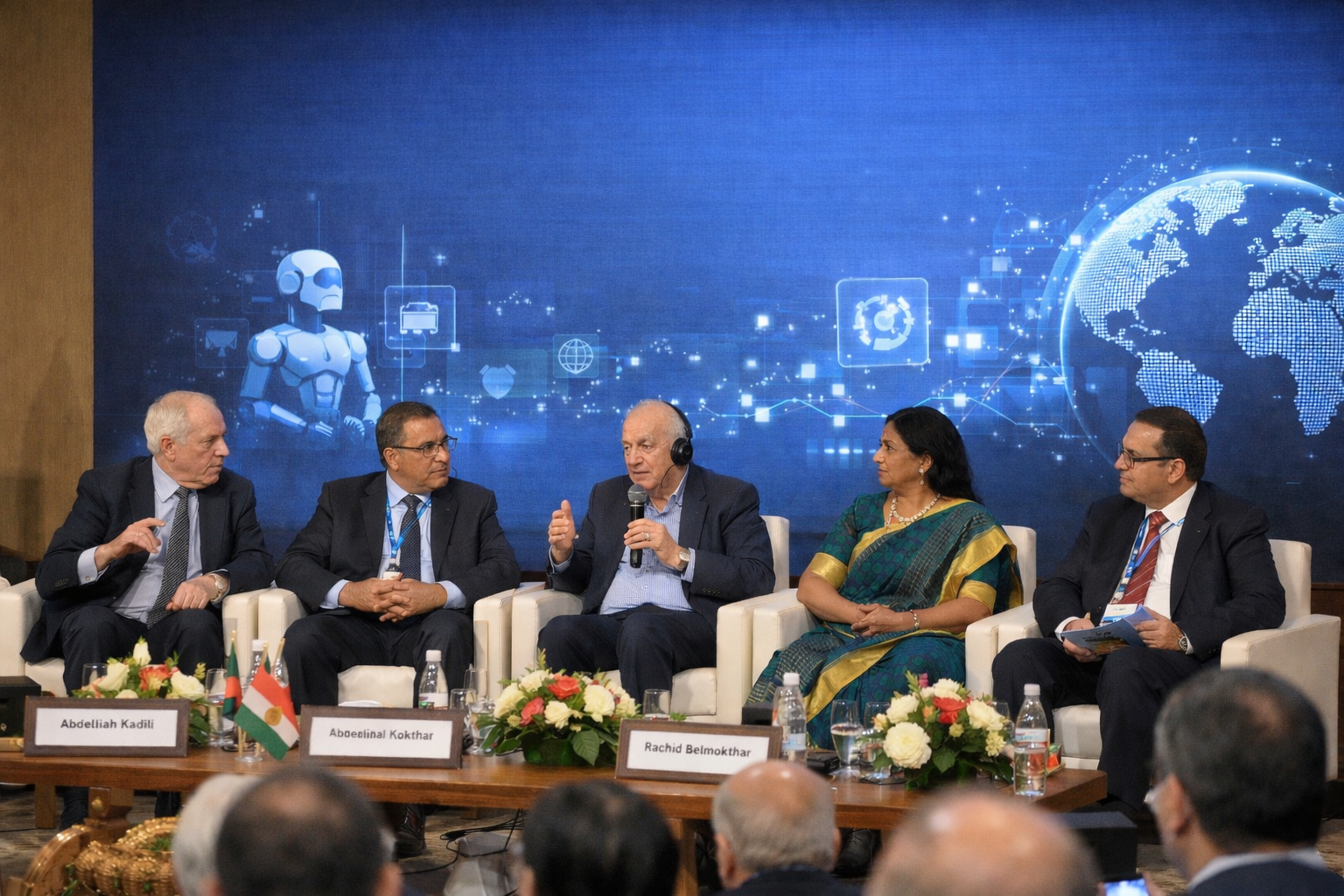
A high-level forum on education systems in the era of artificial intelligence (AI) was held on Wednesday in Fez, organized by the Tamkine Foundation for Excellence and Creativity, ahead of the India–AI Impact 2026 Summit. The event brought together experts, academics, and institutional stakeholders from Morocco and abroad.
Held under the theme “From the Digital Divide to the Digital Dividend: A Global Roadmap Led by the Global South to Democratize AI in Education”, the forum was organized in partnership with the Euro-Mediterranean University of Fez and conducted in a hybrid format. It aimed to examine how education systems can transform artificial intelligence—often seen as a source of inequality—into a driver of shared progress, addressing issues related to leadership, governance, infrastructure, teacher empowerment, and large-scale human capital development.
The strategic orientations and concrete proposals emerging from the Fez pre-summit will be conveyed to the India–AI Impact 2026 Summit, scheduled for February 19–20 in New Delhi, thereby contributing a Global South perspective to the worldwide dialogue on AI and education.
Speaking at the event, the Honorary President of the Tamkine Foundation, Rachid Belmokhtar, noted that while some fear AI’s negative impacts, particularly on employment or the replacement of human roles, the technology can also serve as a powerful catalyst for change by improving quality and equity in education systems.
The Fez pre-summit, which brought together academics from Morocco, Mexico, the United States, Singapore, India, China, and Hong Kong, fostered in-depth reflection on practical ideas to promote AI in education. In this regard, Mr. Belmokhtar proposed the creation of an informal think tank, the “Fez Group”, to further explore issues related to education and artificial intelligence, particularly as Morocco’s education system undergoes major reforms.
For his part, the President of the Tamkine Foundation, Abdelilah Kadili, stressed the need to avoid the risks associated with irresponsible or unethical uses of AI in education, calling for a shift from a risk-centered approach to a vision that sees AI as a transformative resource for education. He also underscored the importance of pooling the efforts of experts and academics, noting that education is a national priority in Morocco.
The pre-summit reflects more than a decade of the Tamkine Foundation’s sustained commitment to education reform, digital transformation, and human capital development, as well as its advocacy for an African Decade of Education, based on the conviction that Africa must actively shape global technological transformations.
On the sidelines of the forum, academic Abdesamad El Fatemi presented his book “The Dawn of Global Artificial Intelligence: The Path of Training and Arab Challenges”, written in Arabic and English. The book seeks to popularize AI for the general public while highlighting the historical depth of science and mathematics and reviving the works of prominent Arab-Muslim scholars such as Al-Khwarizmi, Ibn Sina, and Ibn Al-Haytham. He called on the Arab world to recognize its historical contribution to science and to engage proactively in the global AI race, stressing the strategic choices Morocco must make to achieve regional and continental leadership.
The India–AI Impact 2026 Summit is one of the leading international platforms dedicated to promoting inclusive, responsible, and effective approaches to artificial intelligence. It will bring together governments, international organizations, academic leaders, and private sector actors to shape a forward-looking global agenda for AI, with a strong focus on human development, governance, and equity.