
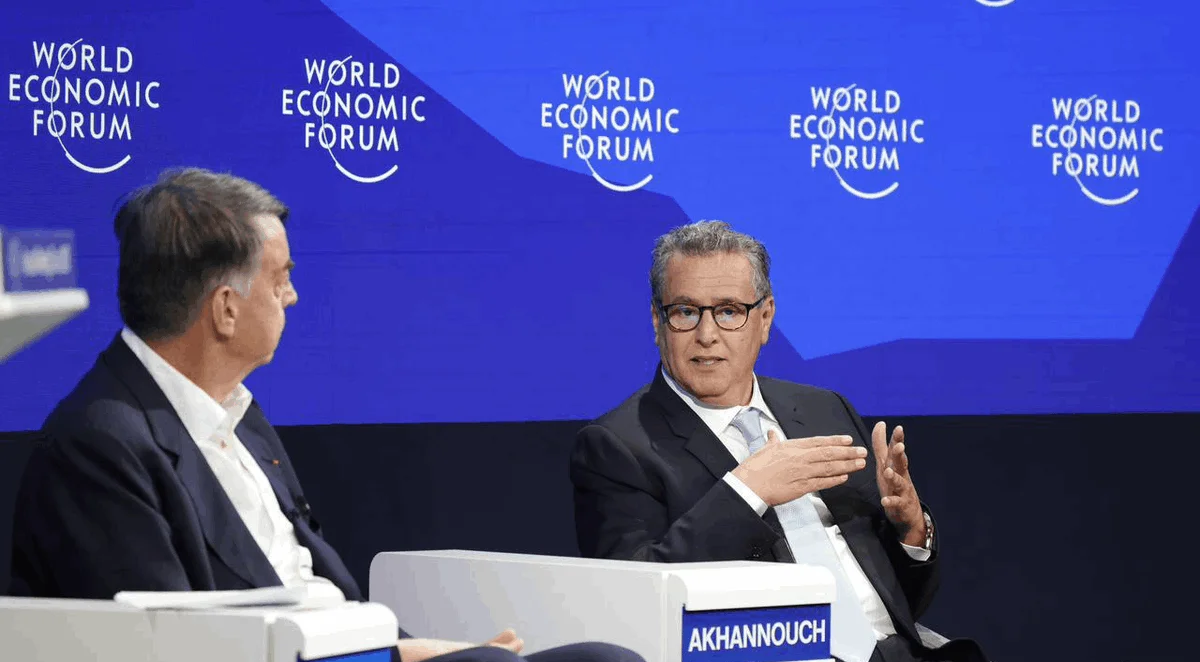
In Davos, Morocco is not there to put on a show. It is stepping into a space where the trade-offs shaping the global economy are increasingly being made. Today, major decisions are no longer taken solely within formal institutions. They are forged through a combination of strategic interests, industrial alliances and economic diplomacy, at the heart of value chains that stretch far beyond borders.
From 19 to 23 January 2026, the World Economic Forum’s 56th Annual Meeting is taking place in Switzerland under the theme “A Spirit of Dialogue”. Against a backdrop of geoeconomic fragmentation, persistent geopolitical tensions and rapid technological acceleration, the Forum is more determined than ever to present itself as a platform for discussion and cooperation, at a time when the rules of global trade are being reshaped and transitions are turning into power struggles.
The World Economic Forum remains one of the rare arenas where heads of state, leading investors, multinational executives, banks, international institutions and technology leaders all converge at once. For the 2026 edition, the organisers announced nearly 3,000 participants from more than 130 countries, including around 400 political leaders, 65 heads of state and government, and over 800 top-tier business executives. The meeting also unfolds under intense media attention, with roughly 400 journalists on site, while sessions and exchanges are widely broadcast and made accessible through the Forum’s digital channels.
In this setting, Morocco’s presence does not carry the same meaning it did ten or fifteen years ago. It reflects a gradual but tangible rise within the circles where the global economy is shaped. Prime Minister Aziz Akhannouch was notably highlighted by the World Economic Forum, reaffirming Morocco’s position as a gateway between Europe, the Atlantic and Africa, and pointing to what he described as solid economic and fiscal fundamentals.
Davos 2026 also offers a useful framework for understanding today’s economic debates. Discussions are structured around five major concerns that run through the Forum’s agenda: cooperation in a conflict-ridden world, the search for new sources of growth, investment in human capital, the responsible deployment of innovation, and building prosperity within planetary boundaries. In other words, the issues that matter are no longer limited to trade or markets. They extend to security, skills, technology, energy and sustainability — the very foundations of competitiveness.
Davos, a platform for access and influence
The first thing Morocco gains from Davos is greater access and strategic reach. Access to decision-makers who are rarely available in conventional settings; access to discussions where investment priorities take shape; and access to agendas that often end up steering international financial flows. Davos does not always produce headline-grabbing announcements, but it does create alignment. And in an economy where uncertainty has become the norm, being in the room carries almost as much weight as speaking.
This year, the atmosphere is defined by a clear return of power politics and intensified competition between blocs. In this context, Morocco is also advancing its own reading of global change: that of a country no longer content with merely adjusting to global trends, but seeking to position itself on the most structuring issues — particularly energy, industrial value chains and regional stability.
Stability as a competitive advantage
The second gain is political, and it translates directly into economic credibility. In Davos, Morocco reinforces an image of stability, continuity and mediation capacity. The events of 22 January provide a clear example. On the sidelines of the Forum, Foreign Minister Nasser Bourita signed, in Davos and alongside Donald J. Trump, the founding charter of a new Peace Council — an initiative backed by the US President and presented as a tool for crisis management and support for conflict-resolution efforts.
Whatever the future trajectory of this format, the signal is unmistakable. The Kingdom continues to be associated with diplomatic mechanisms where sensitive issues are negotiated, and this political centrality mechanically strengthens its economic credibility. In an environment where stability is one of the first markers of investor confidence, that kind of recognition matters. In Davos, influence is not measured only by economic announcements. It is also reflected in the place a country occupies in strategic conversations — the ones that shape perceptions and, ultimately, decisions.
Energy transition: moving into execution mode
The third benefit, and likely the most structuring one, is industrial. Davos has become a place where energy and economic sovereignty are discussed as much as finance itself. And on this front, Morocco arrives with increasingly clear strengths. The Kingdom is advancing a green hydrogen strategy that attracts consortia, mobilises land, and targets concrete industrial uses — including ammonia and key segments of heavy-industry decarbonisation. In 2025, Moroccan authorities officially confirmed the selection of national and international operators under the “Morocco Offer” for green hydrogen, while public announcements point to a project pipeline expected to scale up significantly.
This positioning is not built on intentions alone. It rests on an industrial logic, with players able to turn ambition into real capacity. The OCP Group, the world’s leading phosphate producer, officially announced in 2024 a partnership with Fortescue centred on green hydrogen, ammonia and decarbonised fertiliser solutions. OCP has also set out quantified targets for green ammonia, aiming for 1 million tonnes by 2027 and 3 million tonnes by 2032. In the world of Davos, that level of credibility is what makes the difference. An energy strategy only truly exists when it is embodied in partners, volumes, timelines and the ability to deliver.
Critical minerals: the next global battleground
The fourth lever, often underestimated in public debate, concerns critical minerals. The global economy is redrawing its dependencies. To electrify, store energy, manufacture batteries and secure industrial supply chains, major powers need cobalt, phosphates, manganese, nickel, copper and other raw materials that have become strategic. On this front, Morocco has recognised assets. Several studies place the Kingdom among the best-endowed African countries in resources relevant to the energy transition, while other publications highlight the Moroccan combination of mineral potential and political stability — a factor that is becoming increasingly decisive in industrial location choices.
In this context, Davos is more than a showcase. It is the place where the new geography of value is taking shape. Countries that can secure access to clean energy, strategic inputs, industrial capacity and stable governance are gaining a head start in the competition of the coming years.
The real test is execution
What has changed — and what explains why Morocco has a legitimate place in Davos — is that these issues now sit at the heart of global decision-making. Energy is no longer only a climate file; it has become a battle for industrial competitiveness. Minerals are no longer merely a geological matter; they are an issue of sovereignty. And within this new grammar, Morocco checks several major boxes: logistical proximity to Europe, a natural depth into Africa, export-oriented industrial capabilities, and a transformation agenda aligned with the priorities of the decade.
So what does Morocco truly gain from Davos, beyond announcements and protocol moments? Davos serves as a platform for strategic alignment. It allows the Kingdom to defend its narrative, but also to choose its battles: asserting its role as a bridge, reassuring partners about its stability, positioning itself as a future supplier of clean energy and key inputs for global transitions — while continuing to weigh in within diplomatic formats that shape the international balance.
Ultimately, the question of “spectator or actor” comes down to a simple rule. A country becomes an actor in Davos when it brings something others cannot provide — or not at the same cost, or not with the same level of reliability. On energy, agricultural inputs, certain strategic minerals and political stability, Morocco is no longer seeking an invitation. It is increasingly demonstrating why it must be taken into account.