





Drones, artificial intelligence, maritime surveillance, counter‑drone systems… During a high‑level visit to India, a delegation from the Royal Armed Forces (FAR) focused on several technologies that are increasingly central to modern military operations. Beyond hardware, the trip reflects a clear intent to diversify defense partnerships and keep pace with the technological revolution reshaping warfare.
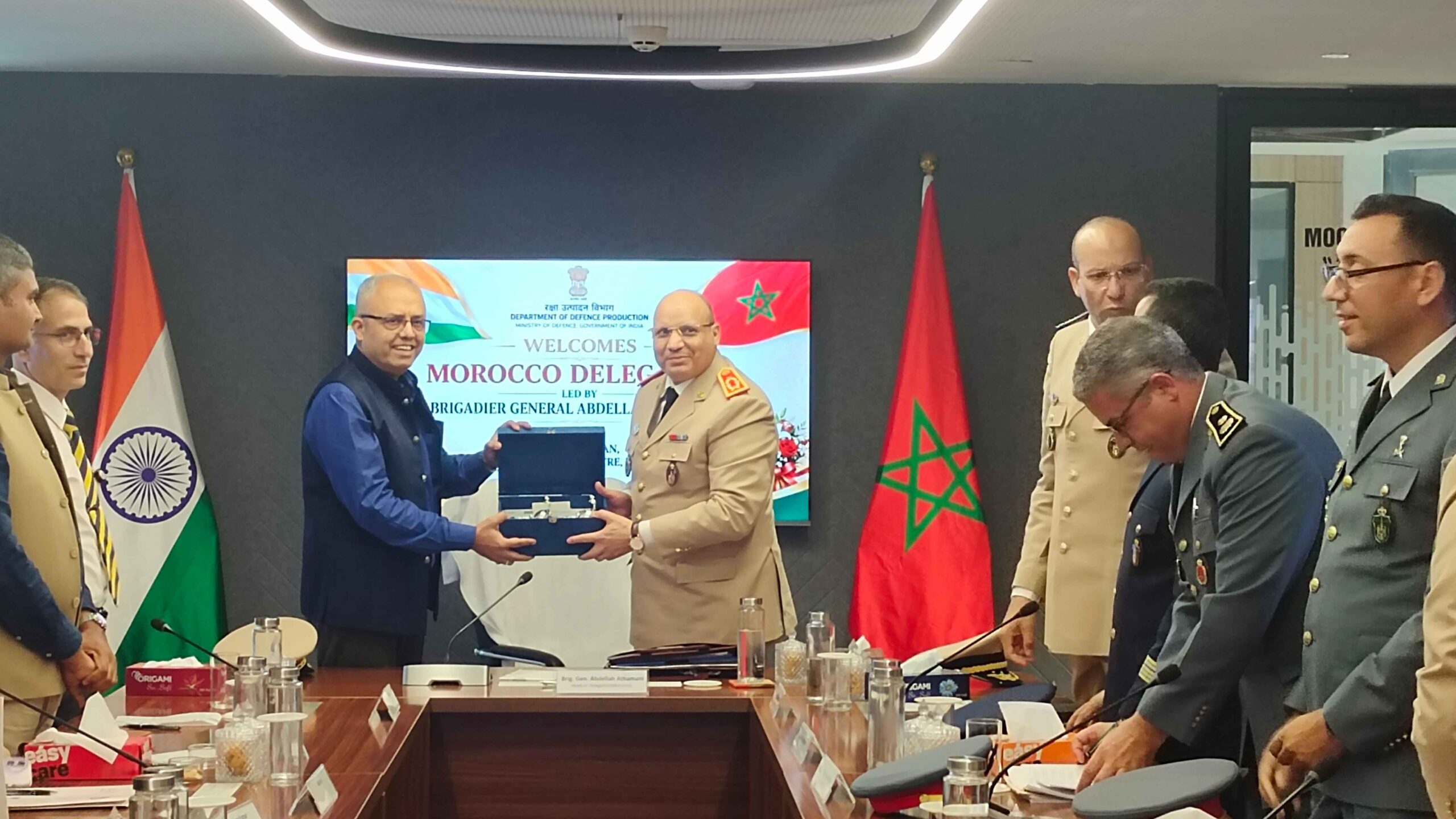
From 7 to 10 September 2026, a senior Moroccan military delegation led by Colonel‑Major Abdellah Athmani, head of the 2nd Bureau of the FAR General Staff (military intelligence), visited New Delhi for talks on defense cooperation and Indian industrial capabilities.
On 8 September, the two countries held the inaugural meeting of their Joint Defence Committee (JDC), a mechanism created under the defense cooperation MoU signed in September 2025. Discussions covered training and education, joint exercises, peacekeeping, military medicine, cyber defense, and defense industries.
The Moroccan team also met Indian defense firms at DPSU Bhawan in New Delhi, where public sector undertakings and private players showcased platforms and technologies. Topics included autonomous systems, maritime applications, border surveillance, AI, counter‑drone devices, and data interoperability.
Drones as the symbol of military transformation
If one technology best illustrates how contemporary conflicts are changing, it is the drone. Once seen mainly as an observation and intelligence tool, the UAV has become central to operations—valued for its surveillance reach, flexibility, relatively low cost, and ability to operate in difficult environments.
For modern armed forces, the challenge is no longer just acquiring drones but building an entire ecosystem around them: sensors, secure communications, data analytics, AI, command‑and‑control, and systems able to detect or neutralize adversary drones. This integration logic appears to have been a key focus in the Moroccan–Indian exchanges.
Among the companies presenting solutions was NeoSky India Limited (a RattanIndia Enterprises subsidiary), which highlighted autonomous solutions with an emphasis on maritime applications and border surveillance.
From firepower to data power
The deeper revolution lies less in individual platforms than in their ability to communicate and jointly exploit information. On a modern battlefield, a drone can detect activity, a maritime sensor transmit data, a surveillance system confirm a presence, and AI analyze the fused picture. The speed at which this information is merged and delivered to decision‑makers can be as decisive as raw firepower.
This explains the emphasis placed in New Delhi on data interoperability. For armies, having high‑performance systems that cannot effectively talk to each other is a weakness. AI helps process vast data volumes and accelerate the identification of situations requiring human intervention.
But this transformation brings new challenges: cybersecurity, protection of communications, system reliability, data governance, and personnel training.
The other battle: countering drones
The massive growth of drones naturally drives parallel advances in technologies designed to neutralize them. Counter‑UAS (C‑UAS) systems are now a core component of modern defense, tasked with detecting, identifying, tracking, and—depending on the system—neutralizing hostile aircraft.
As drones become more accessible, autonomous, and sophisticated, the systems meant to defeat them must evolve in turn. By examining both drones and counter‑drone technologies, Morocco is observing both sides of the same transformation: offensive capabilities and protective measures.
The ocean as a strategic space
Maritime dimensions were also on the agenda. Surveillance of maritime spaces is increasingly critical for states with long coastlines, covering security, infrastructure protection, border monitoring, anti‑trafficking efforts, and persistent maritime domain awareness.
Autonomous systems can add new capabilities here: unmanned platforms can observe areas, collect data, or complement conventional assets. For Morocco, with access to both the Atlantic and the Mediterranean, this maritime dimension carries obvious strategic importance.
India’s ambition: “Make in India, Make for the World”

The Moroccan visit comes at a pivotal moment for India’s defense industry. New Delhi has been pushing to grow its national industrial base and expand military exports under its “Make in India, Make for the World” strategy, aiming to produce competitive equipment meeting international standards.
This opens new options for countries seeking diversified suppliers and technology partners. For Morocco, engagement with India can go beyond buying equipment to include industrial cooperation, local production, maintenance, training, and potentially joint development of certain technologies.
Industrial ties in defense are already taking concrete shape. Cooperation around the Tata WhAP armored vehicle—including component manufacturing in Morocco—illustrates this shift. In September 2025, India and Morocco inaugurated a Tata Advanced Systems facility in Berrechid to produce the WhAP 8×8 for the Royal Moroccan Army, with initial deliveries slated for late 2025.
A more diversified defense diplomacy
The Moroccan delegation’s trip also reads as a diplomatic move. In a fast‑evolving technological landscape, defense partnerships are no longer just about arms purchases; they help build durable strategic relationships.
Morocco already maintains military cooperation with several powers. Interest in Indian solutions reflects not a replacement of existing partnerships but a logic of diversification—allowing Rabat to compare industrial models and technologies and select those best suited to national needs.
Diversification also gives Morocco an additional option: to position itself progressively not only as a buyer but as an industrial partner.
A human and symbolic gesture
During the visit, Colonel‑Major Athmani laid a wreath at New Delhi’s National War Memorial in tribute to Indian service members who died in the line of duty. This protocol gesture fits within the broader rapprochement between the two countries on defense issues.
Behind the technologies and weapon systems, military diplomacy retains a human and symbolic dimension. The message is twofold: deepen professional exchanges between the armed forces and, in parallel, strengthen strategic ties between Rabat and New Delhi.