



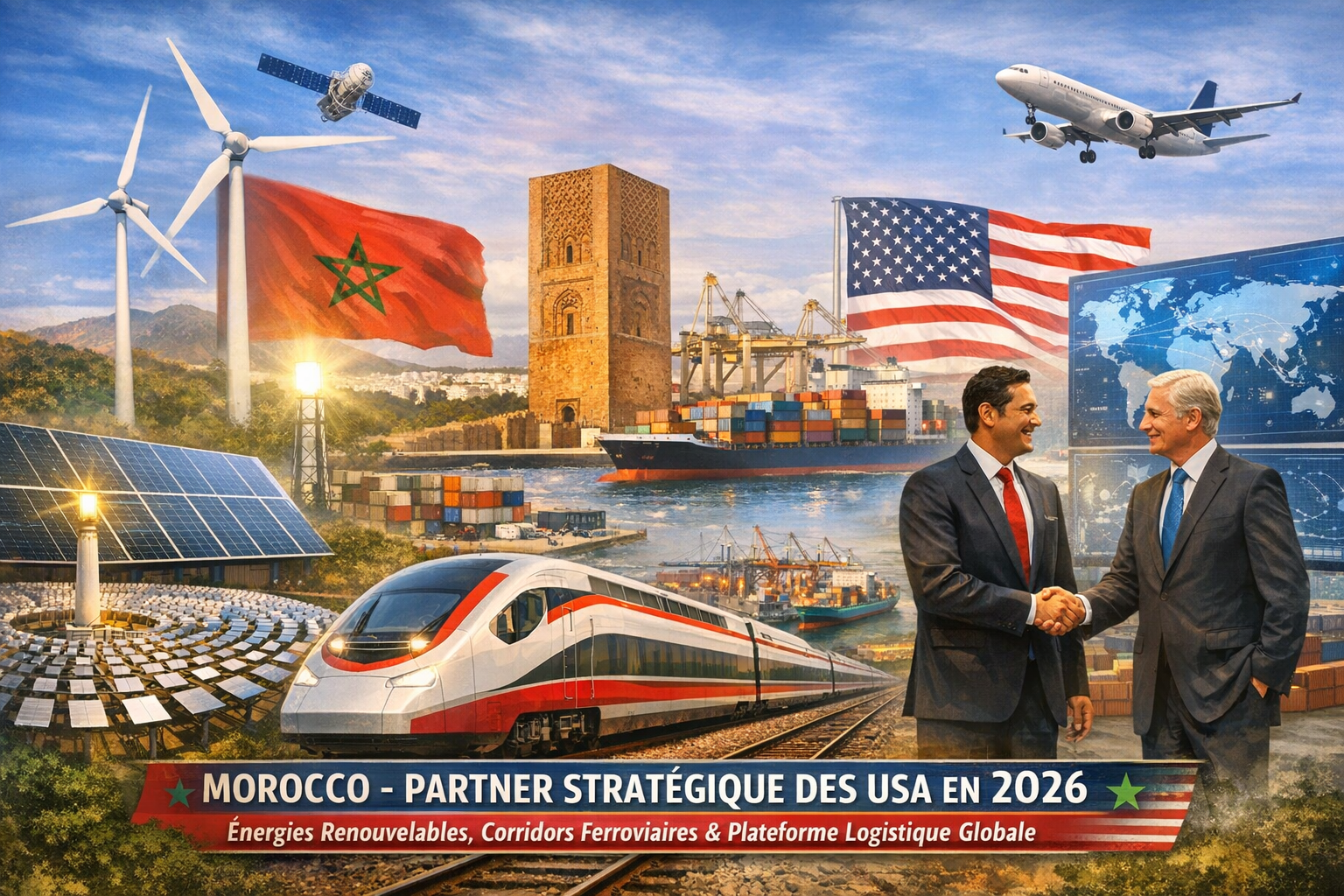

Renewable energy, rail transport, and integration into global markets position the Kingdom among Washington’s key partners in 2026
As part of redefining its African strategy, the United States is increasing its investments in 2026 in high-value strategic infrastructure projects across the continent. According to an analysis of the ten major U.S.-funded infrastructure projects in Africa, Morocco is among the main beneficiaries, confirming its status as a reliable regional platform for energy, industry, and logistics at the crossroads of Africa and Europe.
A U.S. Strategy Focused on Corridors and Energy
Driven by initiatives such as the Partnership for Global Infrastructure and Investment (PGI), the Power Africa initiative, and support from the U.S. International Development Finance Corporation (DFC), American infrastructure policy in Africa is no longer limited to isolated projects. It now aims to structure economic corridors, secure supply chains, and develop energy and digital systems capable of supporting the continent’s industrialization.
In this context, Morocco appears as a natural partner, benefiting from a stable political environment, an attractive regulatory framework, and a clear strategic vision in energy transition and industrial development.
Morocco: A Hub for Renewable Energy and Industrial Logistics
Ranked 8th among the top 10 U.S.-supported infrastructure projects in Africa for 2026, Morocco attracts targeted American investments mainly in renewable energy and rail transport infrastructure linked to industry.
American financial institutions, particularly the DFC, along with private energy sector companies, participate alongside local partners in solar, wind, and hybrid projects. These investments align fully with Morocco’s national strategy to raise the share of renewable energy to over 40% of the energy mix by 2030, strengthening the country’s energy security and its role as a regional exporter of green electricity.
Rail Transport: A Key Competitiveness Lever
Beyond energy, transport infrastructure is another pillar of U.S. engagement. Supported projects include the strengthening of rail capacities connecting Casablanca, Tangier, and the main industrial hubs inland. The goal is clear: to streamline logistics, reduce transport costs, and facilitate the export of Moroccan industrial products to Europe and beyond.
Morocco’s geographic proximity to European markets, combined with the Morocco–U.S. Free Trade Agreement, provides American investors with a strategic advantage, allowing them to integrate the Kingdom into transatlantic and African value chains.
A Safe and Attractive Investment Climate
The growing U.S. interest in Moroccan infrastructure also rests on the country’s strong investment climate, predictable regulatory framework, and policy continuity. Unlike some higher-risk African markets, Morocco is seen as a relatively low-risk destination with high return potential, particularly in green energy, logistics, and export-oriented industries.
Morocco in a Continental Dynamics
While very large-scale projects, such as the Lobito Trans-African Corridor or Mozambique’s LNG infrastructure, dominate in value among U.S. investments, Morocco illustrates another approach: structured, progressive, and sustainable development based on regional integration, industrial upgrading, and energy transition.
Recognition of Morocco’s Strategic Positioning
Through these investments, Washington confirms its view of Morocco as a central actor in North Africa’s economic and energy stability, capable of serving as a bridge between Sub-Saharan Africa, Europe, and international markets.
In 2026, Morocco’s inclusion among African countries benefiting from U.S.-supported infrastructure projects illustrates not only the Kingdom’s attractiveness but also the international recognition of its strategic choices in development, energy, and industrialization.