


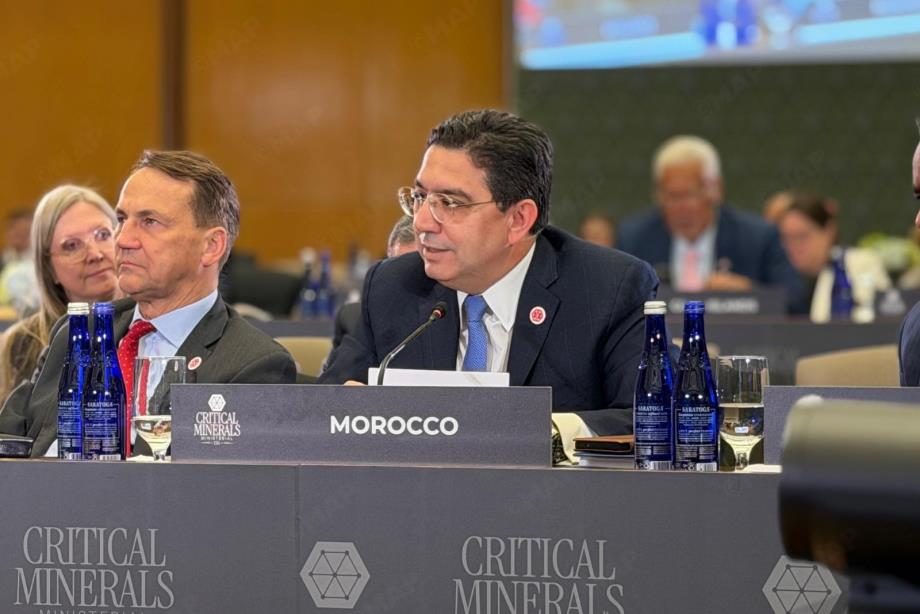
On February 4, 2026, in Washington, Morocco’s Minister of Foreign Affairs, Nasser Bourita, took part in a ministerial meeting on critical minerals hosted by U.S. Secretary of State Marco Rubio. With U.S. Vice President JD Vance attending the opening session, discussions focused on securing and diversifying supply chains, as well as on investment and floor price mechanisms, against the backdrop of Morocco’s call for cooperation grounded in trust, transparency and sovereign balance.
The meeting aimed to exchange solutions to strengthen and diversify supply chains at a time when the energy transition, digital technologies and many strategic industries increasingly rely on these resources. Talks zeroed in on investment in critical minerals and on floor price mechanisms.
In his address, Bourita highlighted the role Morocco intends to play in this strategic file. Under the leadership of His Majesty King Mohammed VI, he said, the Kingdom of Morocco offers an undeniable geostrategic relevance, strong attractiveness and a responsible partnership in critical minerals. He linked this positioning to Morocco’s geographic location, its resources and infrastructure, as well as its political reliability and stability.
Bourita then stressed a broader point. Today’s world, he noted, does not lack minerals or rare earths. What it lacks is responsible development, a language of trust among nations, transparent frameworks where partnership replaces dependency, and value chains that spread prosperity rather than concentrate risks.
Against this backdrop, he called for a pact of loyalty between producers, processors and users, based not on ideology but on strategic respect and sovereign balance. He said Africa should be at the heart of this productive chain.
Bourita added that Africa should be central to this pact, recalling that His Majesty King Mohammed VI had stressed, in a royal message addressed to participants at the 2025 edition of the Ibrahim Governance Weekend Forum, that the continent, with 40 percent of global raw material reserves and 30 percent of critical minerals, as well as considerable potential in mining, energy, water, agricultural and biological resources, can no longer be content with exporting its raw materials.
He also underscored the need for investment in Africa’s infrastructure, skills and governance in order to turn its natural wealth into sustainable economic growth, job creation and long-term prosperity for its people.
On the broader diagnosis, Bourita said today’s mining globalization is neither free, nor fair, nor resilient. He added that it has turned what should be a common good for global progress into an instrument of unilateral pressure. This is not simply a supply chain problem, he insisted, but a structural imbalance.
In closing, he issued a call that sums up Morocco’s position: “If this century is to be marked by critical minerals, it should also be the century of reliable partnerships, mutual respect and shared stability.”
The meeting brought together foreign ministers and senior officials from more than fifty countries. Delegations cited included Saudi Arabia, the United Arab Emirates, Qatar, Jordan, Bahrain, Oman, as well as several European countries such as France, Belgium, Germany, the United Kingdom, Italy, Norway and Sweden. Major Asian partners also took part, including India, Japan, the Republic of Korea and Singapore, alongside countries from the Americas and the Pacific such as Argentina, Brazil, Mexico and Australia.