




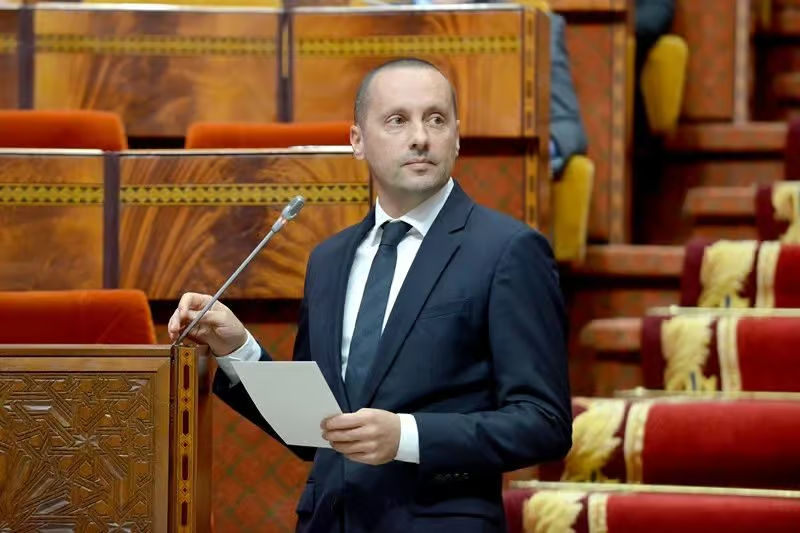
Minister of Health and Social Protection Amine Tehraoui announced that 530 newly graduated specialist doctors will be assigned to various regions across Morocco starting next August, as part of efforts to strengthen healthcare services in public hospitals.
Responding to a parliamentary question on Territorial Health Groups (THGs) at the House of Representatives, the minister stressed that this unprecedented measure will end a situation in which specialist doctors sometimes had to wait up to two years between obtaining their degrees and receiving their assignments.
According to Mr. Tehraoui, the reform will allow healthcare institutions to benefit more quickly from newly trained specialists and will significantly strengthen medical human resources across the country.
The minister recalled that the measure is part of broader structural reforms concerning the training and management of specialist doctors. He highlighted the decree governing students in medical, pharmacy, and dental schools, which extends contractual commitments with the state to all newly enrolled specialist trainees.
Under the new system, all future specialist doctors will be required to complete a period of mandatory service in public healthcare institutions after graduation. The obligation is set at four years for the classes of 2026 and 2027 and will be reduced to three years starting in 2028.
Mr. Tehraoui emphasized that the reform marks a major turning point after more than three decades under the previous system. It aims to ensure that all specialist doctors contribute to public healthcare during a crucial phase of their careers while promoting a fairer distribution of medical expertise nationwide.
The minister also noted that nearly 2,000 residency positions have been opened this year under the new framework. These future specialists are expected to join public healthcare institutions from 2030 onward and will constitute a key pillar of the Territorial Health Groups.
Furthermore, Territorial Health Groups will, for the first time, play a central role in organizing, supervising, and assigning resident doctors, as well as managing training pathways and internships. This approach will help align medical training with the actual needs of each region and ensure consistency with national and regional healthcare planning.