
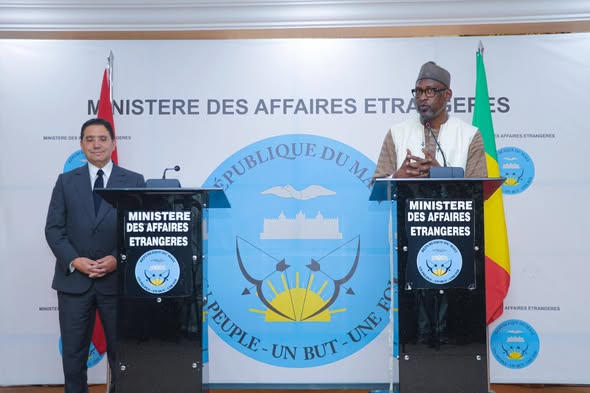
Since Tuesday, July 21, and until Friday, July 24, Bamako has been hosting the 4th Session of the High Joint Commission for Cooperation between the Republic of Mali and the Kingdom of Morocco, a major diplomatic event reflecting the shared determination of both countries to elevate their bilateral relations to a new level.
The meeting brings together government officials, experts and business leaders with the objective of strengthening bilateral cooperation and expanding strategic partnerships within the framework of South-South cooperation.
The programme includes experts’ meetings on July 21 and 22, followed by the Mali–Morocco Business Forum on July 23, before the ministerial session on July 24, co-chaired by the Ministers of Foreign Affairs of both countries. The High Joint Commission serves as the principal institutional platform for political dialogue and bilateral consultation, providing an opportunity to assess progress achieved since the previous session and define a new roadmap for cooperation across a wide range of priority sectors.
Discussions will focus on strategic areas including trade, investment, agriculture, infrastructure, mining, energy, healthcare, higher education, vocational training, security, culture, youth and sports. The session is also expected to conclude with the signing of several cooperation agreements and memoranda of understanding aimed at strengthening the legal framework of bilateral relations and launching new development projects.
A key highlight of the event will be the Mali–Morocco Business Forum, which will bring together business leaders, investors and economic institutions from both countries to explore new partnership opportunities, promote productive investment and develop value chains in high-potential industrial and commercial sectors.
Trade with Significant Growth Potential
Although economic relations between Rabat and Bamako have steadily strengthened over recent years, bilateral trade still remains well below its full potential. According to data from Morocco’s Foreign Exchange Office, annual trade between the two countries is estimated at between MAD 1 billion and MAD 1.5 billion (approximately US$100 million to US$150 million). Morocco’s exports to Mali mainly consist of phosphate-based fertilizers, construction materials, food products, pharmaceuticals, industrial equipment and manufactured goods, while Moroccan imports from Mali primarily include cotton, agricultural products and raw materials. Both governments are now seeking to significantly expand trade by encouraging cross-investment, fostering industrial partnerships and facilitating business-to-business exchanges.
Beyond trade, Morocco has established itself as one of Mali’s leading African economic partners through investments in banking, telecommunications, insurance, healthcare, construction materials and fertilizers. Bilateral cooperation also extends to higher education, professional training and capacity building, illustrating the depth and diversity of the relationship between the two nations.
Through this 4th Session of the High Joint Commission, Mali and Morocco reaffirm their commitment to building a stronger strategic partnership based on economic complementarity, investment, knowledge transfer and pragmatic South-South cooperation. The outcomes of the Bamako meetings are expected to open a new chapter in bilateral relations while contributing to deeper African economic integration and sustainable development across the continent.