


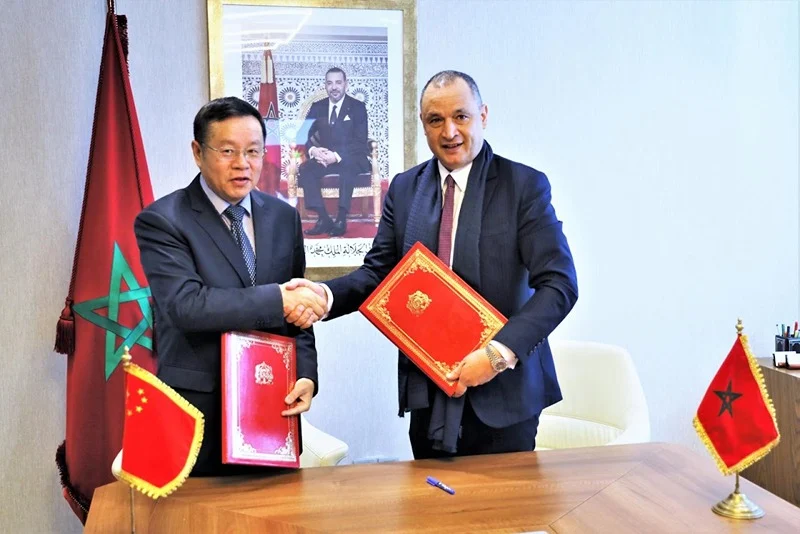

The growing number of Chinese projects in automotive, tyres, equipment and infrastructure confirms Beijing’s expanding economic footprint in Morocco and is gradually transforming the bilateral relationship into an industrial and investment partnership.
China is steadily strengthening its economic presence in Morocco in 2026. This momentum now extends well beyond merchandise trade. Chinese companies are investing in industrial value chains serving the Moroccan market and, above all, export markets.
The Guizhou Tyre project, valued at nearly $300 million, is one of the most emblematic operations of this new phase. The company plans to establish tyre production capacity in Tanger Tech.
Morocco’s appeal is based on several factors: proximity to Europe, port infrastructure, an industrial workforce, stability and access to international markets.
Automotive at the heart of industrial cooperation
The automotive sector is naturally the main area of cooperation. Chinese component suppliers are seeking to move closer to manufacturers operating in Morocco. The objective is to produce locally while reducing logistics lead times to European markets.
This strategy is part of a global restructuring of industrial value chains, in which proximity to final markets has become a key factor in investment decisions.
Morocco can also serve as a platform for expansion into Africa. Tanger Med represents a decisive advantage for Chinese companies seeking to export from the Kingdom, thanks to its strategic location and logistics capabilities.
At the same time, Sino-Moroccan trade continues to expand. Chinese involvement is also extending into infrastructure, renewable energy and industrial equipment.
Morocco, for its part, is seeking to diversify its international partners in order to reduce sector-specific dependencies. Competition among Asian, European and American investors could therefore strengthen Morocco’s negotiating power and improve investment conditions.
The challenge of local value added
The key challenge is to maximize the local benefits of these investments. Chinese projects should promote technology transfer, skills development, job creation and the integration of Moroccan SMEs into industrial value chains.
Chinese engagement in Morocco is therefore evolving from an essentially trade-based model toward a model centered on production, investment and exports. This transformation could make China one of the Kingdom’s most important industrial partners over the next decade, particularly if Morocco succeeds in turning Chinese investment into integrated industrial ecosystems with high local value added.