



Africa possesses an exceptional mineral endowment, accounting for around 30% of the world’s mineral reserves according to a recent estimate, yet captures only a fraction of the value generated by these resources. Copper and cobalt illustrate this paradox particularly well: the continent holds major reserves and plays a strategic role in global production, while much of the processing and value creation still takes place outside Africa.
The continent is home to approximately 55% of the world’s cobalt reserves, while its copper reserves account for around 5.9% of global reserves. Based on roughly 980 million tonnes of global copper reserves recorded in 2024 by the USGS, this represents an estimated 58 million tonnes of contained copper reserves in Africa.
Cobalt represents an even more strategic asset. Global cobalt reserves were estimated at around 11 million tonnes in 2024, with nearly 55% located in the Democratic Republic of Congo, equivalent to roughly 6 million tonnes. The DRC also overwhelmingly dominates global cobalt production.
A Major Production Power Still Focused on Extraction
The Democratic Republic of Congo produced approximately 2.99 million tonnes of mined copper in 2024, including 2.56 million tonnes of refined copper. It also produced around 226,000 tonnes of cobalt, representing approximately 75% of global production that year.
Zambia is Africa’s second major copper-producing hub. Its copper production reached approximately 825,500 tonnes in 2024, before rising to around 890,300 tonnes in 2025. The country accounted for approximately 3.6% of global copper production in 2024.
Across Africa, these volumes make copper and cobalt key pillars of the continent’s mining industry, particularly for batteries, electric vehicles, power grids, electronics and energy infrastructure.
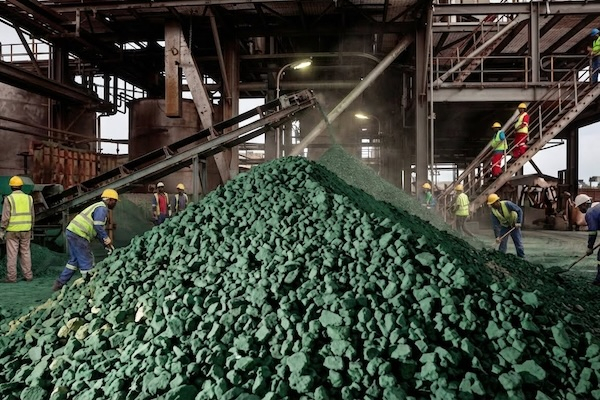
The main challenge is not a lack of resources, but the limited depth of local value chains. A significant share of African minerals is still exported as concentrates, ores or semi-processed products, while advanced refining, battery-material manufacturing, alloys and industrial components remain concentrated mainly in Asia, Europe and North America.
The economic potential is considerable. The Africa Finance Corporation estimates the value of mineral resources present at African mining sites at approximately $29.5 trillion, including around $8.6 trillion that remains undeveloped. This highlights the scale of the continent’s mineral wealth even before taking into account the additional value that could be created through industrial processing.
The revenues already generated are also substantial. African mineral exports amounted to several hundred billion dollars in 2024, with the Democratic Republic of Congo, South Africa, Zambia, Guinea and Ghana among the continent’s major mining hubs. In the DRC, total exports reached $34.9 billion in 2024, of which 79.3% came from copper and 10.9% from cobalt.
South Africa’s mining sector also illustrates the economic weight of the industry. Mining revenues approached 1 trillion rand in 2024, while mineral exports amounted to approximately 774 billion rand.
Local Processing Becomes a Priority
Against this backdrop, several African countries are seeking to move from a resource-export model towards a mining industrialization strategy. The DRC, Zambia, Guinea and Zimbabwe are strengthening local processing policies, while new investments are targeting smelters, refineries, processing facilities and battery-related production chains.
The Lobito Corridor has a strategic role in this emerging architecture. Linking the mining regions of the DRC and Zambia to Angola’s Atlantic coast, it is expected to reduce logistics costs and transit times while supporting the integration of regional value chains.
The formalization of artisanal mining is another major challenge. The sector provides livelihoods for approximately 10 million people across Africa and represents an important source of income, particularly for rural communities. Formalization could improve traceability, working conditions, tax revenues and resource governance.
Africa’s challenge is therefore no longer simply to produce more copper or cobalt. It is to refine more, manufacture higher-value products locally and develop industries capable of transforming mineral resources into batteries, cables, alloys, electrical equipment and industrial components.
In the global race for critical minerals, Africa’s true strategic advantage will therefore depend less on the sheer volume of its reserves than on its ability to turn those reserves into industrial production, jobs, public revenues, technology and African value chains.