
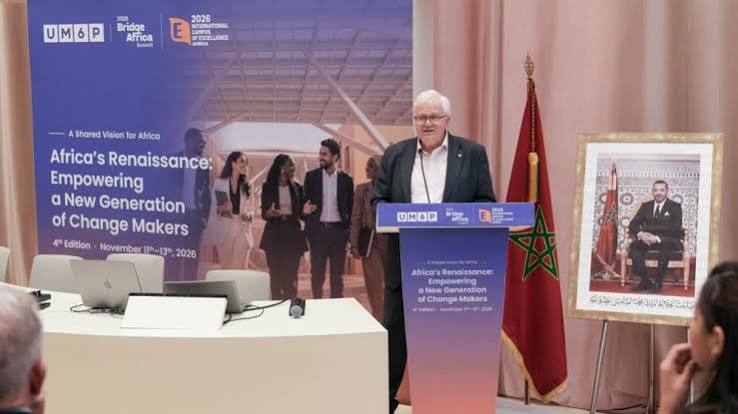
Brian Schmidt and his team set out to measure how quickly the expansion of the universe was slowing. They discovered it was speeding up. Speaking on November 12 at Mohammed VI Polytechnic University (UM6P) in Benguerir, the 2011 Nobel laureate in physics retraced the steps that led to the discovery and made the case for giving young researchers the freedom to pursue questions with uncertain answers.
The stellar explosions that defied expectations
In the mid-1990s, most astrophysicists expected gravity to slow the expansion of the universe. The question was by how much. To find out, Schmidt’s team observed stellar explosions known as Type Ia supernovae. By comparing their estimated intrinsic brightness with how bright they appeared from Earth, the researchers could calculate their distances. They then compared those distances with how far the light had shifted toward the red end of the spectrum to trace how the rate of expansion had changed over time.
The distant supernovae appeared fainter, and therefore farther away, than models of a slowing universe predicted. A second team, led by physicist Saul Perlmutter, independently reached the same conclusion. In 1998, the findings showed that the expansion of the universe was accelerating. They also brought to the fore a question that remains central to cosmology today. What is the nature of the dark energy thought to drive that acceleration?
Thirteen years later, Schmidt was cooking dinner with his wife when the phone rang. He initially assumed it was a prank. Then he learned he had six minutes before a live press conference. The Royal Swedish Academy of Sciences had awarded him the Nobel Prize in Physics, which he shared with Perlmutter and Adam Riess. In Benguerir, Schmidt used the story to reflect on how much the discovery owed to work done by generations of scientists.
At UM6P, the freedom to pursue a question
Schmidt’s talk, “Road to Nobel Prize: A Journey to Excellence,” was part of the fourth edition of the International Campus of Excellence Africa. The event brought together scientists, diplomats and representatives of academic exchange organizations, including Fulbright Morocco and Amideast. Nawal Chraibi, director of UM6P’s Institute for Advanced Studies, emphasized the value of bringing researchers into conversation with the institutions that can support their work.
Schmidt focused on what young scientists need to launch their first projects. Alongside a strong education, they need time, access to equipment and the freedom to follow a line of inquiry whose outcome is uncertain. His own career illustrates the point. In 1994, he realized that advances in observational technology made it possible to measure the universe’s expansion in the distant past. He redirected his research toward that question. Four years later, the measurements changed the question cosmologists were asking.
For African universities, that freedom can take practical forms. A doctoral student might gain access to a new dataset, a research team might secure observing time on a major telescope, or an African laboratory might lead a project with international partners. Schmidt’s account in Benguerir offered a concrete example of what such opportunities can make possible. Years before the prize was awarded in Stockholm, two teams had the instruments to test a prevailing assumption and took seriously what their measurements showed.