Morocco’s Caisse de Dépôt et de Gestion (CDG) and Casablanca Finance City Authority (CFCA) have signed a climate cooperation agreement with the Global Green Growth Institute (GGGI), manager of the Norwegian Climate Action Fund under Article 6 (NACA), aimed at mobilizing carbon finance to support renewable energy development in Morocco.
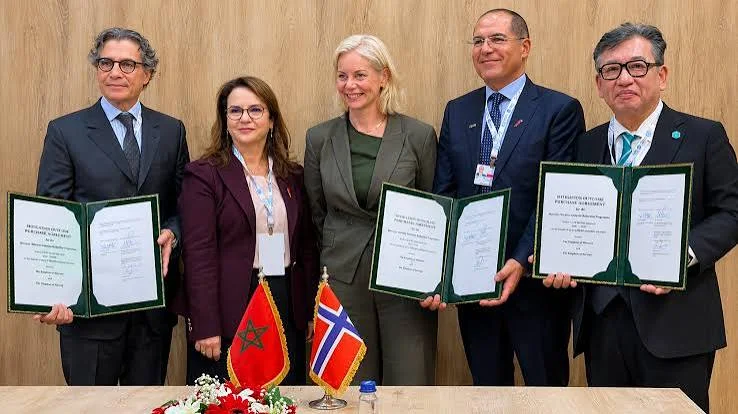
The Mitigation Outcome Purchase Agreement (MOPA) was signed on Thursday at the Moroccan Pavilion during COP31, held in Antalya, Türkiye. The agreement brings together CFCA, represented by its Chief Executive Officer, Saïd Ibrahimi, CDG, represented by its Chief Executive Officer, Khalid Safir, and the Global Green Growth Institute.
The signing ceremony was co-chaired by Morocco’s Minister of Energy, Mines and Sustainable Development, Charafat Afailal, and Norway’s Minister of Climate and Environment, Sigrun Aasland.
According to a joint statement issued by CFCA and CDG, the agreement is aligned with the High Royal Guidelines of His Majesty King Mohammed VI in support of sustainable development, the energy transition and efforts to combat climate change.
It also supports Morocco’s national priorities, particularly accelerating renewable energy development, strengthening energy sovereignty and mobilizing innovative financing mechanisms. The agreement will contribute to implementing the Kingdom’s third Nationally Determined Contribution (NDC 3.0) and advancing its climate ambitions.
Concluded within the framework of the bilateral agreement signed in May 2026 between Morocco’s Ministry of Energy, Mines and Sustainable Development and Norway’s Ministry of Climate and Environment, under Article 6.2 of the Paris Agreement, the partnership links Africa Carbon Link (ACL), a joint initiative of CDG and CFCA, with the trustee of the Norwegian fund dedicated to Article 6, represented by the Global Green Growth Institute.
The agreement aims to mobilize Norwegian carbon financing to support renewable energy projects in Morocco, particularly solar and wind power installations, in exchange for the transfer of corresponding mitigation outcomes resulting from avoided CO₂ emissions.
The programme is based on the Generation-Based Incentive (GBI) mechanism, which provides financial incentives linked to emission reductions that are effectively achieved, measured and verified. It primarily targets new solar and wind installations, including projects incorporating battery storage capacities.
The operational implementation of the partnership will be entrusted to Africa Carbon Link, acting as both aggregator and fund manager. ACL will be responsible for mobilizing project developers, structuring their participation in the programme and monitoring carbon transactions and associated financial flows.
This initiative reflects the joint commitment of CDG and CFCA to developing innovative climate finance mechanisms and structuring Morocco’s carbon market, with ambitions to expand its reach across Africa.
“We want to make this partnership a concrete illustration of what Article 6 of the Paris Agreement can achieve when political commitment, institutional maturity and international cooperation come together to transform climate ambition into investment, innovation and measurable results,” said Charafat Afailal, as quoted in the statement.
For his part, Saïd Ibrahimi said the partnership demonstrates the potential of carbon markets as a financing tool for the energy transition and represents an important step towards positioning Casablanca as a leading climate finance hub in Africa.
Khalid Safir, meanwhile, emphasized that the partnership with Norway reflects a shared ambition to make carbon finance a genuine driver of sustainable development, beyond its purely transactional dimension.
He also highlighted the objective of establishing a robust and transparent mechanism that complies with the requirements of Article 6 of the Paris Agreement, mobilizes international financing for high-impact climate projects and contributes to the emergence of a credible Moroccan carbon market with regional and continental reach.
Over a ten-year period, the programme aims to generate up to 8 million tonnes of CO₂-equivalent emission reductions, potentially corresponding to the deployment of approximately 2 gigawatts (GW) of renewable energy generation capacity.