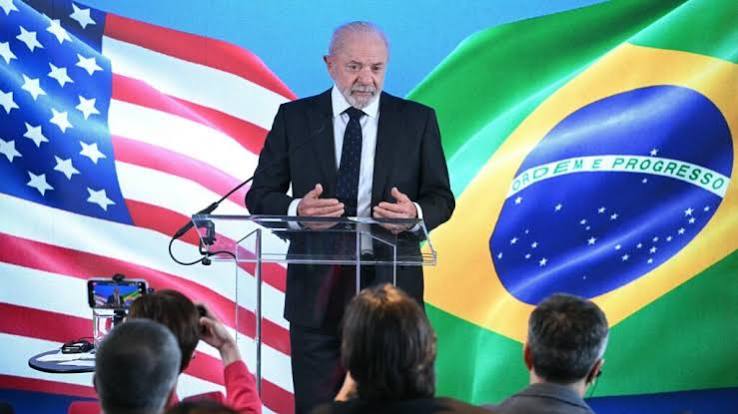
As Washington closes its doors with new tariffs, Brazilian President Lula da Silva is turning to new partners. Morocco is emerging as a strategic ally in this realignment.
A major geopolitical shift is under way in South America. In response to tariffs imposed by the Donald Trump administration, Brazilian President Luiz Inácio Lula da Silva has decided to reduce his country’s dependence on the United States. The United States’ share of Brazil’s trade has fallen to 9.2%, a historic low.
At the same time, Brasília is turning to Asia and Africa, with trade rising sharply with China (+20%), Germany (+15.8%), Indonesia (+15%) and Vietnam (+13%). Lula now aims to make Brazil a permanent partner of ASEAN and expand its influence in Southeast Asia.
Morocco is taking on a central role in this realignment.
The Kingdom has grown from a trading partner into a pillar of Brazil’s food security. Brazil, a global agricultural powerhouse, needs fertilizer for its soybean, corn and coffee crops. Morocco, through the OCP Group, holds the world’s largest reserves of phosphate rock, the essential raw material for these fertilizers. On September 18 at Jorf Lasfar, OCP Nutricrops signed a memorandum of understanding with Brazil’s Ministry of Agriculture. It sets a reference volume of 3.8 million metric tons of phosphate fertilizer for the 2026–2027 growing season.
That volume alone would cover nearly 76% of the shortfall Brasília expects for the coming season. In return, Brazil has become one of Morocco’s main suppliers of red meat, helping the Kingdom rebuild its livestock herds after years of drought. This balance helps explain the strength of the relationship. In 2024, bilateral trade reached $2.77 billion, with flows split almost evenly between the two countries.
Morocco exports between $1.4 billion and $1.6 billion to Brazil and imports between $1.4 billion and $1.5 billion from it. This is a rare example of a South–South partnership in which neither country depends disproportionately on the other.
The relationship also has a political and strategic dimension. Rabat and Brasília coordinate their positions at the United Nations, particularly on development and issues affecting countries of the Global South. Brazil has never recognized the separatist Polisario entity, and its Senate has backed Morocco’s autonomy plan for the Sahara.
Experts see this as a state-to-state relationship that endures through changes of government. “Moroccan–Brazilian relations have historically remained stable, whether the left or the right is in power,” explains Professor Abdelali Barouki of Mohammed V University in Rabat. Relations with Morocco had already gained momentum during Lula’s previous terms. His re-election in October 2026 for an unprecedented fourth term therefore continues an established course.
For Morocco, the opportunity is twofold.
First, Morocco can consolidate its role as a hub linking Africa, Europe and Latin America, supported by the port of Tanger Med and direct flights between Casablanca and São Paulo. Second, it can build on Brazil’s shift toward ASEAN to open new Asian markets for Moroccan products. As the United States adopts a more protectionist stance, Morocco and Brazil are charting a new trade route for the Global South. It is built on fertilizer, food security and sovereignty. And it may quietly become one of the Kingdom’s greatest economic opportunities over the next decade.