
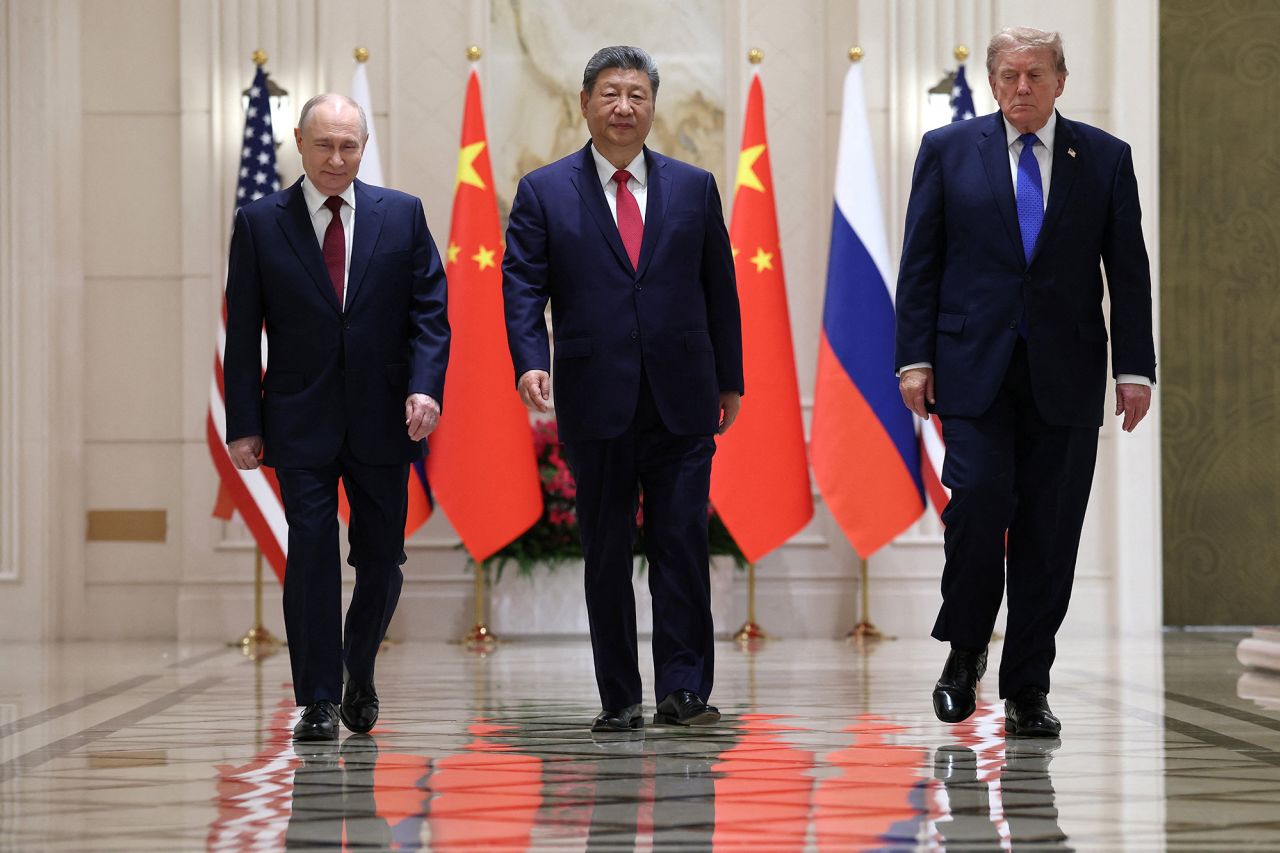
Chinese President Xi Jinping and his American and Russian counterparts, Donald Trump and Vladimir Putin, on Thursday opened an unprecedented trilateral summit in Shenzhen, southern China. The meeting marks the first in-person gathering of the leaders of the three major powers and focuses on key international issues and global security challenges.
The meeting carries “historic significance,” Xi Jinping said in his opening remarks, stressing that peace among major powers is a source of stability for the world, while rivalry between them can only lead to international disorder.
The Chinese president also recalled that more than 80 years ago, China, Russia and the United States, then among the main forces fighting fascism, stood side by side and secured a decisive victory, helping preserve global peace and stability.
For his part, Donald Trump said the three powers bear particular responsibilities in managing international affairs and are expected to address “all the issues currently being debated around the world.”
The US president notably called for maintaining dialogue between world leaders, even in the presence of disagreements, arguing that opportunities to advance peace should not be dismissed. He also stressed that the three countries are “particularly well positioned” to address the issue of nuclear weapons.
Meanwhile, Vladimir Putin said constructive cooperation between China, Russia and the United States could contribute to strengthening international stability. He called for trilateral discussions to take a comprehensive approach encompassing global and regional issues, as well as energy security.
The trilateral summit was preceded by bilateral meetings between the three leaders, including talks between Xi Jinping and Donald Trump, Xi Jinping and Vladimir Putin, as well as between the US president and his Russian counterpart.
The summit is being held on the sidelines of the 33rd Asia-Pacific Economic Cooperation (APEC) Economic Leaders’ Meeting in Shenzhen, attended by representatives of the organization’s 21 member economies. It comes amid shifting patterns in international trade and geopolitical tensions that have placed relations between major powers at the center of global dynamics.