



In the aerospace sector, sovereignty does not mean that Morocco must manufacture an aircraft entirely on its own. In an industry built around highly integrated global value chains, sovereignty is better understood as the ability to progressively master strategic segments, develop national capabilities and reduce dependence on critical technologies.
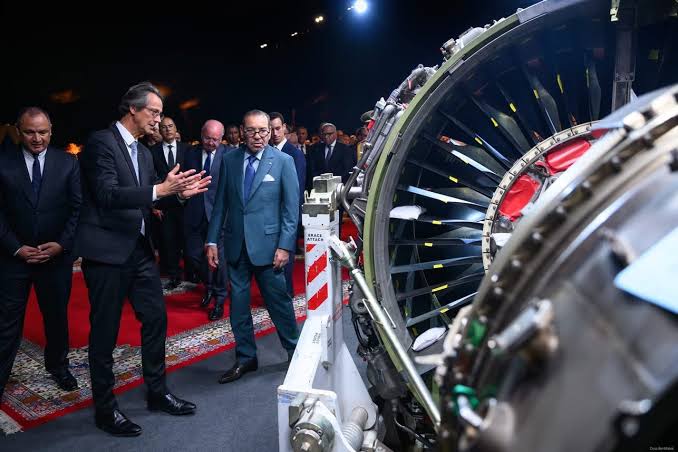
The Marrakech Airshow 2026 provides a particularly relevant platform for assessing this evolution. Behind the aircraft and defense systems on display lies a broader industrial question: how much technological and strategic value can Morocco now capture domestically?
From “Made in Morocco” to “Engineered in Morocco”
The first pillar of aerospace sovereignty is industrial capacity. Morocco has already built an increasingly integrated aerospace ecosystem, with more than 150 companies and activities ranging from component manufacturing to maintenance, engineering and aerospace systems.
The next qualitative step is to move progressively from “Made in Morocco” to “Engineered in Morocco.”
This means strengthening domestic capabilities in design, engineering, simulation, certification, advanced maintenance and software development.
The question is therefore no longer simply how much Morocco produces, but what it is capable of designing, developing and technologically mastering.
Moving the ecosystem up the value chain
Industrial sovereignty also depends on increasing local integration. In aerospace, the manufacturing of metal parts, composites, wiring and structural components represents an initial stage. The most strategic segments lie further upstream and downstream, particularly in engines, avionics, electronics, embedded systems, sensors, software and high-precision equipment.
The investments made by major international aerospace companies in Morocco show that the ecosystem is moving toward increasingly sophisticated activities.
For Moroccan SMEs, the challenge is to make the same transition: from subcontractor to qualified supplier, and ultimately to solution designer and technology provider.
Defense: mastering systems, not only platforms
Sovereignty takes on a particular dimension in defense. Locally producing a vehicle, aircraft or drone is an important industrial achievement. But strategic mastery often lies in the technologies embedded within these platforms: sensors, secure communications, command-and-control systems, embedded electronics, software, optronics, electronic warfare, navigation and data processing.
The development of a defense industry should therefore be viewed as the gradual construction of a technology ecosystem, bringing together major industrial companies, SMEs, startups, research centers and specialized training institutions.
The fundamental question becomes one of mastering critical subsystems.
Artificial intelligence: a new layer of sovereignty
AI is fundamentally reshaping the concept of aerospace sovereignty.
In the coming years, competitiveness will depend not only on the ability to manufacture an aircraft or other platform, but also on the ability to exploit the data generated by these systems.
Predictive maintenance, automated detection, trajectory optimization, simulation, computer vision, autonomous operations, image analysis and cybersecurity are turning AI into a cross-cutting technological layer.
For Morocco, this creates an important opportunity: entering certain value chains through software and data, even when full-scale manufacturing of an entire platform remains beyond the immediate scope.
Space: sovereignty through data
The same logic applies to the space sector.
Space sovereignty is not limited to satellite manufacturing. It also encompasses the ability to acquire, process, secure and exploit space-based data.
Earth observation, precision agriculture, water-resource monitoring, mapping, disaster prevention, environmental surveillance and urban planning are among the applications capable of generating significant economic value.
The strategic objective is therefore to build an integrated chain:
Satellite → Data → Processing → Artificial Intelligence → Industrial or public application.
An outward-looking form of sovereignty
Sovereignty should not, however, be confused with isolation.
Aerospace is inherently global. Aircraft manufacturers, equipment suppliers and specialized companies operate through highly integrated international supply chains.
For Morocco, sovereignty can therefore take the form of open sovereignty: attracting international investment, integrating global value chains, developing local skills, progressively increasing domestic technological content and creating Moroccan companies capable of becoming regional players themselves.
International partnerships can thus serve as vehicles for skills development and technological upgrading, provided that the domestic ecosystem is able to capture an increasing share of the value created.
The real indicator: mastery of critical technologies
Ultimately, Morocco’s aerospace sovereignty should not be measured solely by the number of aircraft manufactured or the value of aerospace exports.
It should also be assessed through the country’s ability to progressively master critical technological building blocks: advanced materials, engines and maintenance, electronics, avionics, sensors, software, cybersecurity, artificial intelligence, drones, autonomous systems, satellite data and engineering.
This is where the Marrakech Airshow 2026 takes on particular significance.
The event is becoming less a showcase of equipment and more a window into the next industrial frontiers for Morocco.
The challenge for the coming decade could therefore be summed up in one sentence:
Not simply to produce more in Morocco, but to design more in Morocco, master more technologies in Morocco, and export more technology from Morocco.
That trajectory — rather than the pursuit of complete self-sufficiency — could give concrete substance to the concept of Moroccan aerospace sovereignty.