






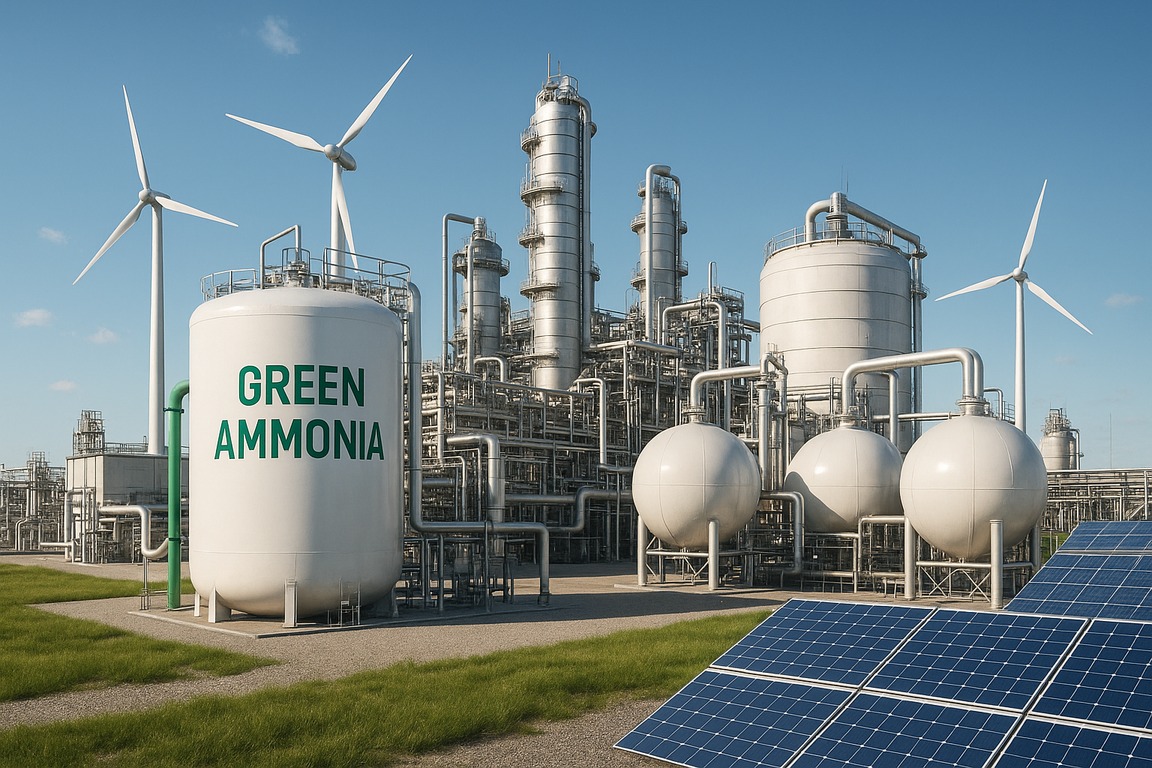
Ammonia is nothing new. It is a global commodity, central to nitrogen fertilizers and, by extension, to food security. What is changing is the energy behind its production. As gas becomes a source of vulnerability and carbon costs increasingly factor into industrial economics, “green” ammonia, produced from low-carbon hydrogen, is attracting governments, ports, energy companies and chemical groups. Beyond the climate promise, a tougher question emerges. Who will be able to turn sun and wind into exportable volumes, and at what cost?
Ammonia is an old molecule in an economy undergoing reorganization. For more than a century, industry has known how to produce it at scale using the Haber-Bosch process, combining nitrogen extracted from the air with hydrogen. The constraint has never been chemical, but energetic. In the dominant model, that hydrogen is produced from fossil fuels, mainly natural gas through steam reforming, and sometimes coal where it is abundant.
In its work on the sector, the International Energy Agency regularly highlights how ammonia production weighs heavily on global energy consumption and industrial emissions, precisely because fossil-based hydrogen is its starting point.
The “green” version changes the entry point of the process. Hydrogen is no longer derived from gas or coal, but from water through electrolysis powered by low-carbon electricity. Technically, the plant remains heavy industry. Economically, however, it shifts from a world governed by gas prices to one shaped by electricity costs, grid availability, long-term contracts and the ability to demonstrate genuine low-carbon credentials. This is where green ammonia becomes an industrial lever, not a niche product, but a potential tool for reshaping value chains.
The fertilizer shock: when energy becomes an agricultural issue again
If ammonia is back at the center of attention, it is first because it indirectly feeds a large share of modern agriculture. Industrial sources broadly agree. Most ammonia production goes into fertilizers, through urea, nitrates and other derivatives. The International Energy Agency, along with major sector organizations, underlines this centrality. Touching ammonia means touching the core of nitrogen fertilizers.
This industry is structurally exposed to gas. When gas prices spike, variable production costs surge, some plants become uncompetitive, output contracts and fertilizer prices escalate. The energy crisis of recent years acted as a stark reminder. A sharp rise in gas prices can turn into agricultural tension within weeks, and then into a social issue. International institutions monitoring agricultural markets and input prices have documented this transmission chain. Energy prices are no longer just a macroeconomic indicator. They have become a factor of food stability.

Green ammonia is often presented as an antidote. It is not one by default, but it offers a different dependency structure. Where fossil ammonia imports volatility linked to global gas markets, ammonia produced from long-term contracted renewable electricity can, at least in theory, gain visibility and predictability. For fertilizer producers, this visibility is a value in itself, as it makes investment cycles less exposed to shocks.
The obvious question is cost. Green ammonia will not be competitive everywhere, nor immediately. But it becomes credible where low-carbon electricity is abundant, affordable and contractable, where capital can be financed, and where a market is willing to pay, whether through regulation, customer requirements or strategic arbitrage.
A shifting geography: from gas to electrons
Historically, ammonia production followed cheap gas, infrastructure and petrochemical complexes. The “green” pathway introduces a different logic. Production moves closer to areas with strong renewable potential, provided three very concrete challenges are addressed.
The first is electricity, in the most literal sense. Large volumes, over long periods. Deployment scenarios for hydrogen and its derivatives, whether from the International Energy Agency, the International Renewable Energy Agency or other bodies, all stress this point. Producing low-carbon molecules at commodity scale requires massive electricity volumes, and therefore generation, grid and flexibility infrastructure.
The second challenge is financing. A green ammonia plant is not a marginal bet. It is capital-intensive heavy chemistry, whose economics depend on the cost of capital, offtake guarantees and regulatory stability. In practice, projects move forward when they secure long-term purchase agreements, public support or carbon-linked market premiums.
The third, often underestimated, is logistics. Hydrogen is difficult to transport, whereas ammonia already circulates globally. Terminals exist, ships exist, and handling rules are well established, even if demanding. This is a decisive advantage in an economy where infrastructure makes the difference between announcements and actual industries.
This combination explains why North Africa, the Middle East, Australia, Chile, Southern Africa and, in Europe, certain industrial port corridors are part of the same conversation. Not because they are identical, but because they share, to varying degrees, sun, wind, space, ports and export ambitions. In this framework, green ammonia is not just a “clean” product. It is a way to convert local energy advantages into export flows.
Morocco and North Africa: industrial promise, very tangible constraints
Morocco starts with a hand that few green ammonia contenders can match simultaneously. Competitive renewable potential, logistical proximity to Europe, a port coastline already integrated into major maritime routes, and above all an industrial fabric familiar with chemistry and exports. The ambition is clear. Convert low-carbon electrons into exportable molecules, for fertilizers, for chemicals and, potentially tomorrow, for new energy uses.
Competition, however, will be decided by execution, not intention. Between potential and volumes lie three decisive workstreams. Water comes first. Electrolysis consumes it, and in a context of water stress, the balance between local resources, desalination and social acceptability becomes an industrial condition. Then comes the grid. Producing green ammonia requires guaranteeing massive, stable and contractable electricity supply, with technical solutions to absorb intermittency. Finally, ports.
Ammonia can be transported, but it requires strict safety standards and dedicated infrastructure. The ability to equip terminals and secure the logistics chain will be a differentiating factor.
Around the Mediterranean, this is where promises are sorted. Comparative advantage is not proclaimed. It is built, connected and financed. That is precisely where Morocco can turn an energy asset into a lasting industrial advantage.
Europe: demand, standards and the test of reality
Europe is less a territory of resources than one of standards and markets. This is a key point. Importers seek low-carbon molecules because carbon constraints are tightening, because industries must decarbonize their inputs, and because finance and customers demand proof. But Europe also sets conditions.
On renewable hydrogen, the European Commission has defined qualification criteria through delegated acts, including additionality and temporal and geographical correlation, which directly affect project economics. What matters is not only producing renewable electricity, but doing so in a framework that qualifies hydrogen as renewable in regulatory terms.
This regulatory sophistication serves a purpose. It aims to prevent the “green” label from masking carbon-intensive realities. But it adds complexity and therefore industrial risk. Non-European producers see Europe as a solvent, rule-driven market, attractive if criteria are met, unforgiving if proof cannot be delivered.
In this context, green ammonia becomes as much a certification battle as an electrolyzer battle. Value lies not only in the tonne produced, but in the tonne recognized as low-carbon by the buyer’s market.
Cost, always cost: green ammonia will not win by virtue alone
Public debate favors narratives of disruption. Industry moves on price. The work of the International Energy Agency and other institutions tracking chemical decarbonization is clear on this point. Green ammonia depends primarily on the cost of low-carbon electricity, renewable load factors and the cost of capital. These variables determine whether the “green” tonne remains a premium product or begins to compete with fossil ammonia without permanent support.
This explains the current dynamic. A wave of announced projects, followed by natural selection at final investment decision, then a slower ramp-up than press releases suggest. This is not failure. It is the usual pace of heavy industry, where reality is decided in permits, grids, contracts and first commissioning, not intentions.
In the meantime, an intermediate pathway is emerging. So-called “blue” ammonia, produced from gas with carbon capture and storage. It is contested, because outcomes depend on actual capture rates, methane management and storage availability. But it features in strategies precisely because it leverages fossil infrastructure while reducing part of emissions, and because it can sometimes deliver volumes before green scales up. Here again, the issue is less ideological than temporal. How to cross a transition decade without input costs spiraling.
A possible second life: ammonia as a maritime fuel
Green ammonia also attracts interest beyond fertilizers. In shipping, decarbonization trajectories push shipowners and charterers to explore alternative fuels. The International Maritime Organization has set a direction, aiming for neutrality around mid-century with intermediate milestones, and the European Union is deploying its own instruments such as FuelEU Maritime. In this horizon, ammonia regularly appears among the candidates, with an energy advantage and a major drawback. Its toxicity requires extreme rigor in safety, training, infrastructure and standards.
If shipping shifts, even partially, demand effects could be substantial. It could also help structure port hubs, routes and contracts, giving market depth to green ammonia projects that today are seeking stable outlets. But the scenario should not be forced. Competition between alternative fuels remains open, and deployment speed will depend as much on regulation as on fleet choices and port infrastructure.
An industrial card played in ports, grids and contracts
What makes green ammonia strategic is not only its emissions reduction. It is the ability, for renewable-rich countries, to move up the value chain by exporting molecules that can travel, rather than kilowatt-hours that cannot. It is also, for importers, a way to diversify dependencies, less gas, more electricity contracts and low-carbon molecules.
This card will not be won through slogans. It will be won through the ability to deliver real tonnes, at sustainable cost, with recognized traceability and robust logistics. The territories that succeed will be those able to align energy, industry and port infrastructure. In that sense, green ammonia is not just a product. It is a test of industrial maturity in a decarbonized economy.