
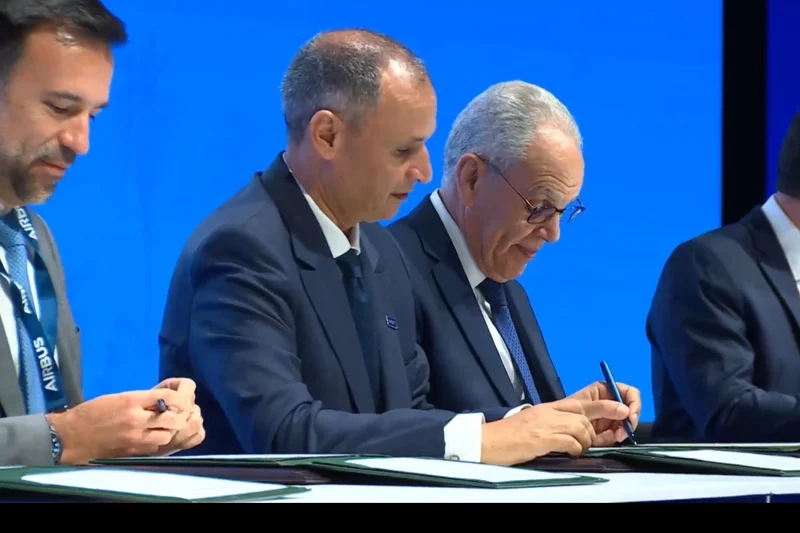
Investment, research and development, drone manufacturing, aerospace subcontracting and modernization of the national fleet: the 2026 Marrakech Air Show stands out for a series of agreements involving Moroccan institutions, international manufacturers and local companies. Signed on October 7 and 8, and complemented by an agreement announced on October 9, these commitments cover advanced manufacturing, defense technologies and the development of “Made in Morocco” products.
An international platform serving industrial development
Held from October 7 to 10, 2026, at the Royal Moroccan Air Force base in Marrakech, the eighth edition of the show brings together nearly 200 exhibitors from 27 countries, alongside civilian and military delegations. The event underscores the growing importance of aerospace and defense industries in Morocco’s industrial strategy. The announced agreements cover applied research, productive investment, local sourcing, autonomous systems and the development of new technological capabilities.
October 7: Five documents signed at the opening
The opening ceremony was marked by the signing of four agreements and one letter of intent. The five documents concern advanced manufacturing research, Safran Oil Systems’ industrial project, local procurement by Royal Air Maroc, and the development of defense technology capabilities with Harmattan AI.
ACME: A consortium bringing together major industrial players
The first agreement formalizes a consortium around the Africa Center for Manufacturing Excellence (ACME), associated with Mohammed VI Polytechnic University (UM6P). It brings together Moroccan institutions and several international industrial players, including Boeing, Airbus, Lockheed Martin, Safran Nacelles and CETIM Maroc, alongside UM6P and the OCP Group.
The initiative is designed to establish a collaborative research and development platform focused on advanced manufacturing, materials, machining, composites, automation and other industrial technologies. Its objective is to bring research closer to industrial production needs and strengthen Moroccan expertise. No overall budget has been disclosed in the information reviewed.
Safran Oil Systems: A new industrial capability
Safran Oil Systems signed a memorandum of understanding concerning the establishment in Morocco of a facility specializing in lubrication systems and fluid management for aircraft engines. The project is intended to expand the group’s industrial activities in the Kingdom and is expected to create 100 jobs.
However, published investment figures differ. Le360 reports 120 million dirhams, while Aeronautique.ma cites 160 million dirhams. The final figure will need to be confirmed through an official announcement.
Royal Air Maroc: Developing local procurement
Royal Air Maroc and Morocco’s Ministry of Industry and Trade concluded a framework agreement aimed at increasing the share of Moroccan products and services in the national carrier’s procurement. The objective is to turn RAM’s supply requirements into business opportunities for local companies, particularly industrial SMEs.
According to information published by Aeronautique.ma, the initiative targets the potential substitution of up to 60% of the relevant imports. It is intended to encourage the emergence of domestic suppliers capable of meeting the aerospace sector’s quality, safety and competitiveness requirements.
Harmattan AI: An industrial and technological platform in Morocco
An investment agreement was concluded with Harmattan AI, a French company specializing in autonomous systems. It concerns the establishment in Morocco of industrial and technological capabilities for the development and local production of autonomous defense systems.
According to information reported by Le360, annual production capacity could reach 55,000 systems. The project is expected to include research and development, engineering, manufacturing, integration and testing, with the aim of strengthening national expertise in defense technologies.
IRIFI: A letter of intent for an autonomous drone
The fifth document signed at the opening was a letter of intent between Morocco’s National Defense Administration and Harmattan AI. It concerns the acquisition, development and manufacturing in Morocco of IRIFI, a long-range autonomous strike system presented by the company.
This document should be distinguished from a definitive procurement contract: it formalizes an intention to cooperate and develop the system. It complements the broader industrial agreement with Harmattan AI to establish technological capabilities in the Kingdom.
October 8: Five new industrial agreements
The second day was marked by five additional agreements: three aerospace investment projects, a memorandum of understanding with South Korean manufacturer Korea Aerospace Industries, and a tripartite partnership in defense mobility.
The three aerospace projects represent nearly MAD 470 million in announced investment and are expected to create 950 direct jobs.
MATIS Aerospace: 750 jobs announced
MATIS Aerospace’s project involves an investment of USD 16.457 million to expand its aerospace electrical-wiring manufacturing operations. It is expected to create 750 direct jobs.
Electrical wiring is a key segment of aerospace production because of its role in onboard electrical and electronic systems. The investment is expected to strengthen Morocco’s ability to meet the needs of major international manufacturers.
Mecapole: Strengthening precision machining
The memorandum signed with Mecapole, involving the Moroccan Agency for Investment and Export Development (AMDIE), concerns the development of machining capabilities for aircraft and helicopter components.
The announced investment amounts to EUR 10 million and is expected to create 80 direct jobs. The project aims to consolidate precision-engineering expertise and broaden Morocco’s industrial offering in aerospace components.
APS Coating: A new surface-treatment facility
APS Coating plans to establish a surface-treatment facility for aerospace components, with an announced investment of EUR 18 million and 120 direct jobs.
This specialized process helps protect components, extend their service life and ensure compliance with demanding technical standards. The project complements the wiring and machining investments announced on the same day and contributes to diversifying Morocco’s manufacturing capabilities.
Korea Aerospace Industries: Exploring new partnerships
A memorandum of understanding was signed between Korea Aerospace Industries (KAI), AMDIE and the Moroccan Aerospace Industries Group (GIMAS).
It establishes a framework for exploring future industrial partnerships, developing local suppliers and identifying potential investment opportunities. No specific investment amount, timetable or location for a new facility has been publicly disclosed.
Nevertheless, the agreement opens the way for closer cooperation between Morocco’s aerospace ecosystem and the South Korean aircraft manufacturer.
Defense mobility: A partnership between three companies
The fifth agreement announced that day brings together US-based ND Defense, Morocco’s MZ Automotive and Poland’s Demarko.
It aims to develop activities in defense mobility, specialized vehicle integration and heavy-equipment logistics. Available information does not specify the investment amount, the location of the proposed operations or the detailed division of responsibilities among the partners.
The agreement is distinct from the aerospace projects announced on the same day.
October 8: Royal Air Maroc and Boeing to modernize seven Dreamliners
Another agreement, made public on October 9, was signed by Royal Air Maroc and Boeing on Thursday, October 8. It covers the refurbishment of the cabins of seven Boeing 787-8 Dreamliners acquired new by the airline between 2015 and 2018.
The project is intended to modernize the interiors and improve passenger comfort on long-haul flights. This agreement concerns fleet modernization and the passenger experience, and is separate from the agreement with the Ministry of Industry to develop local procurement.
A 25,000-job industry focused on exports
These agreements are part of a broader sectoral growth trend. Morocco’s aerospace industry comprises approximately 160 companies and employs around 25,000 people, according to figures reported by GIMAS and public authorities.
Aerospace exports reached approximately USD 3 billion in the previous year and could rise to USD 5 billion annually within the next three years, according to projections reported by Reuters.
The industry is seeking to move beyond component manufacturing toward the production of more complex systems, including engines and landing gear.
Turning signed agreements into industrial capabilities
A review of publicly documented announcements made on October 7, 8 and 9 identifies at least eleven distinct agreements or formal documents: five signed at the opening, five industrial agreements announced for October 8, and the RAM-Boeing agreement covering the cabin refurbishment of seven aircraft.
The available information does not establish that this is an exhaustive list of every agreement signed on the sidelines of the show, as some private commercial agreements may not have been publicly disclosed.
Morocco’s challenge is now to turn these commitments into actual investment, skilled jobs, technology transfer and greater integration of domestic suppliers. From advanced manufacturing and autonomous systems to wiring, machining and aerospace equipment, the 2026 Marrakech Air Show confirms the Kingdom’s ambition to broaden its industrial base and strengthen its position in international value chains.