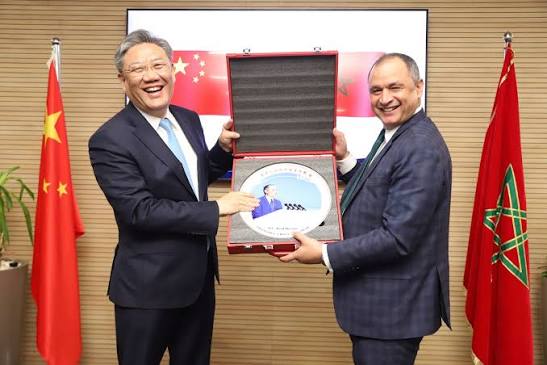
Now Morocco’s largest supplier, China could find its next wave of growth in the Kingdom’s factories, solar plants and desalination facilities. Machine tools, battery storage systems and water treatment equipment are among the most promising opportunities. For Moroccan buyers, operating costs and the availability of spare parts will matter as much as the purchase price.
In 2025, Morocco imported 114.06 billion dirhams worth of Chinese goods, up 26.4% from 2024. China accounted for 13.9% of Morocco’s imports, overtaking Spain as the Kingdom’s largest supplier. Morocco’s bilateral trade deficit with China reached 110.23 billion dirhams. As imports grow, what Morocco buys from China matters increasingly for what it can produce at home.
Machinery to expand Moroccan manufacturing
Chinese manufacturers could sell more injection moulding machines, laser cutters, welding robots and camera-based quality inspection systems. These tools meet practical needs for Moroccan suppliers. An automotive parts maker can automate inspections before shipment. A packaging producer can switch formats more quickly on the same line and take on smaller orders.
Gotion’s planned battery plant in Kenitra illustrates how a new industry can create demand for specialised equipment. Cell production could generate orders for assembly machinery, testing equipment and traceability systems. For machinery suppliers, the ability to train technicians and provide prompt on-site support could carry considerable weight in purchasing decisions.
Energy storage opens a new market
Chinese manufacturers could also find opportunities in stationary batteries, inverters and power management systems. The Noor Midelt II and III solar projects each include battery storage, allowing some of the electricity generated during the day to be supplied when demand rises in the evening. At factory level, a properly sized storage system can also reduce the amount of power drawn from the grid during peak hours.
Electric vehicles and delivery vans offer another opening. Chinese suppliers could sell depot charging stations, spare parts and diagnostic tools alongside the vehicles themselves. For a Moroccan fleet operator, the time a vehicle spends off the road awaiting repairs directly affects the fleet’s profitability.
Water and food processing create demand for equipment and spare parts
Morocco’s expansion of desalination could generate orders for high-pressure pumps, reverse-osmosis membranes and energy recovery devices. With a planned capacity of 300 million cubic metres a year once fully developed, the Greater Casablanca plant gives a sense of the scale of investment. Demand continues after commissioning, as operators replace membranes, service pumps and monitor water quality.
In food processing, Chinese manufacturers could win more orders for sorting and packing lines, cold rooms and freezing equipment. For Moroccan fruit and vegetable exporters, these investments can reduce post-harvest losses and help them deliver consignments of consistent quality to overseas distributors.
With the bilateral trade deficit already above 110 billion dirhams, Morocco has a stake in using some of these imports to expand domestic production. An imported machine can enable a Moroccan supplier to make a component it previously sourced abroad and eventually sell it to an international customer. For Chinese equipment makers, some of the most durable demand may therefore come from Moroccan companies looking to export more themselves