




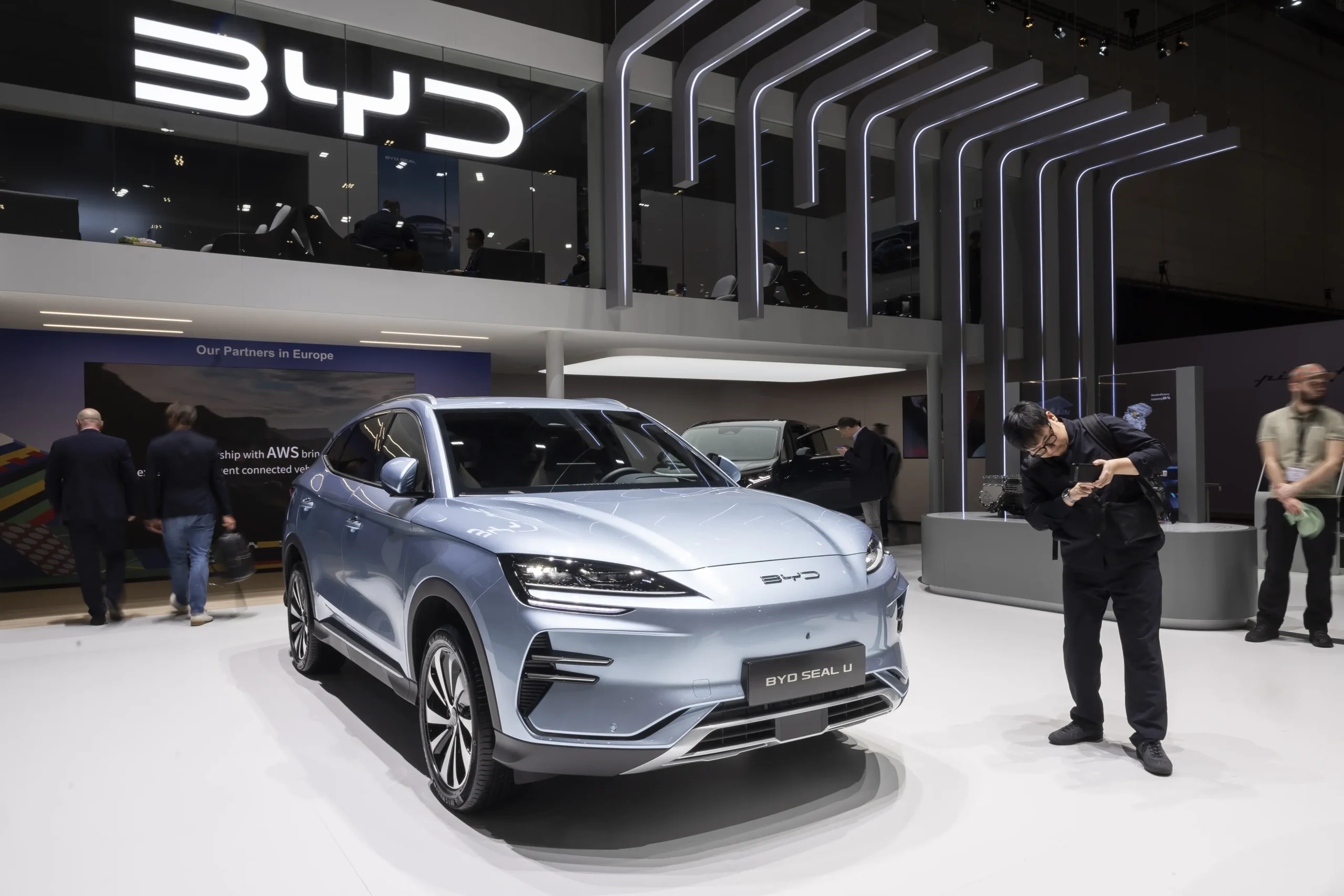
Chinese automaker BYD sold more vehicles than U.S.-based Ford in 2025, marking a symbolic turning point in the global automotive industry and highlighting the rapid rise of Chinese manufacturers.
According to data from the China Passenger Car Association, Ford sold just under 4.4 million units in 2025, down about 2%. BYD, for its part, reported nearly 4.6 million vehicles sold over the same period. While the gap in volume may appear modest, it carries major significance: the Chinese group has now climbed to sixth place worldwide and established itself as a central player in the sector.
The year 2025 confirms a structural transformation. Traditional automakers, long dominant thanks to internal combustion engines, are now operating in a slowing market segment. In contrast, Chinese groups are advancing rapidly in the fast-growing electrified vehicle segment, driven by technological innovation, software integration, and strong control over the battery supply chain.
Ford posted solid results in the United States, its home market, but recorded declines in Europe and especially in China, the world’s largest automotive market and a key driver of the electric transition. In this strategic arena, companies such as BYD, Xiaomi, and Geely are gaining ground with technology-intensive electric models, rapid product renewal cycles, and highly competitive pricing.
BYD said it sold 4.602 million new energy vehicles in 2025, strengthening its position as the world’s leading manufacturer in this segment. The company also surpassed, for the first time, the milestone of one million vehicles sold outside China, reflecting the acceleration of its international expansion.
According to Cui Dongshu, Secretary General of the China Passenger Car Association, this performance is built on long-term foundations: continuous innovation, a dense supply ecosystem, and intense domestic competition. The competitive edge of Chinese automakers now goes beyond cost advantages, resting instead on an integrated and highly responsive industrial model.
The geo-industrial dimension is also becoming more prominent. BYD has established production facilities in Brazil, Thailand, and Hungary to reduce exposure to trade tensions and strengthen access to major regional markets. Producing closer to end markets is increasingly a strategic necessity rather than a mere expansion choice.
By overtaking Ford, BYD has not simply achieved a one-off milestone. The shift reflects a deeper reconfiguration of the global automotive hierarchy, now shaped by the ability to scale up electrification, integrate software and hardware, and rapidly adapt industrial capacity to evolving market demands.