
Despite solid growth momentum, international uncertainties and rising production costs call on manufacturers to strengthen their resilience.
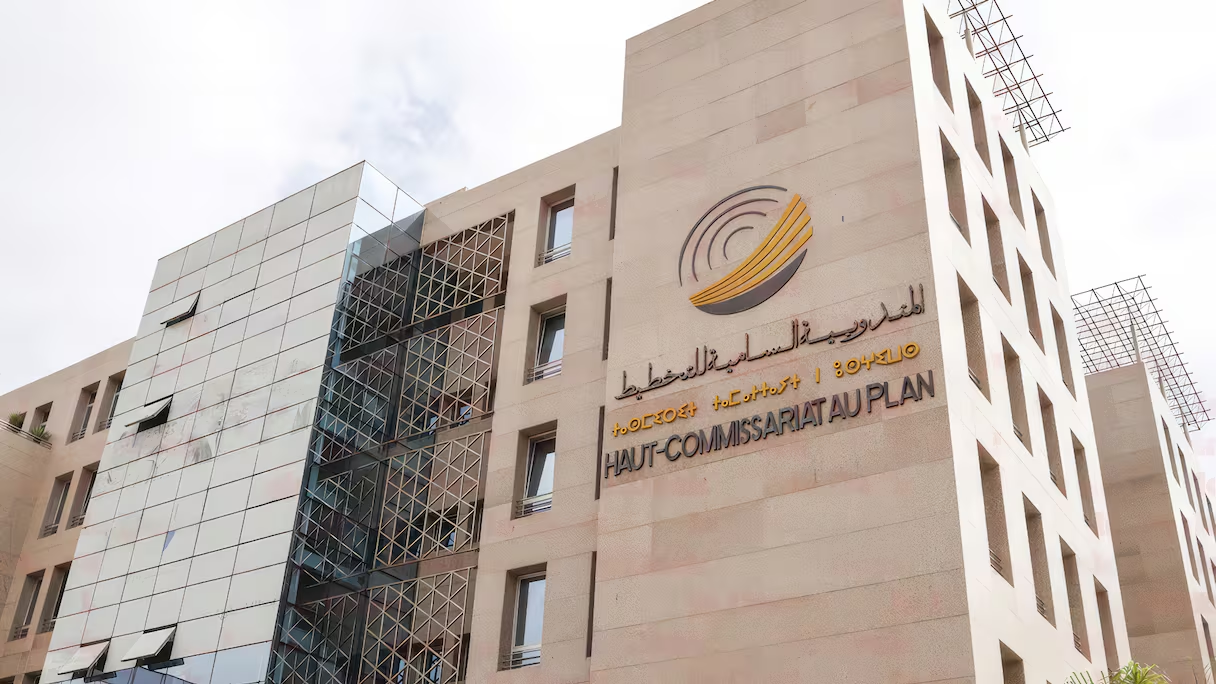
Morocco’s manufacturing industry continues to demonstrate remarkable resilience, driven by the strong performance of key sectors such as automotive, aerospace, agri-food, and electronics. However, the international environment remains highly uncertain. In its latest economic outlook and business cycle analyses published in July 2026, Morocco’s High Commission for Planning (HCP) urges economic operators to remain vigilant in the face of risks affecting the industrial landscape.
According to the HCP, the Moroccan economy is evolving in a fragile global environment marked by geopolitical tensions, disruptions in international supply chains, volatility in energy markets, and slower global trade growth. After external demand for Moroccan exports expanded by an estimated 4.9% in 2025, it is expected to slow to 2.6% in 2026, before recovering slightly to 2.9% in 2027. This trend could weigh on export-oriented manufacturing industries.
The 2027 Exploratory Economic Budget also notes that tensions in the Middle East—particularly around the Strait of Hormuz—have led to higher commodity prices and additional pressure on global supply chains. Although these tensions have eased, they underscore the vulnerability of import-dependent economies to external shocks.
Manufacturing remains a key driver of growth
These cautionary signals do not, however, alter the positive outlook for Morocco’s industrial sector. The HCP forecasts that the national economy will grow by 4.8% in 2026, supported by robust domestic demand, a rebound in agriculture, and sustained public and private investment. Manufacturing remains one of the principal contributors to this growth, driven by higher-value exports and the continued development of industrial ecosystems.
Over the past several years, Morocco has significantly strengthened its productive base through competitive industrial platforms, world-class logistics infrastructure, and deeper integration into global value chains. The automotive, aerospace, electronics, chemicals, plastics, and agri-food industries continue to attract foreign direct investment while boosting the country’s export performance.
Competitiveness becomes the central challenge
The HCP nevertheless emphasizes that future industrial competitiveness will increasingly depend on structural factors, including higher productivity, innovation, digital transformation, workforce upskilling, and an accelerated energy transition.
Manufacturing companies continue to face several challenges, including volatile raw material prices, rising transportation costs, stricter decarbonization requirements, new environmental regulations in European markets, and intensifying international competition.
In this context, manufacturers’ ability to invest in automation, research and development, and energy efficiency will become a decisive competitive advantage.
Investing in diversification
One of the HCP’s key conclusions is the need to continue diversifying Morocco’s industrial base. Expanding access to African markets, opening new export destinations, and strengthening local value chains are seen as essential strategies to reduce dependence on fluctuations in European demand.
The Kingdom’s industrial policy, combined with the new Investment Charter, Industrial Acceleration Zones, and major infrastructure projects, provides a favorable framework for achieving this diversification.
Vigilance rooted in confidence
Rather than signaling an industrial slowdown, the HCP’s message is primarily a call to anticipate the profound transformations reshaping the global economy. The fundamentals of Morocco’s manufacturing industry remain strong, but companies are encouraged to enhance their adaptability in response to an increasingly complex international environment.
For manufacturers, the challenge is now to transform this period of uncertainty into an opportunity to generate greater added value, foster innovation, and strengthen industrial sovereignty. In a rapidly evolving global economy, resilience may well become the Moroccan manufacturing industry’s most valuable competitive asset.