




Morocco’s participation in the Farnborough International Airshow 2026, held in the United Kingdom from 20 to 24 July, reflects the remarkable progress achieved by the Kingdom’s aerospace industry. As one of the world’s premier gatherings for aircraft manufacturers, suppliers, investors, and industry leaders, Farnborough serves as a strategic showcase for countries seeking to strengthen their position within global aerospace value chains.
For Morocco, the objective is clear: to consolidate its position among the world’s most competitive industrial platforms while attracting a new generation of high-value, technology-driven investments.
Morocco Establishes Itself as a Leading Global Aerospace Manufacturing Hub
Over the past two decades, Morocco’s aerospace industry has evolved from an emerging sector into one of the country’s leading industrial pillars. According to figures released by the Ministry of Industry and Trade and the Moroccan Agency for Investment and Export Development (AMDIE), the sector now comprises more than 150 companies—including around 40 of the world’s leading aerospace manufacturers and suppliers—employs over 26,000 highly skilled professionals, and has achieved a local integration rate exceeding 40%, one of the highest in Africa.
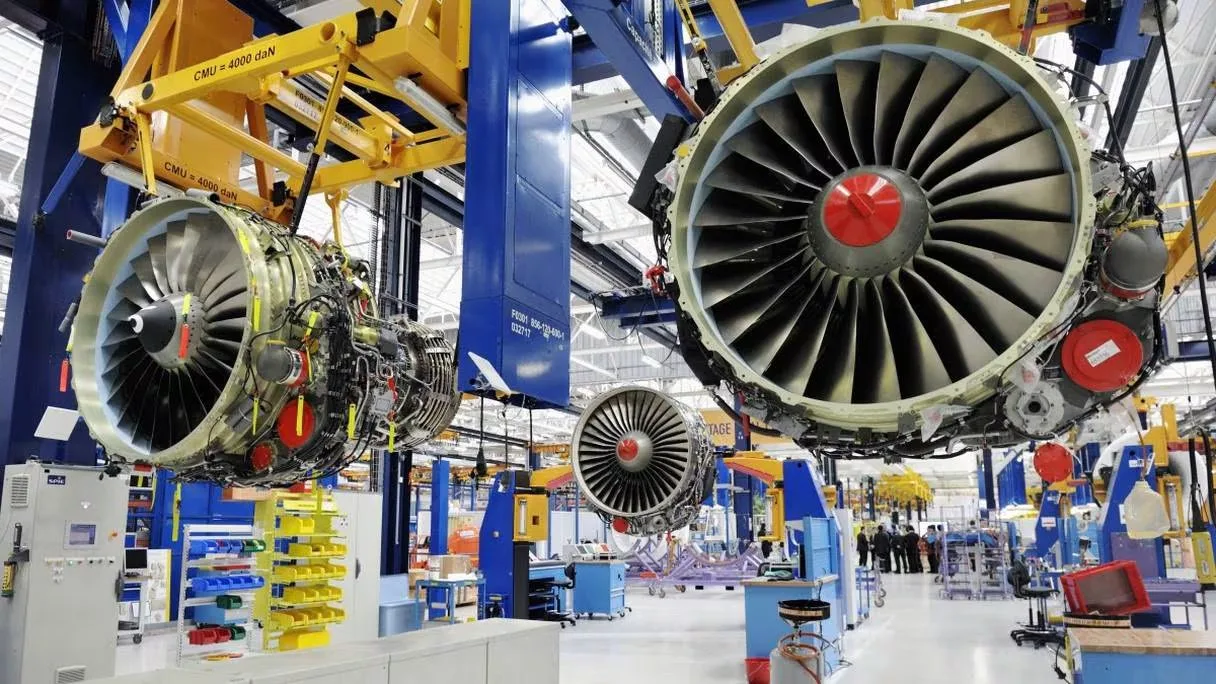
The industry generates more than MAD 27 billion in export revenues, equivalent to nearly US$3 billion, and has consistently recorded one of the fastest growth rates within Morocco’s manufacturing sector. Aerospace exports continue to expand, driven by the rapid development of aircraft assembly, electrical wiring systems, precision machining, composite materials, maintenance, repair and overhaul (MRO), and engineering services.
Today, Morocco is fully integrated into the world’s leading aerospace programmes. Components manufactured in the Kingdom are installed on aircraft produced by Airbus, Boeing, Embraer, Bombardier, Dassault Aviation, as well as by numerous helicopter and aircraft engine manufacturers. This integration places Morocco at the heart of global aerospace supply chains and reinforces its growing role in supporting worldwide aircraft production.
A World-Class Industrial Ecosystem Recognized by Global Leaders
The success of Morocco’s aerospace industry is built on a highly structured and competitive industrial ecosystem. International groups such as Safran, Spirit AeroSystems, Collins Aerospace, Hexcel, Eaton, Thales, Latecoere, Stelia Aerospace, Le Piston Français, Aircelle, and TDM Aerospace have all chosen Morocco as a strategic location for their manufacturing operations.
Around these global leaders, an extensive network of local SMEs and specialized suppliers has gradually developed, capable of meeting the aerospace industry’s most demanding international standards. Specialized industrial platforms—particularly MidParc Casablanca—provide an integrated environment combining manufacturing, logistics, training facilities, and business support services.
The industry’s expansion is also supported by a highly qualified workforce. Through the Institute for Aerospace Professions (IMA) and strong partnerships between manufacturers and higher education institutions, Morocco trains thousands of technicians, skilled operators, and engineers each year to meet the requirements of the world’s leading aerospace companies.
A Strategy Focused on Moving Up the Value Chain
At Farnborough, Morocco is no longer promoting only its competitive production costs or its geographical proximity to European markets. The Kingdom is now highlighting its capability to manufacture complex aerospace components, increase domestic value creation, and support the technological transformation reshaping the global aviation industry.
The authorities aim to significantly raise the local integration rate by attracting additional world-class original equipment manufacturers (OEMs), expanding the national supplier network, and strengthening engineering, research and development, as well as other high-value-added industrial services.
This strategy is aligned with the profound changes taking place across the aerospace sector, including digital manufacturing, industrial automation, advanced composite materials, additive manufacturing, artificial intelligence, and increasingly demanding environmental standards.
Morocco also intends to capitalize on the transition toward low-carbon aviation. Future programmes involving next-generation aircraft, onboard electrical systems, sustainable aviation fuels (SAF), and hydrogen-powered aviation represent significant opportunities for companies operating in the Kingdom.
Morocco Aims to Become a Global Aerospace Hub
Political stability, an extensive network of free trade agreements, world-class logistics infrastructure, specialized industrial zones, and a highly competitive workforce have become Morocco’s strongest advantages in attracting international aerospace investment.
At a time when major aircraft manufacturers are seeking to diversify their supply chains and locate production closer to key markets, Morocco is emerging as a reliable and competitive destination for next-generation industrial investments.
Morocco’s presence at the Farnborough International Airshow reflects a clear strategic ambition: to transform its aerospace industry from a highly competitive manufacturing base into a global hub for production, innovation, and engineering, capable of designing, manufacturing, and exporting high-value aerospace components to major international markets. Backed by a mature industrial ecosystem, internationally recognized expertise, and a long-term industrial vision, Morocco is positioning itself to play a leading role in shaping the future of the global aerospace industry.