
SISTEP IMME 2026: Morocco and Mauritania Bet on a New African Industrial Alliance
Held under the High Patronage of His Majesty King Mohammed VI, the 14th edition of SISTEP IMME was officially inaugurated on Wednesday, September 9, at the Casablanca International Fairgrounds (OFEC), with an ambition that goes far beyond that of a conventional industrial trade show. By placing Mauritania in the spotlight as guest of honour, the event organized by the Federation of Mechanical, Metallurgical and Electromechanical Industries (FIMME), under the supervision of the Ministry of Industry and Trade, opens a new chapter in the development of shared value chains between Morocco and one of West Africa’s most promising economies.
Running until September 12, SISTEP IMME 2026 brings together manufacturers, equipment suppliers, major industrial buyers, clusters, investors and experts around production technologies, maintenance, industrial safety and Industry 4.0. Through SISTEP, SIPEX — dedicated to industrial safety and risk prevention — and INTEC, focused on digital transformation, the event seeks to support Moroccan industry in meeting a dual objective: strengthening competitiveness while deepening its integration into African and international value chains.
The 14th edition stands out particularly for the strategic importance given to Mauritania. The theme “Morocco–Mauritania: From Industrial Complementarity to Joint Projects” reflects the evolution of bilateral cooperation: moving progressively from trade to investment, from product exchanges to co-production, and from geographical proximity to a genuine regional industrial strategy.
Mauritania: An Industrial Potential Entering a New Phase
Mauritania’s presence at SISTEP IMME takes on particular significance given the profound transformation currently underway in its economy. Its potential is rooted in mineral and energy resources, but increasingly extends to green hydrogen, industrial processing, fisheries, logistics and related services.
Data from international institutions illustrate the scale of this potential. According to the Extractive Industries Transparency Initiative (EITI), extractive industries accounted for 76.28% of Mauritania’s exports and 18.91% of GDP in 2023, while their contribution to government revenues reached 22.73%. The country produces iron ore, gold, copper, silver and hydrocarbons.
Iron ore remains one of the main pillars of Mauritania’s extractive economy. The latest IMF report on Mauritania projects an increase in production to 15.4 million tonnes in 2026, 16 million tonnes in 2027, 18.4 million tonnes in 2028 and 19.7 million tonnes in 2029, according to its projections.
This expansion of the extractive sector is taking place alongside the emergence of natural gas as a new driver of economic transformation. The Greater Tortue Ahmeyim (GTA) project, developed offshore on the Mauritania–Senegal border, is entering a new phase of development. The IMF estimates that increasing production from the project will contribute directly to the recovery of extractive activity and stronger economic growth in Mauritania.
For 2026, the IMF forecasts economic growth of 4.7%, supported particularly by the recovery of the extractive sector and the gradual increase in GTA production. Over the medium term, growth could average around 5% between 2026 and 2029, driven by the recovery of gold and iron ore production, gas, as well as agriculture and fisheries.
From Iron and Gas to Industrial Processing
This is precisely where one of the main opportunities of Morocco–Mauritania industrial cooperation lies. The issue is no longer simply to extract and export resources. The challenge is now to process them locally and create greater industrial value around those resources.
The expansion of mining activities is generating significant demand for equipment, maintenance, engineering, industrial components, automation, safety, logistics and technical services. The development of the gas sector is also creating new opportunities in infrastructure, energy, industrial maintenance and specialized services.
For Morocco, which has developed a diversified industrial ecosystem in recent years — particularly in automotive, aerospace, metallurgy, mechanical engineering, electromechanical industries, agri-food and industrial services — Mauritania can represent much more than an export market. It can become a new platform for industrial deployment and cooperation.
Green Hydrogen: A New Industrial Horizon
Mauritania’s mineral and gas wealth is complemented by another strategic asset: green hydrogen. Under its national roadmap, Mauritania has set a target of producing 1.2 million tonnes of hydrogen per year by 2030, rising to 6.5 million tonnes annually by 2050, with a significant share intended for export.
The AMAN project illustrates the scale of this ambition. According to the International Energy Agency, the framework agreement provides for 18 GW of wind power capacity and 12 GW of solar capacity, with an announced potential of 1.7 million tonnes of green hydrogen or 10 million tonnes of green ammonia per year.
These projects could progressively reshape the country’s industrial structure. Hydrogen is not merely a potential new export commodity; it could support industrial activities linked to green ammonia, methanol, decarbonized steel, energy equipment, and transport and storage infrastructure.
For Morocco, this development creates additional opportunities for cooperation in engineering, equipment, industrial services, logistics and energy technologies.
Agreements Turning Industrial Ambition into Projects
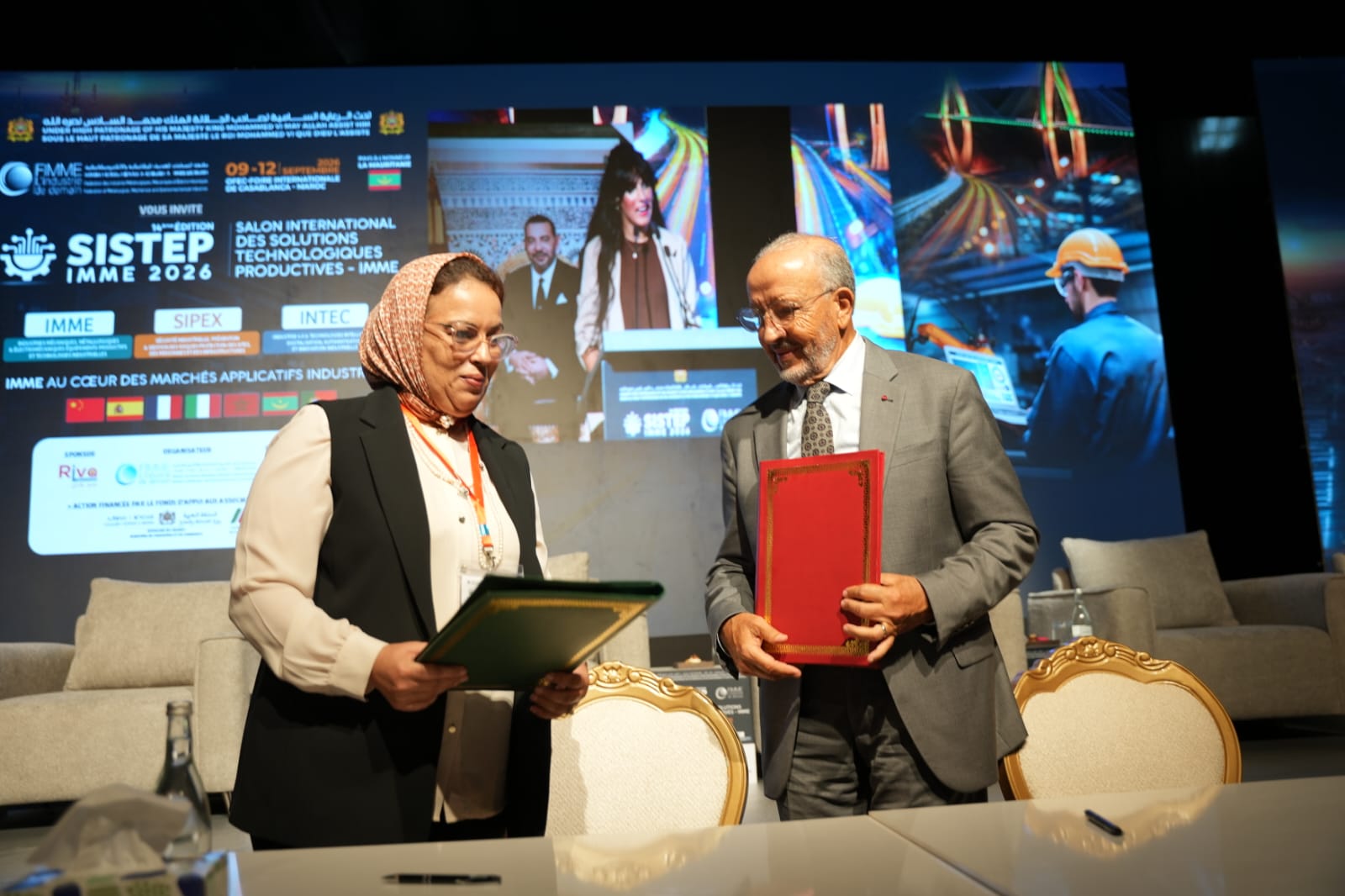
This industrial transformation agenda was reflected from the opening day of SISTEP IMME 2026 through the signing of two major agreements.
The first, between FIMME and the Maintenance 4.0 Cluster, was signed by Mr. Abdelhamid Souiri, President of FIMME, and Mr. Jbili Abdenour, President of the Maintenance 4.0 Cluster. The agreement aims to accelerate the digitalization of industrial processes, equipment retrofitting and predictive maintenance.
The second agreement, between FIMME and the MWC – Mechanical and Metallurgical Cluster, was signed by Mr. Abdelhamid Souiri and Ms. Nadia Meziane, President of MWC. It seeks to strengthen the competitiveness of the mechanical and metallurgical sector and promote higher-value-added local subcontracting.
Both agreements address the same strategic challenge: how can technological investment be transformed into industrial competitiveness, skilled employment and stronger local production capabilities?
The answer lies in modernizing equipment, digitalizing factories, developing smart maintenance and building supplier networks capable of supporting major industrial groups.
Industrial Safety: Another Pillar of Competitiveness
The opening day also featured the presentation of the Prevention Awards, organized as part of SIPEX. Three major companies were recognized for their initiatives in industrial prevention and safety: AtlantaSanad Assurance, JESA and Holcim Maroc.
The initiative highlights a fundamental reality: industrial competitiveness can no longer be separated from risk management. In mining, energy, chemicals, metallurgy and manufacturing, the safety of people and facilities has become an essential component of operational performance, business continuity and corporate reputation.
A Platform Focused on Africa
With more than 6,500 professional visitors expected, international pavilions — particularly from Mauritania, China and Italy — and specialized spaces such as the Foundry Village, SISTEP IMME is strengthening its position as a platform for industrial and business partnerships. Yet its ambition now goes beyond connecting suppliers and buyers. The real challenge is to build industrial ecosystems.
Mauritania has significant resources in iron ore, gold, gas, fisheries and renewable energy. Morocco, for its part, has a diversified industrial base, an extensive supplier network, engineering capabilities and growing experience across African markets.
Combining these two strengths could generate a new generation of partnerships in mining equipment, maintenance, metallurgy, resource processing, energy infrastructure, engineering, logistics, agri-food, green technologies and industrial services.
Mauritania’s 2024 EITI report, published in October 2025, also shows that the country is broadening its strategic approach beyond mining and gas, increasingly incorporating issues related to green hydrogen and the energy transition.
Casablanca–Nouakchott: Towards a Regional Value Chain
The Mauritanian focus at SISTEP IMME 2026 therefore represents a particularly significant economic signal. Morocco and Mauritania now have the foundations to move their relationship from a trade-based model towards a model of co-industrialization.
The objective is to connect Mauritania’s resources with Morocco’s industrial, technological and financial capabilities, while enabling companies from both countries to jointly expand into West African markets.
In this perspective, Casablanca can serve as an industrial and financial platform, while Nouakchott and Nouadhibou can become gateways to resources, energy infrastructure, mining and fisheries activities and West African markets.
SISTEP IMME 2026 is therefore not simply showcasing the technologies of tomorrow’s industry. Through the Morocco–Mauritania partnership, it highlights a much broader ambition: to build, on the basis of the complementarity between two neighbouring economies, African value chains capable of producing more, processing more and exporting more.