

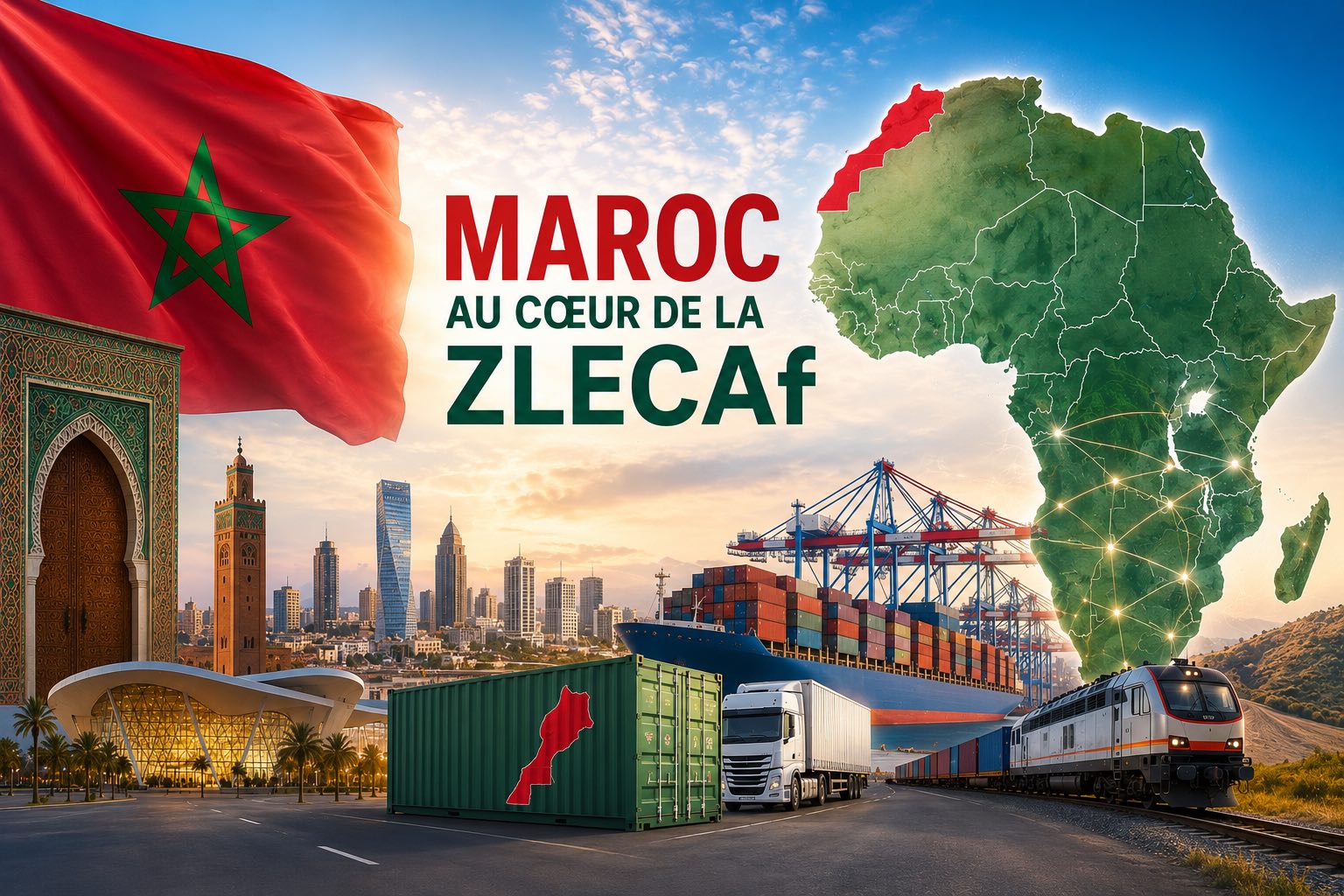
The African Continental Free Trade Area (AfCFTA), which officially entered into force in January 2021, has become the world’s largest integrated market in terms of participating countries, bringing together 54 signatory states, more than 1.4 billion people and a combined Gross Domestic Product exceeding US$3.4 trillion. The agreement aims to boost intra-African trade by progressively eliminating tariff barriers, facilitating cross-border commerce and fostering regional value chains capable of accelerating industrialization and economic transformation across the continent.
For Morocco, which has made Africa a central pillar of its economic strategy for more than two decades, the AfCFTA represents a historic opportunity to strengthen its continental footprint. Yet, five years after the agreement became operational, Morocco remains more successful as an African investor than as an exporter to African markets. In 2025, trade between Morocco and the rest of Africa reached approximately US$9.5 billion, driven by exports of fertilizers, processed food products, construction materials, pharmaceuticals, plastic products, electrical equipment, vehicles and automotive components. Nevertheless, Africa still accounts for only about 7% of Morocco’s total foreign trade, compared with more than 55% for the European Union, highlighting the considerable room for expansion. Morocco’s leading African trading partners remain Senegal, Côte d’Ivoire, Mauritania, Nigeria, Ghana, Mali, Guinea, Cameroon, Gabon and Egypt, with West Africa continuing to account for the largest share of commercial exchanges. Morocco also maintains a significant trade surplus with most Sub-Saharan African partners, while imports from the continent remain largely concentrated in cocoa, coffee, cotton, selected minerals, timber, agricultural products and hydrocarbons from a limited number of countries.
Morocco’s greatest strength lies in foreign direct investment across Africa. The Kingdom has consistently ranked among the continent’s leading intra-African investors, particularly in West Africa. Moroccan banking groups—including Attijariwafa Bank, Bank of Africa and Banque Centrale Populaire—have established extensive networks across dozens of African countries. OCP Group continues to expand its continental leadership through major investments in fertilizers, logistics platforms and agricultural development programmes. Maroc Telecom is strengthening its footprint across Sub-Saharan Africa, while Royal Air Maroc plays a strategic role in improving air connectivity between Casablanca and major African capitals. Other Moroccan champions, including Addoha, TGCC, Intelcia, Saham, Dislog and several industrial companies, have expanded into construction, real estate, healthcare, services, distribution and manufacturing. Today, Moroccan companies operate in more than thirty African countries, making the Kingdom one of the continent’s most influential economic players.
Despite these achievements, Moroccan small and medium-sized enterprises (SMEs) have yet to fully capitalize on the opportunities offered by the AfCFTA. Official assessments estimate that Morocco has the immediate potential to generate nearly MAD 12 billion in additional exports to African markets, while around sixty industrial investment projects have already been identified as direct beneficiaries of the continental free trade framework. However, several obstacles continue to constrain greater participation, including limited awareness of AfCFTA rules of origin, complex customs procedures in several countries, high transport and logistics costs, insufficient market intelligence, limited access to export financing for SMEs and underdeveloped regional industrial value chains. Even so, prospects remain particularly promising in sectors such as automotive manufacturing, electric batteries, electronics, renewable energy, construction materials, pharmaceuticals, agribusiness, plastics, fertilizers, digital technologies and financial services. At the same time, Africa’s expanding infrastructure programmes are creating significant opportunities for Moroccan companies specializing in construction, engineering, water management, energy and logistics.
Casablanca Finance City is also strengthening its role as a regional financial and business hub by attracting hundreds of international companies seeking to manage their African operations from Morocco, thereby reinforcing the Kingdom’s position as a strategic gateway linking Europe, the Middle East and Africa. To unlock the full potential of the AfCFTA, Morocco will need to accelerate support for exporting SMEs, simplify trade procedures, expand logistics infrastructure, improve export financing mechanisms, strengthen market intelligence and promote industrial partnerships across Africa. Thanks to its diversified industrial base, modern infrastructure, institutional stability and the growing presence of its private sector throughout the continent, Morocco possesses all the necessary assets to become one of the principal beneficiaries of the AfCFTA. The challenge over the coming decade will be to extend these opportunities to the entire Moroccan business ecosystem—particularly SMEs—thereby increasing exports, expanding investment, developing regional value chains and consolidating Morocco’s position as a leading industrial, financial and logistics hub connecting Europe and Africa.