




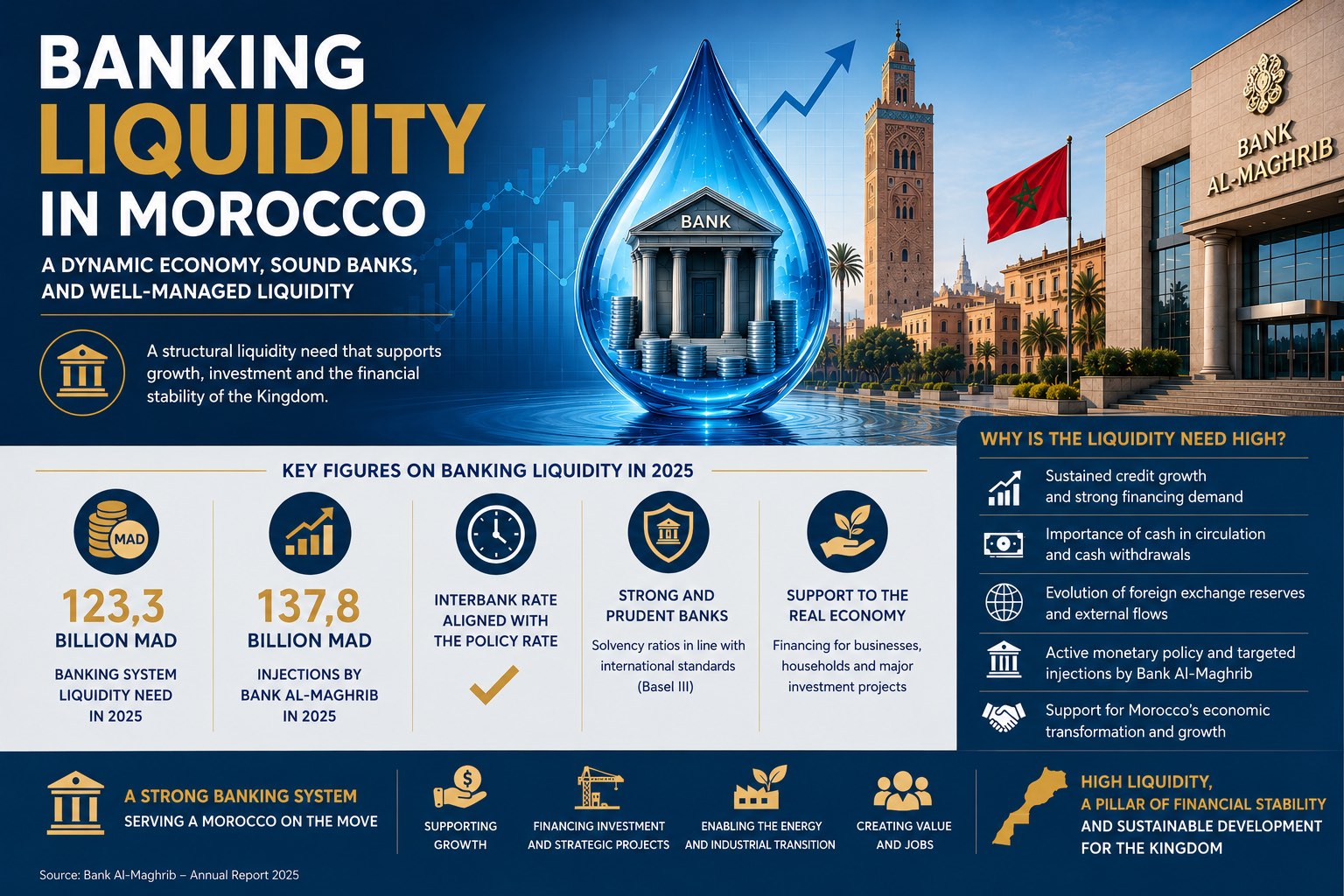
The Moroccan banking system’s liquidity requirement, which remained at MAD 123.3 billion in 2025, according to Bank Al-Maghrib’s annual report, should not be interpreted as a sign of weakness in the banking sector. On the contrary, it reflects a structural transformation of the Moroccan economy, characterized by strong demand for financing, sustained credit growth, and an active monetary policy. Behind this figure lies a delicate balance between the resilience of the banking sector, the financing needs of the real economy, and the central role of Bank Al-Maghrib in safeguarding financial stability.
Over the past several years, the banking sector’s liquidity deficit has remained well above historical averages. While the average liquidity need fluctuated around MAD 78 billion between 2021 and 2023, it now exceeds MAD 120 billion, illustrating a profound shift in the way Morocco’s economy is financed.
An Economy with Growing Liquidity Needs
The primary explanation lies in the rapid expansion of financing across the Moroccan economy. Banks are extending more credit to businesses, households, and large-scale investment projects, which naturally increases their refinancing requirements.
Morocco is currently experiencing an unprecedented investment cycle. Major infrastructure projects, preparations for the 2030 FIFA World Cup, the energy transition, the automotive and aerospace industries, and the development of the green hydrogen sector are mobilizing significant amounts of capital. Banks play a central role in financing these projects, resulting in higher liquidity consumption.
At the same time, the gradual recovery of private investment and increasing corporate working capital requirements are further boosting credit demand.
Cash Circulation Continues to Weigh on Liquidity
One of the defining characteristics of Morocco’s financial system remains the widespread use of cash. Cash withdrawals continue to rise, reducing the volume of funds available within the banking system.
Every dirham withdrawn in banknotes temporarily leaves the banking circuit and must be offset through additional funding sources. This persistent preference for cash payments remains one of the key structural drivers of the banking sector’s liquidity deficit.
Despite significant progress in digital payment solutions, Morocco continues to be a predominantly cash-based economy for everyday transactions.
Foreign Exchange Reserves Directly Influence Liquidity
The level of Bank Al-Maghrib’s net foreign exchange reserves also has a decisive impact on banking liquidity.
When foreign reserves increase thanks to exports, foreign direct investment, tourism revenues, and remittances from Moroccans living abroad, more dirhams are injected into the economy.
Conversely, when foreign currency outflows increase or inflows slow down, the supply of dirhams contracts, forcing banks to rely more heavily on refinancing from Bank Al-Maghrib.
This explains why fluctuations in foreign exchange reserves have a direct effect on the banking sector’s liquidity deficit.
A Central Bank Supporting the Economy Without Fueling Inflation
In response, Bank Al-Maghrib has adopted a balanced approach.
By injecting MAD 137.8 billion through various refinancing instruments—including seven-day advances, one- and three-month refinancing operations, and dedicated programs supporting economic financing—the central bank ensures the smooth functioning of the money market while maintaining strict control over financing conditions.
Its objective is not to provide unlimited liquidity, but rather to meet the banking sector’s actual needs, preserve interest rate stability, and ensure the effective transmission of monetary policy.
The fact that the interbank rate has remained closely aligned with the policy rate demonstrates the effectiveness of this strategy.
High Liquidity Needs Do Not Indicate Banking Weakness
Contrary to common perception, a high liquidity requirement does not mean that Moroccan banks are financially weak.
The sector maintains capital adequacy levels fully compliant with Basel III international standards and continues to display strong prudential ratios. Recourse to refinancing from Bank Al-Maghrib is primarily a normal liquidity management mechanism.
In most major economies, central banks also serve as the primary providers of liquidity to ensure the proper functioning of money markets.
Towards a Gradual Normalization?
Over the medium term, several factors could gradually reduce the liquidity deficit.
Improved tourism revenues, continued growth in industrial exports, higher foreign direct investment inflows, the expansion of electronic payments, and stronger domestic savings could all strengthen the banking system’s funding base.
However, as long as Morocco continues its ambitious investment agenda and industrial transformation, refinancing needs are likely to remain elevated.
A Reflection of Economic Momentum
Ultimately, the banking system’s liquidity requirement of more than MAD 123 billion should be viewed less as a sign of financial stress than as evidence of a rapidly transforming economy. Banks are financing more projects, businesses are investing more, and Bank Al-Maghrib is supporting this momentum by ensuring sufficient liquidity in the money market.
In this context, the central bank’s liquidity injections represent above all a financial stability instrument. They support economic growth, preserve favorable financing conditions, and enable the banking sector to continue fulfilling its essential role as a key driver of investment and Morocco’s economic development.