




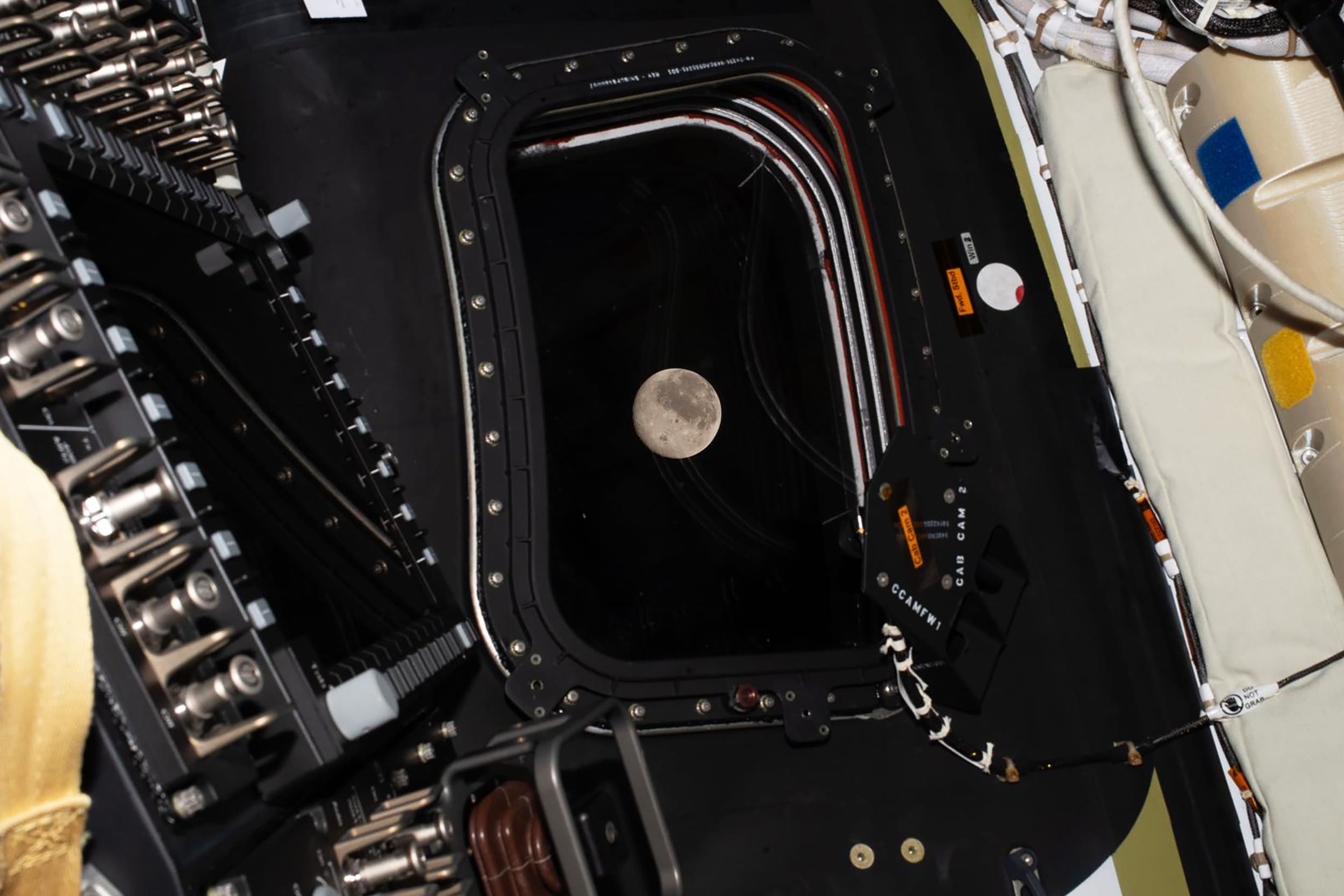
NASA’s Artemis II mission has reached a new milestone in space exploration. On Monday, the astronauts surpassed the farthest distance from Earth achieved by Apollo 13 in 1970 and are now preparing to spend several hours flying over previously unexplored regions of the Moon.
The Apollo 13 record of 400,171 km has been broken: American astronauts Christina Koch, Victor Glover, Reid Wiseman, and Canadian astronaut Jeremy Hansen are now expected to reach over 406,000 km from Earth during their lunar flyby.
“The control room is full of lunar joy today, and I imagine you are too,” said Jenni Gibsons from NASA’s Houston control center. Mission commander Reid Wiseman also displayed the Apollo 8 mission patch onboard, honoring the pioneers of lunar exploration.
The lunar observation period will last nearly seven hours, beginning at 18:45 GMT, allowing the crew to see the Moon in full view through the Orion spacecraft’s window. The astronauts, trained for over two years to identify and describe geological formations, will provide verbal observations, notes, and photographs to scientists on Earth.
“Hearing this crew describe the lunar surface will give you goosebumps,” said Kelsey Young, the mission’s lead scientist. The astronauts will fly over the Moon’s far side, never visible from Earth, and will pass over iconic sites like the Orientale Basin, nicknamed the “Grand Canyon of the Moon,” previously seen only by unmanned probes.
Their journey will also provide spectacular phenomena, including a solar eclipse and a view of Earth rising and setting behind the Moon, reminiscent of the famous “Earthrise” photograph from Apollo 8 in 1968.
If Artemis II and next year’s mission go according to plan, NASA aims to land astronauts on the Moon by 2028, opening a new era of lunar exploration.