




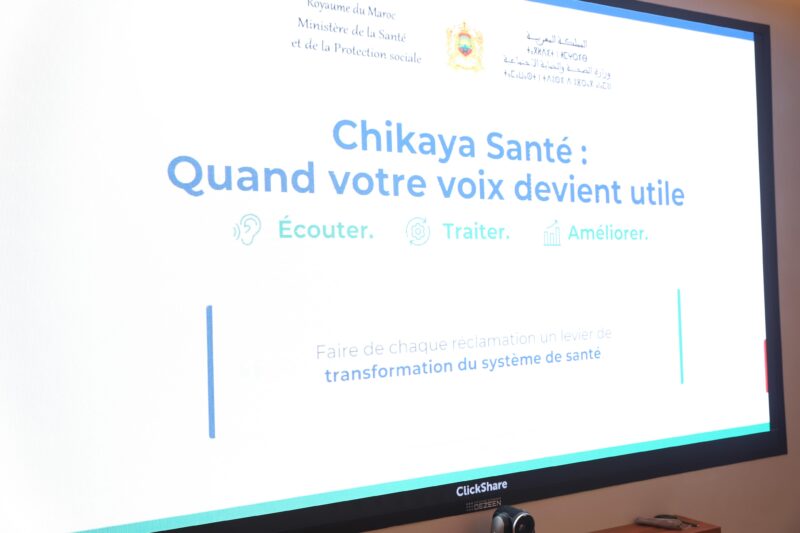
The digital platform “Chikaya Santé,” recently launched by the Ministry of Health and Social Protection, has generated significant public engagement. Within just four days, it recorded 764 complaints, reflecting citizens’ growing trust in this new participatory tool, Minister Amine Tehraoui announced on Tuesday.
Speaking before the House of Councillors, the minister noted that prior to the platform’s launch, the number of daily complaints did not exceed an average of ten. This sharp increase highlights citizens’ willingness to voice their concerns about the quality of healthcare services and contribute to their improvement.
Designed as a modern tool for listening and interaction, “Chikaya Santé” ensures transparent monitoring of complaints and guarantees their processing within defined timeframes. It relies on a national call center supported by advanced digital technologies.
This initiative is part of a broader transformation of Morocco’s healthcare system, rooted in fostering a culture of citizen engagement and aligned with Royal High Directives that place patient dignity and quality care at the center of priorities.
The minister outlined four main pillars of the reform. The first focuses on reorganizing emergency services, including the introduction of a triage system based on case severity and the deployment of more than 531 healthcare professionals. This approach has already improved patient care and begun reducing waiting times.
The second pillar concerns strengthening hospital capacity. With the commissioning of 11 new healthcare facilities, 1,777 additional beds have been added, benefiting nearly 14 million citizens. Ongoing projects aim to provide nearly 2,900 more beds by the end of the third quarter of 2026.
The third pillar aims to enhance patient reception and support within hospitals. This includes the creation of 182 medical-social assistance units, the mobilization of 70 specialized assistants, and improved organization of patient care pathways.
Finally, the fourth pillar addresses a structural reform of the emergency system, including the implementation of a regional SAMU model, the strengthening of emergency response teams, the deployment of modern ambulances, and the adoption of a real-time information system.