




Despite maintaining their dominance in the global university rankings, the United Kingdom and the United States are seeing their lead gradually challenged by the rapid rise of Chinese institutions, according to the latest QS World University Rankings released on Wednesday.
The Massachusetts Institute of Technology (MIT) retained its position as the world’s top university, followed by Imperial College London. The Universities of Oxford and Cambridge ranked fourth and sixth respectively, while Harvard University secured fifth place.
Published annually by the British higher education analytics firm Quacquarelli Symonds (QS), the rankings assess more than 1,500 universities worldwide based on a range of indicators, including academic reputation, employer reputation, research impact, citations and internationalization.
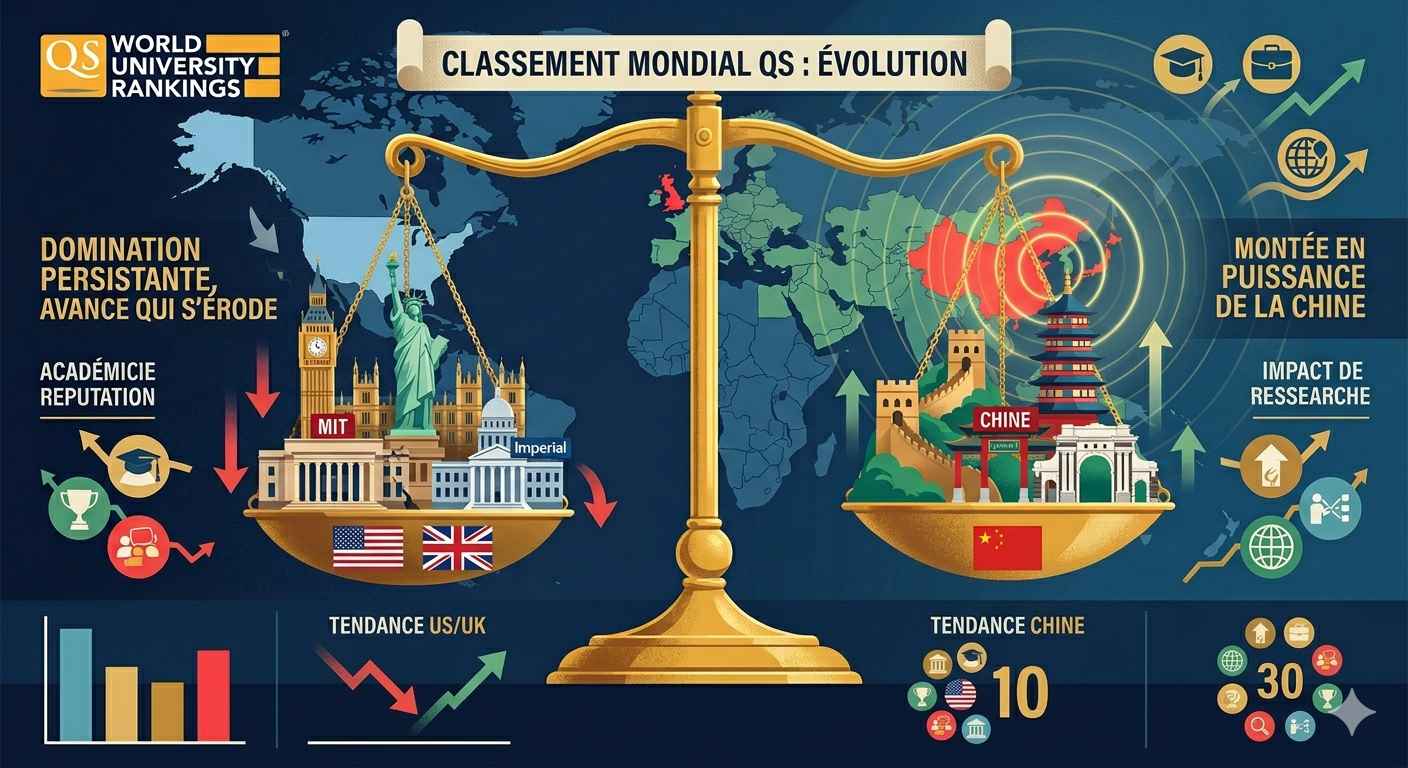
The United Kingdom now has 93 institutions among the 1,504 universities ranked, one more than last year. China has 85 ranked universities, an increase of 13 institutions compared to the previous edition. The United States remains the most represented country with 184 ranked universities, although this figure has declined from a record 201 in 2023.
The rankings also highlight a shifting global landscape. Nearly 65% of U.S. universities fell in the rankings this year, compared with 40% of British institutions. In contrast, 61% of Chinese universities improved their positions.
According to QS Chief Executive Officer Jessica Turner, the United Kingdom remains one of the world’s leading higher education powers, but its position cannot be taken for granted. She stressed that sustaining British leadership will depend on the country’s ability to attract talent, foster innovation and remain open to the world.
QS noted that declining international student enrollment is already affecting British universities. Measures introduced in recent years, including restrictions preventing most master’s students from bringing dependents and planned reductions in post-study work opportunities for foreign graduates, have contributed to lower international enrollment. The trend is impacting both campus diversity and university finances.
The United States is facing similar challenges. New international student enrollments fell by 17% last autumn amid tighter visa and immigration policies, according to the report.
“For decades, the United States was the default destination for the world’s most talented students and researchers. The data now show that this advantage is increasingly being challenged,” Turner said.
Meanwhile, China continues its rapid ascent. Although its universities still lag behind their Western counterparts in terms of internationalization, they are steadily strengthening their academic influence.
Mainland China now has three universities among the world’s top 30 institutions, compared with four from the United Kingdom and eleven from the United States. Within the global top 200, China is represented by ten universities, compared with 28 from the United Kingdom and 38 from the United States.
This progress has been fueled by substantial public investment in research, particularly in science, engineering and healthcare, helping Chinese universities strengthen their global competitiveness and academic standing.
Vivienne Stern, Chief Executive of Universities UK, said the rankings continue to demonstrate the breadth and diversity of world-class British universities and provide grounds for optimism about the country’s future in an increasingly competitive international environment.