
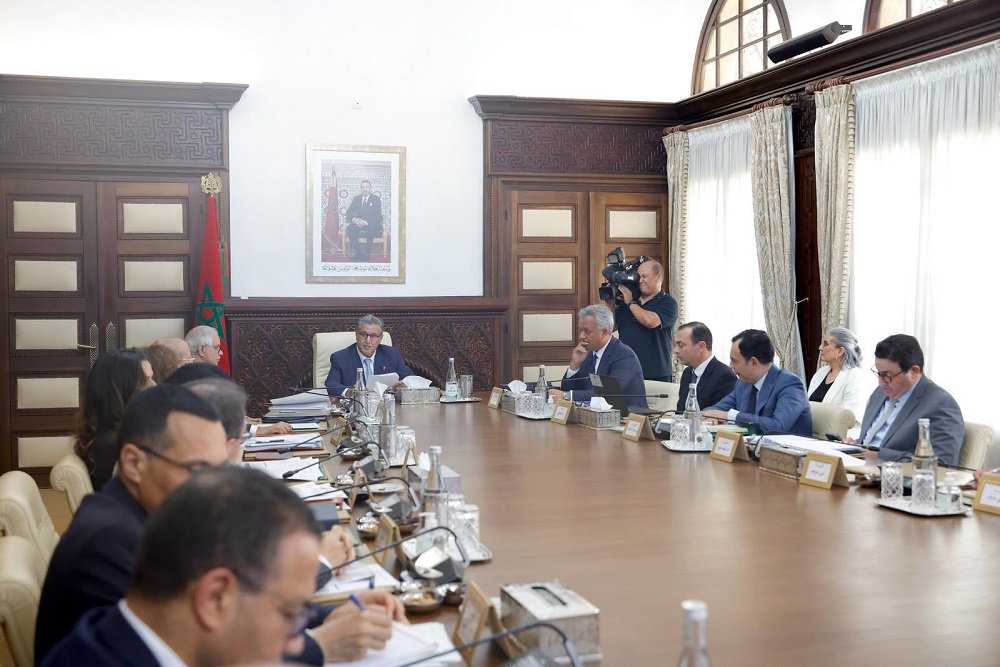
Morocco’s 11th National Investment Commission, chaired by Head of Government Aziz Akhannouch in Rabat, has approved 29 investment agreement projects worth nearly MAD 42 billion, along with nine amendments to existing agreements under the main investment support scheme.
According to a statement from the Head of Government’s Department, the approved projects are expected to create nearly 9,800 jobs, including 2,400 direct and 7,400 indirect positions.
The investments cover 16 provinces and prefectures across six regions of the Kingdom, including Al Haouz, El Jadida, Moulay Yacoub, Nador, Rehamna, and Taroudant. They span 13 economic sectors, notably tourism and leisure, chemicals and petrochemicals, the agri-food industry, port infrastructure, aeronautics, logistics, trade and distribution, telecommunications, waste recovery and recycling, and renewable energy.
Among the approved projects, the agri-food industry is expected to generate the largest number of jobs, followed by the chemicals and petrochemicals sector and the aeronautics industry.
Under the strategic investment scheme, the Commission also approved three investment agreements totaling MAD 8.4 billion and expected to create more than 2,700 direct jobs, in addition to one amendment. These projects focus on electric vehicle manufacturing, aeronautics, and textiles, and will be implemented in the Casablanca-Settat, Rabat-Salé-Kénitra, Fès-Meknès, and Tangier-Tetouan-Al Hoceima regions.
The Commission also granted strategic status to three additional investment projects representing nearly MAD 29 billion in investments and expected to create more than 1,100 direct jobs.
At the opening of the meeting, Prime Minister Aziz Akhannouch highlighted the positive results of Morocco’s new Investment Charter, which has been fully operational for three years. Since its implementation, the framework has enabled the signing of 391 investment agreements representing a total investment volume of MAD 520 billion.
Akhannouch emphasized the Charter’s contribution to balanced regional development, sustainable job creation, gender equality, environmental sustainability, and the emergence of future-oriented industrial sectors, while underscoring its role in attracting strategic projects that strengthen Morocco’s competitiveness and economic sovereignty.