

Since 1979, Oued Eddahab, with Dakhla as its main urban and economic hub, has undergone a profound transformation of its economic structure. From a territory with relatively limited economic activity, the region has gradually developed infrastructure, facilities and productive activities capable of supporting an increasingly diversified economy. This dynamic has accelerated in recent decades through public policies aimed at making Morocco’s Southern Provinces a space for development, investment and greater openness to Africa and the Atlantic.
Data from the High Commission for Planning (HCP) illustrate the scale of this transformation. Between 2014 and 2023, the GDP of the Dakhla-Oued Eddahab region increased from MAD 9.09 billion to MAD 18.73 billion, more than doubling in nine years. In 2023, the region recorded real GDP growth of 10.1%. Fisheries remain one of the main productive drivers, with a value added of MAD 2.54 billion, compared with MAD 682 million for manufacturing, MAD 696 million for agriculture and MAD 1.64 billion for construction. These figures reflect an economy undergoing significant transformation, with diversification now becoming one of its key challenges.
Mohammed VI: A Structuring Vision for Oued Eddahab
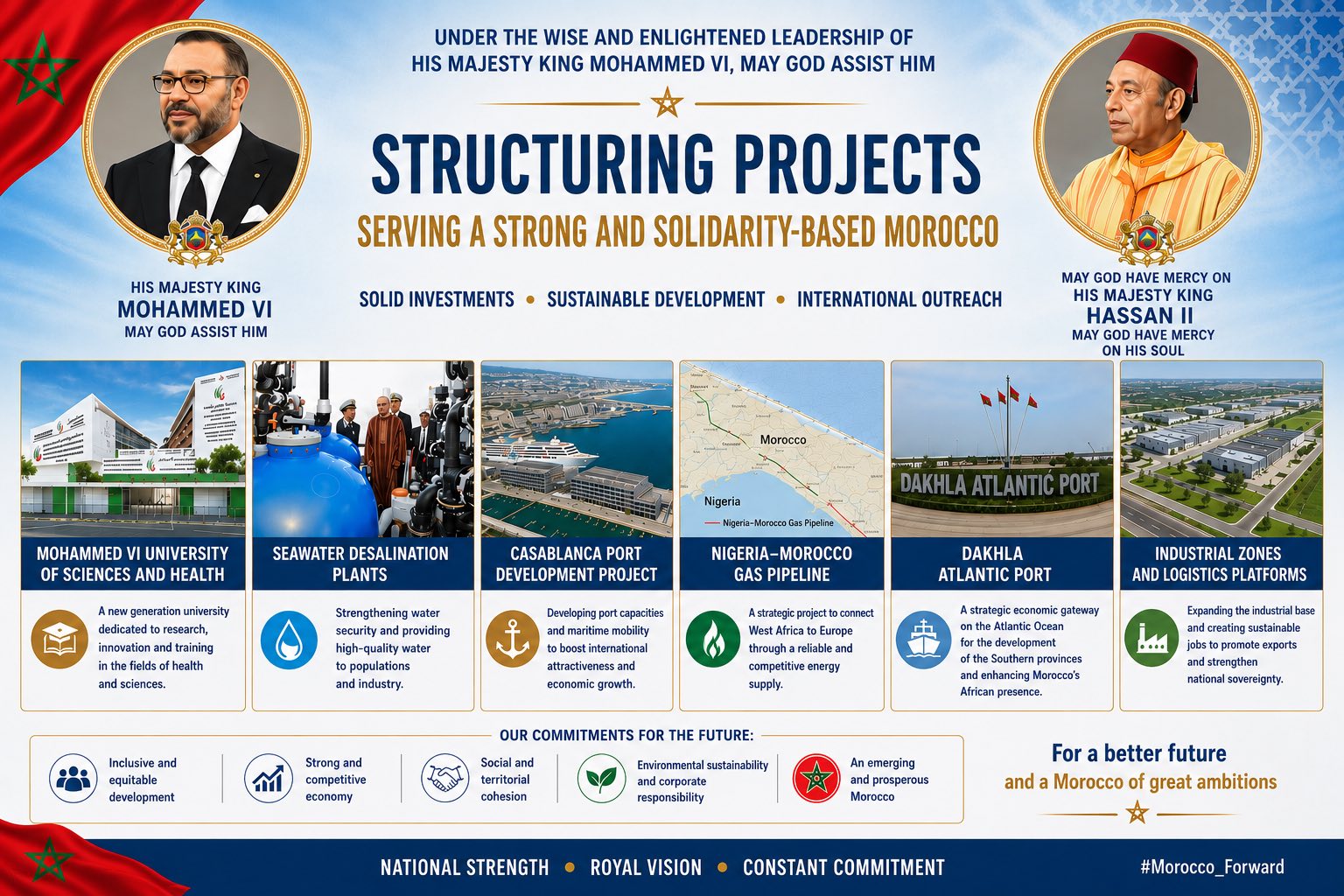
Under the reign of His Majesty King Mohammed VI, this transformation has taken on a new dimension through an approach based on infrastructure development, improved connectivity, resource valorization and enhanced investment attractiveness. The New Development Model for the Southern Provinces, launched in 2015, marked a major milestone, with an initial allocation of MAD 77 billion aimed at strengthening infrastructure and productive capacities in these territories. This vision has gradually helped transform Dakhla from a developing regional center into a territory increasingly positioned to play a greater economic role at both national and African levels.
The construction of the Tiznit-Dakhla Expressway is one of the key projects underpinning this new economic geography. By improving Dakhla’s connectivity with the rest of the Kingdom, it helps reduce the constraints associated with geographical distance and facilitates the movement of people, goods and investment. It also strengthens Oued Eddahab’s integration into national logistics chains while preparing the region for greater access to African markets.
The Dakhla Atlantic Port represents an even more strategic step. Its role goes beyond maritime activities: it is designed as a major economic development platform combining transport, logistics, trade, fisheries, industry and exports. Its importance lies in strengthening the competitiveness of companies operating in the region, facilitating access to industrial inputs and increasing the capacity to export processed products. Dakhla can therefore gradually become a platform connecting Morocco with West Africa and Atlantic markets.
Water is another fundamental condition for this transformation. In a territory characterized by an arid climate, seawater desalination projects have major strategic importance. They are intended not only to secure water supplies for local populations, but also to create the conditions required for agricultural and industrial development. Greater control over water resources can therefore help unlock new investment in high-value-added activities.
The development strategy has also focused on fisheries, agriculture and renewable energy. The region’s rich marine resources offer significant potential for seafood processing, freezing, canning, packaging and aquaculture. Meanwhile, greenhouse agriculture demonstrates that high-value-added production can be developed in a desert environment through technology, irrigation and efficient water management.
Oued Eddahab also has exceptional energy potential. High levels of solar radiation, strong wind resources and its Atlantic location create favorable conditions for renewable energy development. These advantages could enable the region to participate in emerging green industry value chains, particularly renewable electricity, green hydrogen and related industrial activities.
A Territory with Strong Industrial Potential
The key challenge now is to move from a resource-based economy to a value-added industrial economy. Oued Eddahab has raw materials, land, energy resources, a maritime coastline, developing infrastructure and a strategic geographical position. The challenge is to transform these advantages into integrated value chains.
In fisheries, this means moving beyond simply landing and marketing products towards processing, packaging, preservation, logistics and exports. In agriculture, it means moving from production towards agro-industry, packaging, conservation and international marketing. In energy, the objective could be to transform renewable electricity into new industrial and technological activities.
This is precisely where the next phase of Dakhla-Oued Eddahab’s development lies: producing, processing and exporting. Infrastructure is not an end in itself; it must serve as a foundation for attracting private investment, accelerating industrialization, promoting innovation and creating skilled employment.
The region now brings together a combination of assets rarely found in a single territory: fisheries resources, agricultural potential, solar and wind energy, an Atlantic coastline, a strategic geographical position, new infrastructure, tourism potential and proximity to African markets. This combination gives Oued Eddahab an economic value that goes well beyond its demographic weight.
Since 1979, the transformation has been considerable. But the real ambition now is to move into a new phase: turning resources into industries, infrastructure into economic platforms, and geographical position into a commercial advantage. With Dakhla as an economic gateway, Oued Eddahab has the potential to become one of Morocco’s most strategic territories for industry, logistics, energy and trade with Africa.
The challenge for the coming years will be to ensure that this momentum generates increasing local value added, skilled employment, industrial companies and exports. Only then can the economic development initiated several decades ago fully translate into genuine productive and industrial strength at the regional level.