



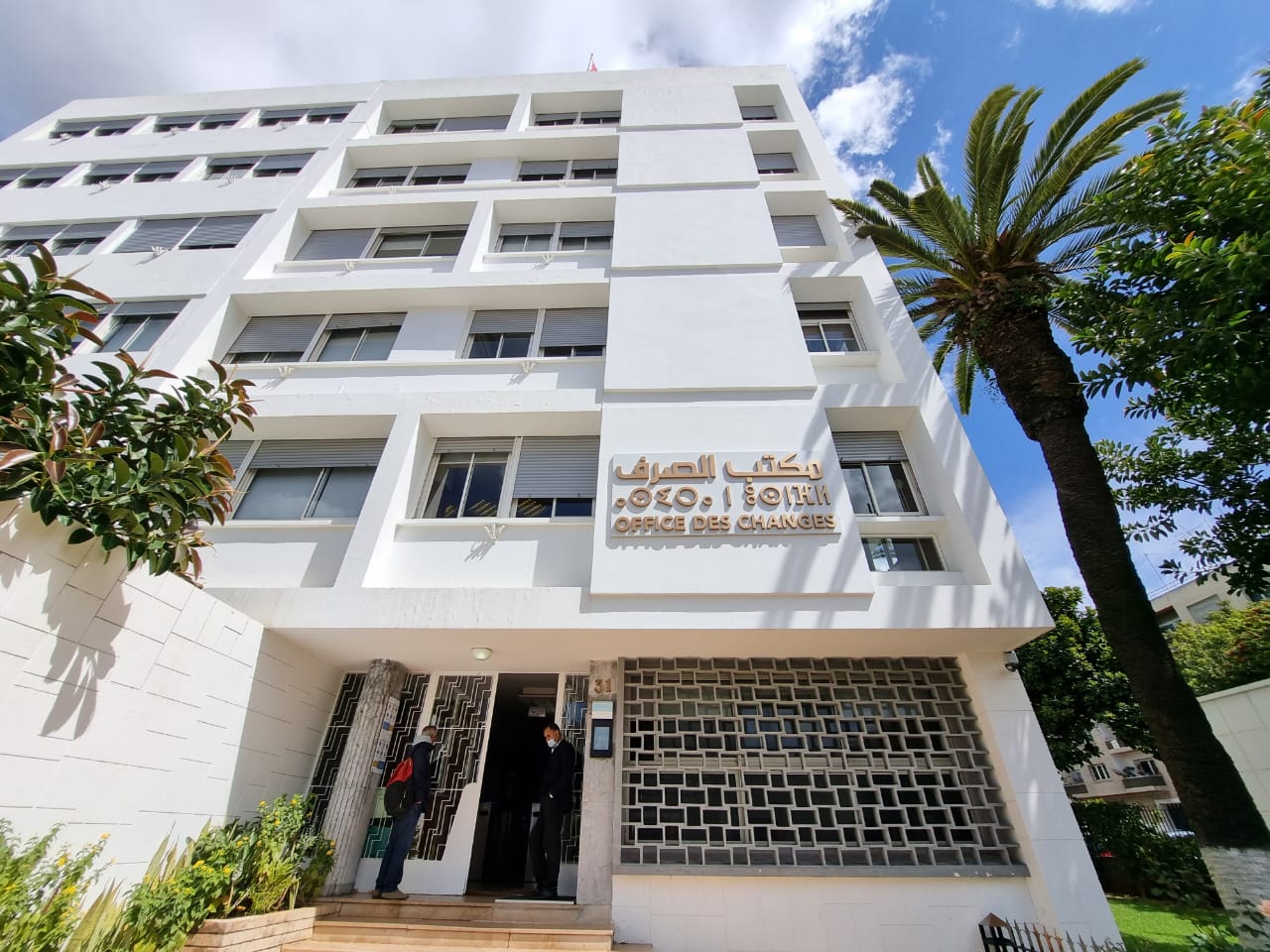

Morocco’s Exchange Office is strengthening the supervisory framework applicable to offshore holding companies operating in the Kingdom. Through a new circular, the institution is reinforcing vigilance, internal control and compliance requirements, placing the identification of beneficial owners, the traceability of funds and the monitoring of high-risk transactions at the heart of the new framework. The move marks another step in the modernization of financial supervision in Morocco.
The tightening of oversight of offshore holdings is part of a broader evolution of Morocco’s framework for combating money laundering and terrorist financing. Offshore holding companies have for several years been among the entities subject to the obligations established under Moroccan legislation on vigilance and control. Law No. 43-05 notably requires them to identify customers and beneficial owners, understand business relationships, monitor transactions and report suspicious operations.
The new circular further clarifies and strengthens the requirements applicable to these structures. Its approach is based on a principle that has become central to international compliance standards: the level of control must be proportionate to the level of risk. In practice, offshore holdings will not necessarily be required to apply identical procedures. The size of the company, the nature of its activities, its organization, its customer profile and its exposure to different risks must all be taken into account when assessing and managing compliance requirements.
This risk-based approach is one of the pillars of Morocco’s anti-money-laundering framework. Existing legislation already requires regulated entities to establish internal control policies, vigilance measures and detection mechanisms adapted to the nature and scale of their activities. They must also identify, assess and regularly document their risks and introduce enhanced measures whenever those risks are considered high.
Beneficial ownership at the heart of the new controls
One of the key issues concerns the identification of the beneficial owner. In holding structures, where ownership chains may involve several entities and jurisdictions, identifying only the legal entity or its representative is no longer sufficient.
The framework therefore requires institutions to identify the natural persons who ultimately own or control the structure. This requirement is designed to improve shareholder transparency and prevent complex legal arrangements from being used to conceal the true owners of assets or capital.
The companies concerned must also maintain sufficiently detailed information on their customers, partners and business relationships. Moroccan regulations already require verification of identity, legal form, business activity, address, capital, management and the authority of individuals representing legal entities.
Greater scrutiny of financial flows
The second major pillar concerns capital movements. Offshore holdings operate by nature in an international environment and may manage investments, equity stakes and cross-border financial flows. The traceability of these transactions therefore becomes a central element of the control framework.
Vigilance focuses in particular on the origin and destination of funds, as well as on the consistency of transactions with the profile, activities and risk level of the business relationship. Moroccan legislation already requires regulated entities to establish the origin and destination of funds and to verify that transactions are consistent with the information available about their customers.
Particular attention must also be given to unusual, complex or high-risk transactions. The objective is not to prevent legitimate international transactions, but to enable companies to identify transactions requiring closer examination and, where legal conditions are met, to report them to the competent authorities.
Compliance becomes a core governance function
Another important development is the growing importance of the compliance function within offshore holding governance. Appointing a person responsible for overseeing the compliance framework provides clear internal accountability and ensures continuous monitoring of procedures.
This function should not be reduced to an administrative formality. It involves establishing procedures, maintaining and updating information, monitoring transactions, escalating alerts and regularly informing management about high-risk business relationships.
Moroccan regulations require regulated entities to establish internal systems for vigilance, detection, monitoring and management of money-laundering risks. Relevant officers are also expected to centralize information relating to unusual or complex transactions and keep management regularly informed about transactions involving customers presenting a high-risk profile.
A broader regulatory shift
Beyond the operational requirements, the measures introduced by the Exchange Office reflect a deeper transformation of Morocco’s regulatory approach: a shift from controls focused primarily on individual transactions toward supervision increasingly based on risk, knowledge of market participants and the quality of internal control systems.
This approach is consistent with the Exchange Office’s 2025–2029 strategy, which identifies intelligent supervision, regulatory innovation, digital transformation and improved governance among its key priorities.
The new framework also comes as the Exchange Office is modernizing its wider foreign-exchange regulatory architecture. The 2026 General Instruction on Foreign Exchange Operations, published in June 2026, aims in particular to make regulations clearer and more accessible while supporting investment, exports and the modernization of foreign-exchange operations.
For offshore holdings, this evolution means that compliance can no longer be viewed as a secondary administrative requirement. It is becoming a genuine governance and risk-management tool.
Preserving attractiveness while strengthening credibility
Morocco’s challenge is now to preserve the attractiveness of its offshore regime while ensuring a high level of transparency and financial security. The offshore holding-company regime continues to serve a specific purpose within Morocco’s financial environment, particularly for portfolio management and investments in non-resident companies.
The legal framework notably provides for such companies to engage in portfolio management and equity participation, with capital denominated in convertible foreign currencies and transactions carried out in those currencies. Companies must also notify the Exchange Office of their establishment under the conditions set by the applicable regulations.
Strengthening supervision therefore does not necessarily mean introducing restrictions designed to slow down activity. Rather, it reflects an effort to create an environment in which offshore structures can continue to play their role while meeting higher standards of transparency, traceability and compliance.
With this new framework, Morocco’s Exchange Office is sending a clear message: financial openness and the facilitation of international transactions must go hand in hand with thorough knowledge of market participants, stronger capital traceability and sound governance.
For offshore holdings, the requirements are now very concrete: maintain an up-to-date risk map, accurately identify beneficial owners, document the origin and destination of funds, monitor unusual transactions and professionalize the compliance function.
For Morocco, the move contributes more broadly to building a more transparent, credible and internationally aligned financial ecosystem, while preserving the international vocation of its offshore financial centers.