



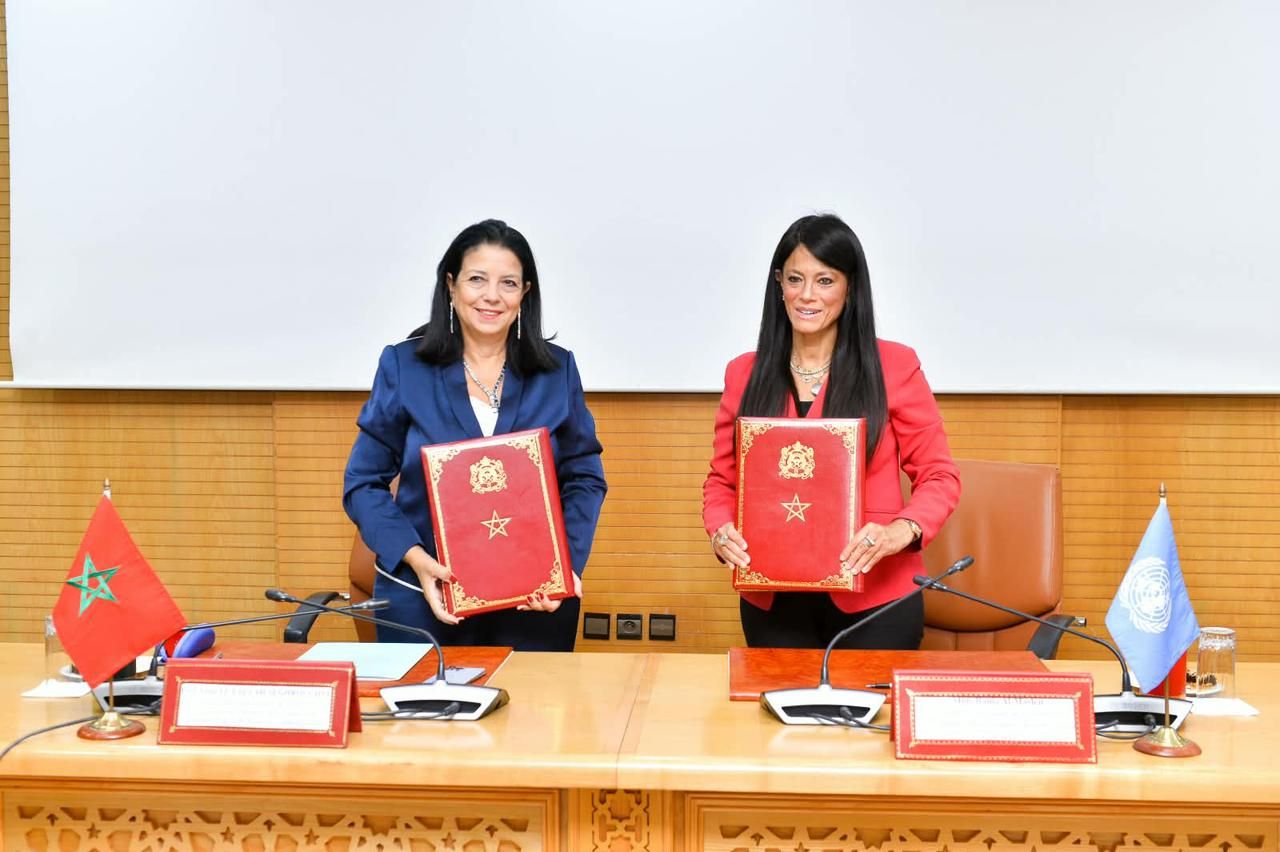
A Memorandum of Understanding (MoU) was signed on Wednesday in Rabat between Morocco’s Ministry of Digital Transition and Administrative Reform and the United Nations Economic and Social Commission for Western Asia (ESCWA), with the aim of strengthening cooperation in digital transformation, public administration modernization, governance, artificial intelligence (AI) and innovation.
The MoU was signed by Minister Delegate in charge of Digital Transition and Administrative Reform, Amal El Fallah Seghrouchni, and Executive Secretary of ESCWA and UN Under-Secretary-General, Rania Al-Mashat.
The new agreement aims to establish an institutional and operational framework to support Morocco’s efforts to modernize public administration and accelerate its digital transformation. It also seeks to improve the quality of public services, enhance their efficiency and effectiveness, and strengthen administrative governance.
Speaking on the occasion, Amal El Fallah Seghrouchni stressed that the signing of this cooperation framework reflects a shared determination to elevate relations between Morocco and ESCWA to a more advanced institutional and operational level.
She said the cooperation will help turn exchanges of expertise and perspectives into concrete programs and initiatives, while building on the accumulated experience of both sides.
The minister noted that the initiative forms part of the major reforms undertaken by Morocco and reflects a clear political commitment to accelerating administrative reform. She emphasized the complementarity between digital transition and administrative reform, which she described as two inseparable levers for reshaping the administrative model.
The approach aims in particular to improve the quality of public services, strengthen the effectiveness of administrative action, and bring public administration closer to citizens and businesses.
Since May 2025, the ministry has been working on a roadmap for administrative transformation for 2026-2030. The roadmap seeks to establish a modern, agile and efficient administrative model capable of anticipating and responding to the rapid changes affecting society, the economy and technology.
For her part, Rania Al-Mashat highlighted the importance of the MoU in strengthening cooperation and the exchange of expertise between ESCWA and Morocco. She particularly emphasized the value of drawing on Morocco’s experience in administrative reform and digital transformation, while promoting the sharing of best practices.
The UN official also stressed the importance of strengthening South-South cooperation and sharing experiences among countries in order to contribute to the modernization of public administration, support digital and technological transformations, and help build more efficient and effective administrations that are better able to meet citizens’ expectations.
According to the ministry, the MoU provides a new platform for cooperation with ESCWA in several priority areas, including digitalization, innovation, artificial intelligence, the simplification of procedures, skills development and improving the user experience.
The cooperation framework also provides for the exchange of expertise, knowledge and best practices in governance, public administration, digital transformation and innovation. Both sides intend to build on their respective experiences to develop approaches and solutions adapted to the rapid changes affecting public administration.
The signing of the agreement comes as part of the ongoing cooperation between Morocco and ESCWA, notably marked by the organization in Rabat, on June 30 and July 1, 2026, of the 3rd Arab Public Administration Forum.
Organized jointly by the ministry and ESCWA under the theme “Innovation in Governance for a Future-Ready Public Administration,” the forum culminated in the adoption of the “Rabat Declaration.”
The declaration established a shared vision for the future of public administration in the Arab world, based on more efficient, agile and forward-looking administrations centered on citizens and users and capable of responding to economic, social and technological transformations.
It notably emphasized that digital transformation and administrative reform are complementary and inseparable processes. Modernizing public administration should therefore not be limited to digitizing services, but should also involve redesigning user journeys, simplifying procedures, evolving governance models and strengthening interoperability.
The “Rabat Declaration” also identified 14 key orientations, focusing in particular on improving the quality of public services, reducing administrative burdens, accelerating secure and inclusive digital transformation, promoting the responsible adoption of AI and emerging technologies, developing human resources’ skills, and strengthening transparency, accountability and trust in public administration.