
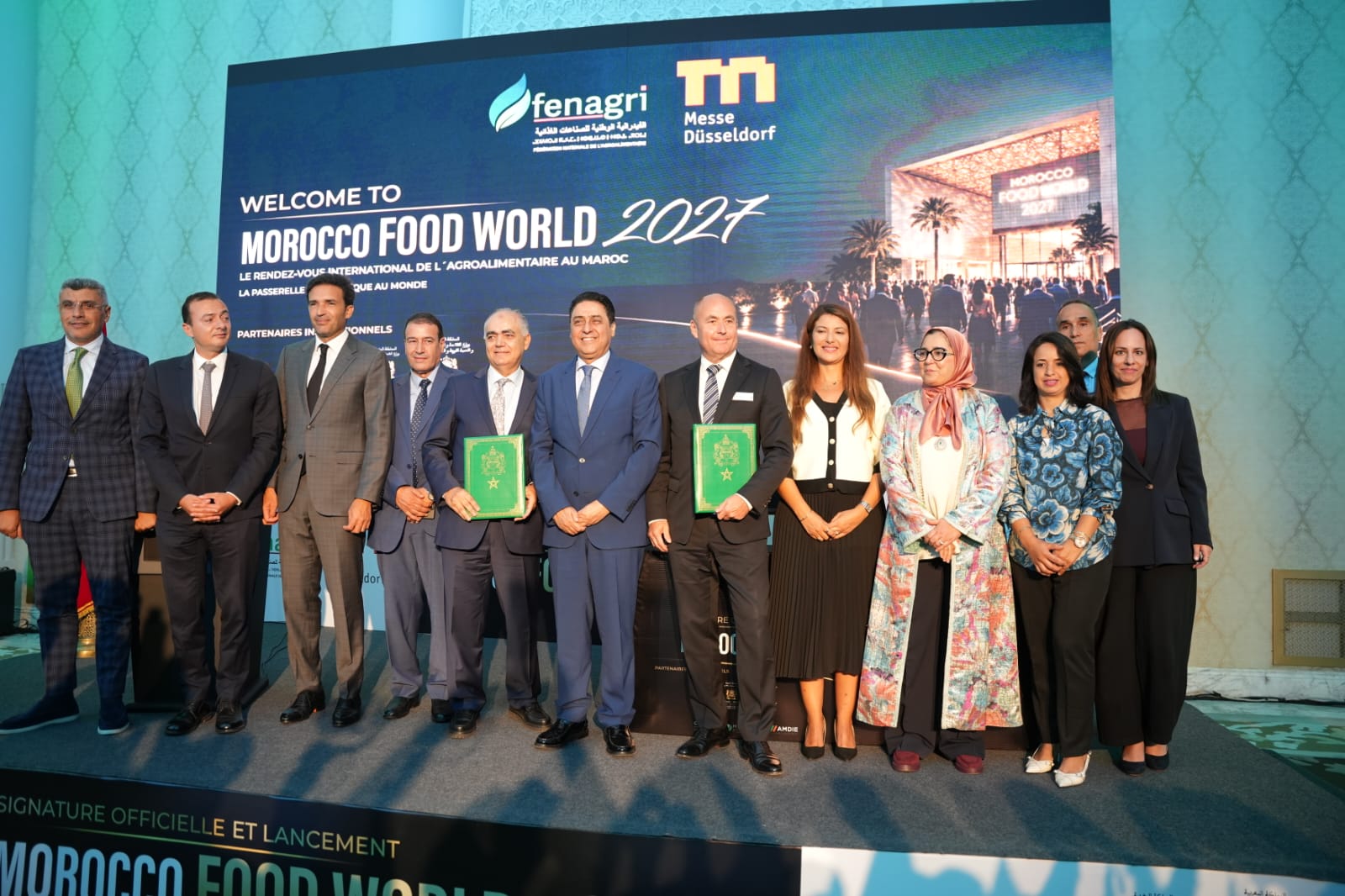
Over the past decade, Morocco has profoundly transformed its productive system. Industry, whose turnover reached nearly MAD 898 billion in 2024, the agri-food sector, whose production exceeded MAD 181 billion, and agri-food exports, which reached MAD 86.2 billion in 2025, illustrate a major change in scale. The launch of Morocco Food World by FENAGRI and Messe Düsseldorf is part of this momentum: producing more in Morocco, increasing local processing and conquering new markets.
The partnership signed in Rabat between the National Federation of Agri-Food Industries (FENAGRI) and Messe Düsseldorf is not simply the launch of a new trade fair. It comes at a time when Morocco is consolidating its productive sovereignty and seeking to strengthen its position within global industrial and trade value chains.
Scheduled for the second half of 2027, Morocco Food World aims to connect Morocco’s agri-food industry with international markets, investors, technologies and major buyers. The event is therefore part of a broader industrial strategy focused on increasing local value creation and strengthening Morocco’s international competitiveness.
The conference, attended by Abdelmounim El Eulj, Omar Hjira, Mehdi Tazi, Ghita El Ghorfi and Bernd Jablonowski, highlighted a common priority: enabling Moroccan industry to enter a new stage of value creation.
In 2024, Moroccan industry generated approximately MAD 897.8 billion in turnover, compared with around MAD 822 billion a year earlier. Industrial production reached nearly MAD 842 billion, while industrial investment increased by around 30% to approximately MAD 90 billion. Industrial employment exceeded one million jobs.
Within this ecosystem, agri-food occupies a particularly strategic position. In 2024, the sector accounted for approximately 21% of industrial turnover and 22% of industrial production. Production reached MAD 181.6 billion, turnover MAD 190.9 billion and value added MAD 53.9 billion, while employment exceeded 209,000 jobs.
At the same time, medium- and high-technology activities now account for more than half of industrial value added, while average productivity per job has increased by around 30% over the past decade.
Producing more, but above all creating more value
For Abdelmounim El Eulj, Morocco Food World must contribute to the national and international visibility of Moroccan industry. The objective is no longer simply to showcase products, but to connect companies with markets, technologies, investors and international buyers.
The figures demonstrate the sector’s growing export capacity. Agri-food exports reached MAD 86.2 billion in 2025, compared with approximately MAD 62 billion in 2020, representing an increase of around 38% in five years. The sector now accounts for approximately 18% of Morocco’s national exports and represents a major source of foreign currency.
The real challenge, however, is to export more value rather than simply more volume. This requires increasing the share of processed products, strengthening Moroccan brands, improving quality and traceability, investing in innovation and packaging, expanding certification and developing greater product differentiation.
Ghita El Ghorfi emphasized Morocco’s strong international presence in seafood, fruit and vegetables and processed food products. Morocco is the world’s leading exporter of canned sardines, but the next challenge is to support a larger number of companies, particularly first-time exporters.
Omar Hjira also stressed the importance of market diversification. The United States, Canada, Nigeria, Ghana and Angola are among the priority destinations, while markets such as India and Indonesia offer new opportunities.
Geographical diversification is itself an element of productive sovereignty. A strong industrial base must not only be able to produce in Morocco; it must also be capable of accessing several international markets.
For Mehdi Tazi, productive sovereignty means strengthening national production, infrastructure and supply security, while controlling energy costs and creating the conditions necessary for Moroccan SMEs and mid-sized companies to scale up.
Sustainable productive sovereignty cannot depend solely on large corporations. It requires a strong ecosystem of SMEs and mid-sized companies capable of investing, innovating, subcontracting, producing locally and exporting.
The Industrial Sovereignty Task Force has identified more than 1,000 projects representing potential investments of over MAD 46 billion, aimed at supporting import substitution and export development.
In the agri-food sector, food sovereignty is not limited to the availability of raw materials. It also involves processing, preservation, packaging, logistics, marketing and the ability to retain a larger share of value within the country.
Agri-food therefore sits at the intersection of agriculture, industry, logistics, energy, trade and investment, making it one of the strategic pillars of Morocco’s productive sovereignty.
Messe Düsseldorf adds an international dimension
The partnership with Messe Düsseldorf provides Morocco Food World with a powerful international dimension. Its global network can connect Moroccan producers with international buyers, investors and technology suppliers while facilitating access to new markets.
The exhibition is therefore expected to function as a platform for business, investment, technology transfer, market intelligence and commercial expansion.
Its success should not be judged solely by the number of exhibitors or visitors. The key indicators will be contracts signed, investments attracted, industrial partnerships established, new exporters created, additional value generated in Morocco and stronger integration of domestic value chains.
Over the past decade, Morocco has moved from a phase of accelerated industrialization towards the consolidation of its productive capabilities. With an industrial turnover approaching MAD 900 billion, agri-food production exceeding MAD 181 billion and agri-food exports surpassing MAD 86 billion, the country has clearly changed scale.
The next challenge is to transform this industrial momentum into sustainable productive sovereignty.
Morocco Food World embodies this ambition. The objective is not only to produce more, but to process more locally, innovate more, gain greater control over value chains and export more value-added products.
By the second half of 2027, the exhibition will have the opportunity to demonstrate that Made in Morocco is more than a statement of origin. It is increasingly becoming a marker of industrial capacity, quality, competitiveness and productive sovereignty.