

Morocco is entering a new phase in its digital transformation. Through the national event “AI Made in Morocco,” the Kingdom presented the latest developments in its “Morocco AI 2030” roadmap, with a clear ambition: to make artificial intelligence a driver of economic growth, public-service modernization, skills development and technological sovereignty.
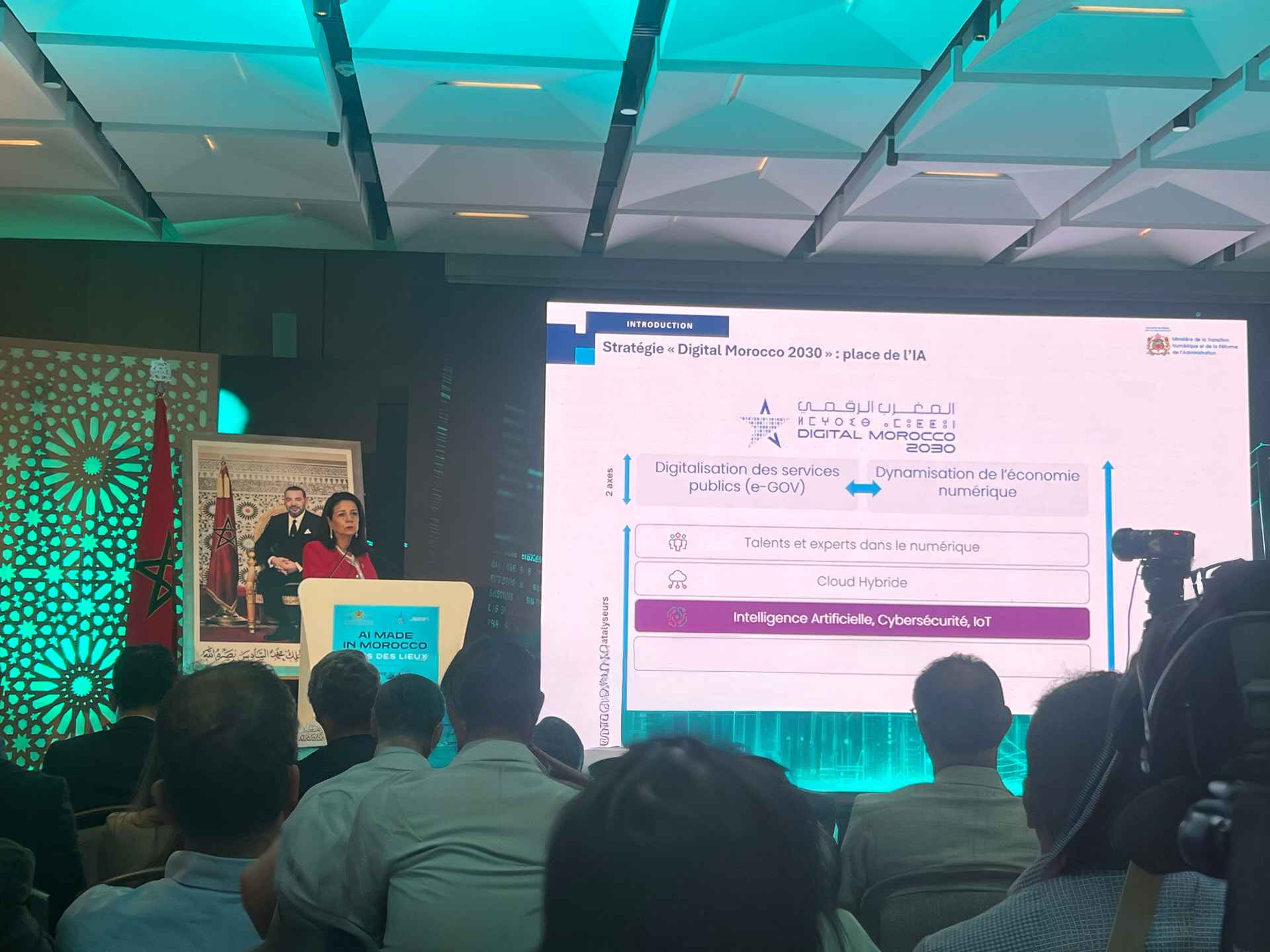
The event, chaired by Amal El Fallah Seghrouchni, Minister Delegate in charge of Digital Transition and Administrative Reform, highlighted the main components of Morocco’s national AI strategy, as well as several concrete initiatives designed to build a strong national artificial intelligence ecosystem.
At the center of the discussions were Digital Morocco 2030, the Morocco AI 2030 roadmap, talent development, digital infrastructure, research and innovation, AI-powered public services and the broader issue of digital sovereignty.
Artificial Intelligence at the Heart of Digital Morocco 2030
The Digital Morocco 2030 strategy is one of the Kingdom’s main frameworks for digital transformation. It is built around two major priorities: the digitalization of public services and the development of the digital economy.
Within this vision, artificial intelligence occupies a strategic position alongside other technologies considered essential to the country’s transformation. Digital infrastructure, hybrid cloud, widespread connectivity, cybersecurity, the Internet of Things, as well as the development of digital talent and expertise, are among the key levers supporting this transformation.
The objective is to make digital technology a genuine tool for modernizing public administration, improving services for citizens and strengthening the competitiveness of the national economy.
Artificial intelligence is now reinforcing this strategy by providing new capabilities for automation, data analysis and personalized support for citizens and businesses.
Morocco AI 2030: From Ambition to a Structured Strategy
With “Morocco AI 2030,” the Kingdom aims to accelerate its development specifically in the field of artificial intelligence.
The roadmap is not limited to promoting the use of existing technologies. It also seeks to create the conditions necessary for Morocco to develop its own skills, infrastructure, research capabilities and AI solutions.
The ambition is therefore to build a national ecosystem capable of addressing Morocco’s needs while strengthening the country’s position in a sector that has become strategic for global economic and technological competitiveness.
The roadmap is structured around three major pillars.
The first focuses on the foundations of sovereignty and trust, with the aim of strengthening national capabilities, security, digital infrastructure and confidence in AI technologies.
The second is built around innovation and competitiveness, with particular emphasis on research, talent, innovation and the ability of Moroccan companies to develop AI-based solutions.
The third focuses on impact, adoption and international reach, with the objective of making AI a practical tool for public administrations, businesses, citizens and different regions of the Kingdom.
These priorities are translated into ten major programs designed to give the national AI strategy an operational dimension.
100 Billion Dirhams in Added Value and 50,000 Jobs Targeted
One of the key elements of Morocco AI 2030 is the economic targets set for 2030.
Morocco aims to generate 100 billion dirhams in added value for GDP through the development of artificial intelligence.
The strategy also targets the creation of 50,000 direct and indirect jobs, as AI is expected to transform an increasing number of professions and economic sectors.
These objectives demonstrate Morocco’s intention to view artificial intelligence not only as a strategic technology, but also as a new engine of growth, investment and high-skilled employment.
The challenge will be to encourage the emergence of new technology companies, strengthen Moroccan startups and enable national players to develop solutions that meet local needs and, eventually, can be exported to international markets.
200,000 Talents to Be Trained and Certified
Skills development is another major pillar of this ambition.
The growth of artificial intelligence requires specialized profiles in areas such as data, machine learning, cloud computing, cybersecurity, software engineering and digital infrastructure.
In this context, Morocco AI 2030 aims to train and certify 200,000 talents by 2030.
The strategy also seeks to act at an earlier stage of the education system, with the ambition of progressively introducing young people to artificial intelligence from childhood.
The objective is to build, over the long term, a national pool of skills capable of supporting the needs of public administrations, companies, universities and research centers.
The goal is therefore not simply to import the expertise required for digital transformation, but to progressively build a Moroccan talent base capable of designing, developing, deploying and mastering artificial intelligence technologies.
JAZARI Institutes to Develop Skills and Innovation
As part of this talent-development strategy, the “AI Made in Morocco” event featured the launch of JAZARI ROOT, presented as the founding core of the Al Jazari Institutes.
The initiative is designed to contribute to the creation of a national network of centers of excellence dedicated to training, research and innovation in artificial intelligence.
The JAZARI Institutes network is expected to include four components: JAZARI ROOT, JAZARI Smart City, JAZARI EduTech and JAZARI Industrie X.0.
This structure covers several dimensions of artificial intelligence, from education and research to smart cities, education technology and industrial applications.
The objective is to bring together universities, researchers, businesses, public administrations and young talents in order to create stronger synergies around AI.
Building Sovereign Digital Infrastructure
Technological sovereignty is also a central pillar of Morocco AI 2030.
As artificial intelligence relies on massive amounts of data, significant computing power and advanced digital infrastructure, control over these resources has become a strategic issue.
Morocco therefore aims to strengthen its capabilities in areas such as hybrid cloud, computing infrastructure, connectivity, cybersecurity and data management.
The objective is not to isolate Morocco from international technologies, but rather to ensure that the Kingdom has sufficient national capabilities to choose, secure, adapt and master the technologies it needs for its development.
This approach is particularly important in a global environment characterized by growing competition around data, cloud infrastructure, AI models, semiconductors and computing capacity.
A Sovereign AI Marketplace
Among the initiatives presented is the creation of a Sovereign Artificial Intelligence Marketplace.
The platform is intended to help structure access to AI solutions and encourage their adoption across different sectors.
It forms part of a broader effort to create a trusted environment where public administrations and economic players can access AI solutions that meet requirements related to security, data protection and digital sovereignty.
The Marketplace could also provide greater visibility to solutions developed by Moroccan companies and ecosystem players.
Idarati AI: Artificial Intelligence at the Service of Citizens
Morocco AI 2030 also aims to deliver concrete applications for citizens.
Among the initiatives presented is Idarati AI, an assistant based on agentic artificial intelligence designed to support citizens in their administrative procedures.
The objective is to provide information, guide users and assist them in their interactions with public administration.
This initiative illustrates the evolution of Morocco’s digital strategy: after developing digital platforms and services, the Kingdom is now seeking to integrate artificial intelligence to make these services simpler, more accessible and more personalized.
AI is therefore gradually becoming an interface between citizens and public administration.
Towards a National Meta-Application and E-Wallet
The event also presented a Proof of Concept (POC) for a national meta-application and e-wallet.
These projects are part of a broader effort to simplify and integrate digital services.
The objective is to bring different services together within a more integrated digital environment, reducing the complexity of administrative procedures and facilitating interactions between citizens and public institutions.
This approach reflects one of the major ambitions of Digital Morocco 2030: moving from multiple independent digital services towards a more integrated, interoperable and user-centered experience.
AI Adapted to Moroccan Realities
Another challenge of the national strategy is to develop artificial intelligence capable of addressing Morocco’s specific needs.
This includes the requirements of public administration, the country’s economic and social realities, as well as the languages used by its citizens.
Developing solutions adapted to Arabic and Moroccan Darija, as well as to the different sectors of the Moroccan economy, could provide a significant strategic advantage.
The ability to develop models and applications that reflect Morocco’s linguistic and cultural realities would allow the country to reduce its dependence on solutions designed primarily for other markets.
This dimension is directly connected to the ambition of building truly “Made in Morocco” artificial intelligence.
Research, Innovation and Financing
The success of this strategy will also depend on Morocco’s ability to strengthen its national research and innovation system.
Universities, research centers, technology companies and startups need to work more closely together to transform scientific knowledge into products and services.
Financing will also be critical. Developing AI models, computing infrastructure and new technology companies requires significant investment.
Morocco AI 2030 therefore seeks to create an environment conducive to innovation and attract greater investment in strategic technologies.
International cooperation will continue to play an important role. Digital sovereignty does not mean isolation; rather, it means that Morocco can build international partnerships while strengthening its own capabilities.
“Towards Digital Sovereignty – 70 Years Later, 1956–2026”
Another highlight of the “AI Made in Morocco” event was the presentation of the book “Towards Digital Sovereignty – 70 Years Later, 1956–2026.”
Presented during the event by Minister Amal El Fallah Seghrouchni, the book adds a historical and strategic dimension to the debate surrounding Morocco’s digital future.
Its title refers to the seven decades separating Morocco’s independence in 1956 from 2026, while drawing a parallel between national sovereignty and the new challenges created by digital transformation.
The concept of sovereignty has taken on a new dimension.
It is no longer limited to territories, institutions or the economy. It also encompasses a country’s ability to control its data, digital infrastructure, information systems, skills, cloud environment and strategic technologies.
In this context, artificial intelligence has become a central component of digital sovereignty.
From National Sovereignty to Technological Sovereignty
The development of a national digital industry does not necessarily mean turning away from the rest of the world.
For Morocco, the challenge is rather to strengthen its ability to choose, develop, master and secure the technologies it needs.
This approach would allow the Kingdom to continue working with international partners while reducing excessive dependence in strategic areas.
Control over data, computing infrastructure, cloud services and expertise is therefore becoming an essential element of this sovereignty.
Artificial intelligence fits directly into this logic, as it depends on all of these resources.
Building a Genuine Moroccan AI Ecosystem
The ambition behind Morocco AI 2030 goes beyond the public administration.
The objective is to bring together the government, businesses, startups, universities, researchers and talents in order to create a coherent national ecosystem.
Morocco already has a growing digital and technology services base. The new strategy now seeks to move this ecosystem towards higher-value technologies.
The goal is to progressively move the Kingdom from being a technology consumer to becoming a producer of AI solutions and expertise.
This transformation could affect public services as well as industry, finance, healthcare, education, agriculture, smart cities and business services.
AI as a Tool for Modernizing Public Administration
One of the areas where Morocco could quickly see the impact of this strategy is public services.
Artificial intelligence can help improve access to information, automate certain procedures, analyze large volumes of data and support public-sector employees in their work.
Initiatives such as Idarati AI show that this transformation is already beginning to translate into applications directly designed for citizens.
However, the challenge will be to ensure that the development of these technologies respects principles of security, data protection, transparency and user trust.
Digital sovereignty therefore does not simply mean owning technologies. It also means creating a framework that enables their responsible use.
A Strategy That Must Now Scale Up
With Morocco AI 2030, the Kingdom now has a structured framework for the development of artificial intelligence over the coming years. The strategy is entering a new phase: turning the roadmap into concrete and sustainable results.
The success of this strategy will depend on the ability of different stakeholders to coordinate their efforts and ensure the continuity of the projects already launched. Talent development will need to accelerate, infrastructure will have to keep pace with growing demand for computing and data, while companies and public administrations will gradually need to integrate AI into their activities.
Governance will also be critical. The development of artificial intelligence requires a framework capable of balancing innovation, security, data protection, ethics and public trust.
Scaling up will ultimately require stronger links between research, education, business and government. The ability to transform skills and infrastructure into solutions that are actually used will be one of the key measures of Morocco AI 2030’s impact.
The roadmap is therefore a starting point. Its success will be measured not only by the number of initiatives announced, but by their ability to deliver services, companies, jobs and technologies that meet Morocco’s needs in the years ahead.
Morocco Wants to Build Its Own AI Model
Through “AI Made in Morocco,” the Kingdom is expressing an ambition that goes beyond simply adopting artificial intelligence.
The objective is to progressively build a Moroccan AI model, based on national infrastructure, local expertise, stronger research capabilities, innovative companies and solutions adapted to citizens’ needs.
Digital Morocco 2030 provides the broader framework for the country’s digital transformation, while Morocco AI 2030 gives artificial intelligence a dedicated strategic dimension.
Talent development, the creation of the JAZARI Institutes, infrastructure, the Sovereign AI Marketplace, Idarati AI, integrated digital-service projects and the broader reflection on digital sovereignty all contribute to the same ambition.
That ambition is to make Morocco not only a country that uses artificial intelligence, but one capable of developing the skills, infrastructure, applications and, ultimately, technologies behind it.
By 2030, the challenge will therefore be both economic and strategic. In a world where data, algorithms, computing power and digital infrastructure are becoming essential assets, the ability to master these resources is emerging as a new dimension of national power.
Morocco intends to provide its own response to this transformation: building “Made in Morocco” artificial intelligence, developing its talent base, strengthening its infrastructure, modernizing public administration and making digital technology a new pillar of the Kingdom’s sovereignty and development.