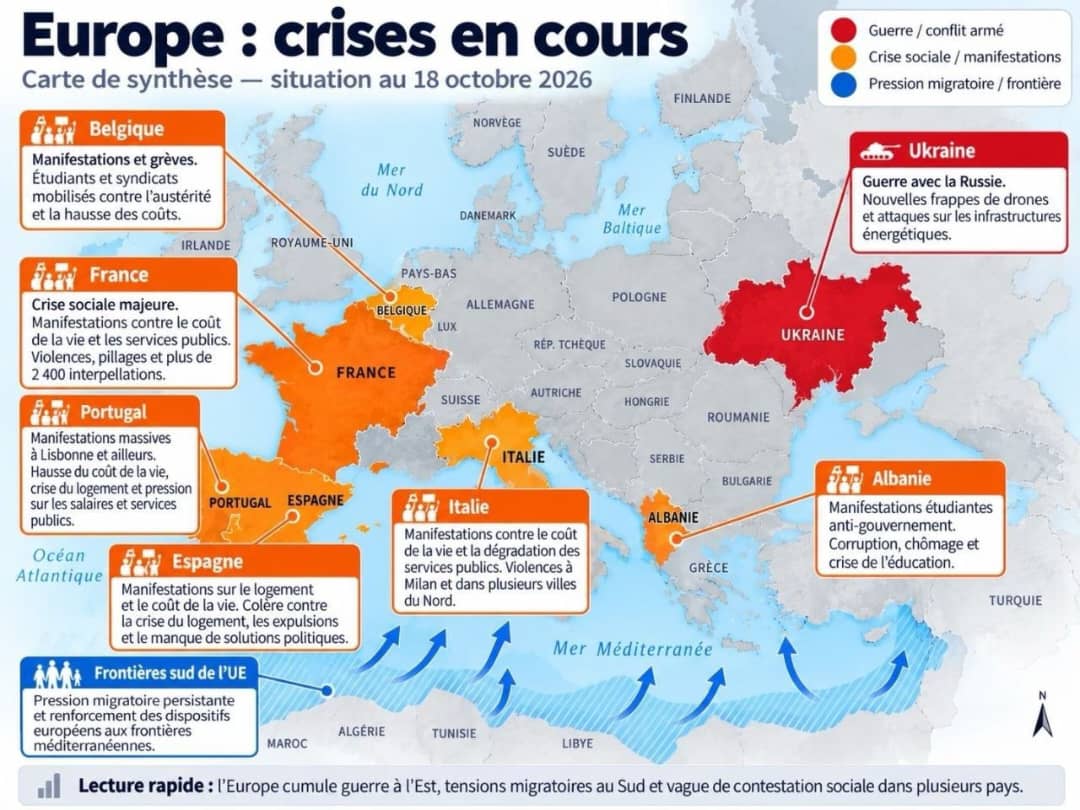

From France to Italy, Belgium to Portugal, and across Spain and Albania, social mobilizations reveal a deep-seated discontent extending far beyond wage demands. Weakened purchasing power, a worsening housing crisis, difficulties accessing education, fears of downward social mobility, and growing distrust of institutions are fueling protests that challenge European governments’ ability to preserve their social contract. Behind these demonstrations lies a fundamental economic and political question: can Europe sustain its model of prosperity and social protection without reconsidering wealth distribution, budgetary priorities, and the mechanisms of solidarity?
Europe is experiencing a period of social tension that exposes the contradictions within its development model. Long regarded as a region of institutional stability, economic prosperity, and social protection, the continent now faces an accumulation of public frustrations. Rising living costs, increasingly unaffordable housing, concerns about the quality of public services, and growing insecurity among young people have become major drivers of mobilization. Although national circumstances differ, they reflect a shared concern: the growing perception that employment income is no longer sufficient to guarantee stable living conditions.
This crisis cannot be reduced to a succession of demonstrations. It reflects a deeper transformation in the relationship between economic growth, wealth distribution, and social cohesion. Across several European economies, households have experienced the cumulative effects of energy inflation, higher food prices, rising rents, and increased borrowing costs. Even when inflation slows, prices do not necessarily return to their previous levels. This fundamental economic distinction explains why improving macroeconomic indicators can coexist with a persistent deterioration in people’s perception of their living standards.
France illustrates this contradiction particularly clearly. Demands concerning purchasing power, public services, working conditions, and territorial inequalities are rooted in a longstanding tradition of social protest. However, pressure on public finances complicates government decisions. Between controlling budget deficits, financing social protection, supporting productive investment, and responding to household expectations, policymakers must reconcile objectives that are difficult to achieve simultaneously in the short term. When austerity measures are perceived as unfairly distributed, they risk intensifying distrust rather than restoring confidence.
In Belgium, tensions surrounding education, public funding, and opportunities for young people also reflect the challenges facing European welfare systems. Higher education has traditionally served as a mechanism for upward social mobility. Yet when tuition-related expenses and housing costs rise faster than available resources, academic qualifications no longer necessarily guarantee satisfactory employment opportunities. This situation fuels generational anxiety among graduates who fear they may experience less favorable living conditions than their parents.
Italy faces structural vulnerabilities extending beyond short-term economic fluctuations. Regional disparities, difficulties integrating young people into the labor market, relatively low wages in certain sectors, and productivity gaps continue to fuel dissatisfaction. The contrast between economically dynamic metropolitan areas and territories with limited opportunities highlights the shortcomings of insufficiently inclusive growth. Italy’s challenge is to translate investment and competitiveness gains into sustained improvements in incomes and employment quality.
In Portugal, housing has become a central source of social tension. The international attractiveness of Lisbon and Porto, expanding tourism activities, strong property demand, and an insufficient supply of affordable housing have widened the gap between household incomes and residential property prices. The housing crisis is therefore becoming an economic competitiveness issue. When employees can no longer afford to live near their workplaces, businesses face greater recruitment difficulties, labor mobility declines, and territorial inequalities deepen.
In Spain, movements defending the right to housing highlight a similar contradiction. An economy may record growth in output and employment while part of its population continues to experience severe housing insecurity. Housing is no longer merely a social concern; it has become a determining factor in family stability, consumption, labor mobility, and institutional trust. When housing expenses absorb an excessive share of income, they directly reduce households’ ability to save, invest, and sustain domestic demand.
Albania presents a different situation, shaped by governance challenges, economic opportunities, and public confidence in institutions. Political and social protests must be examined in light of income disparities, youth aspirations, and expectations associated with European integration. They demonstrate that economic integration cannot be measured solely through market liberalization or foreign investment, but also through institutions’ ability to generate tangible opportunities for citizens.
Europe’s social contract tested by purchasing power and inequality
Beyond national differences, these tensions reveal a widening gap between overall economic performance and the living conditions experienced by citizens. Gross domestic product, investment indicators, and employment statistics remain essential for assessing economic health. However, they are insufficient to measure housing affordability, household financial security, the quality of public services, or opportunities for upward mobility. An economy can generate more wealth without its distribution being perceived as fair.
Housing has emerged as one of the most revealing indicators of this divide. In many European metropolitan areas, property prices have risen faster than disposable incomes over extended periods. This trend disproportionately affects young workers, low-income families, and the middle class. It also reinforces wealth concentration among homeowners compared with households that remain long-term tenants. Over time, this divergence risks transforming income inequalities into structural wealth inequalities, with lasting consequences for social cohesion and intergenerational opportunity.
Public finances constitute another major source of tension. European governments must simultaneously finance the energy transition, modernize infrastructure, strengthen defense capabilities, address population aging, and preserve healthcare and education systems. These priorities place growing pressure on national budgets. As fiscal room for maneuver narrows, policy choices become increasingly politically sensitive. Any perceived reduction in social benefits or public investment may be interpreted as a retreat from the historical commitments of the welfare state.
The transformation of the labor market adds another dimension. Digitalization, artificial intelligence, international competition, and industrial restructuring are redefining the skills demanded by businesses. While these developments offer opportunities for higher productivity, they also generate uncertainty about job security and wage growth. The risk is the emergence of a two-speed economy in which highly skilled workers benefit from technological progress while other occupational groups experience greater insecurity and wage stagnation.
Student mobilizations deserve particular attention in this context. They frequently express more than disagreement over university budgets. They question the implicit promise associated with educational investment: studying, acquiring skills, and working should provide a pathway to economic independence. When this prospect becomes increasingly uncertain, education loses part of its traditional role as a stabilizing force in society. The fear of downward mobility can then become a powerful driver of political protest.
The economic consequences of prolonged social unrest should not be underestimated. Transport disruptions, business interruptions, property damage, and political uncertainty can affect trade, tourism, investment, and business confidence. Yet the economic cost cannot be assessed solely through immediate material losses. Persistent social distrust can also weaken household consumption, reduce the predictability of economic policy, and undermine governments’ capacity to implement structural reforms.
For the European Union, the challenge extends beyond national borders. The convergence of social concerns comes amid intensifying industrial competition, trade tensions, reindustrialization requirements, and growing demands for strategic autonomy. Europe must mobilize substantial resources to maintain its competitiveness against the United States and China. However, this industrial ambition will struggle to deliver lasting stability unless the benefits of economic transformation translate into quality employment, sustainable wages, and improved living standards.
The response to these tensions cannot therefore rely exclusively on temporary purchasing-power support measures. It requires a structural approach combining housing policies, educational investment, public-service modernization, fair taxation, and productivity improvements. Expanding affordable housing supply, improving public transportation, developing workforce skills, and ensuring broader distribution of economic gains are essential instruments for reducing economic divisions.
The political dimension remains decisive. The credibility of reforms depends on their clarity, the quality of social dialogue, and the perception of fairness accompanying their implementation. An economically coherent policy may fail if its consequences are considered unequally distributed. Conversely, strong institutional consultation can facilitate acceptance of difficult transformations, provided public commitments produce tangible results.
Europe consequently faces a strategic choice. It can treat social tensions as a succession of national crises requiring limited security and budgetary responses. Alternatively, it can interpret them as evidence of a deeper transformation in its economic model, requiring a new balance between competitiveness, social protection, and intergenerational fairness. From this perspective, the central question is not simply how to generate more wealth, but how to ensure that collective prosperity creates genuine opportunities for improving living conditions.
Europe’s real vulnerability lies not only in the intensity of social protests, but in the growing risk of a rupture between the promise of prosperity and citizens’ everyday experiences. If this gap continues to widen, it could weaken democratic trust, deepen political divisions, and complicate long-term economic policymaking. The continent’s stability will depend as much on its capacity to invest, innovate, and produce as on its ability to make the benefits of economic transformation accessible to the greatest possible number of people.
A social crisis that could reshape Europe’s political landscape
The events described in October 2026 give this analysis a particularly concrete dimension. According to the initial account, approximately 550,000 people participated in demonstrations across France, while violent incidents caused significant property damage, including a reported fire at Limoges City Hall. The same account mentions approximately 1,800 arrests and 150 injured police officers. These figures remain subject to independent verification. Nevertheless, the reported events illustrate the difficulty of simultaneously protecting the right to demonstrate, maintaining public security, and preserving the legitimacy of social dialogue.
In Albania, opposition to Prime Minister Edi Rama’s government combines social grievances, allegations of corruption, and concerns about the country’s economic future. Initial reports describe hundreds of arrests and more than 120 injured police officers, figures requiring confirmation. The situation demonstrates how economic difficulties can rapidly develop into a broader crisis of institutional confidence.
In Spain, mobilizations defending housing rights underline the political significance of these tensions. The housing crisis has become a major electoral issue, revealing the difficulty of reconciling economic attractiveness, household protection, and governmental stability. The reported reference to early elections scheduled for November 29, 2026, requires confirmation from official sources before publication.
It would nevertheless be misleading to describe these mobilizations as a unified European movement. Their origins, demands, scale, and organizational structures differ considerably. Violent incidents must also be distinguished from the peaceful demonstrations attended by many citizens. Their convergence lies less in any demonstrated transnational coordination than in the recurrence of comparable economic and social concerns.
For Europe’s trading partners, particularly African and Mediterranean economies, the situation also calls for strategic vigilance. A prolonged deterioration in European household confidence could affect certain export markets, tourism flows, and investment decisions. Conversely, Europe’s search for new sources of growth and competitiveness could strengthen its interest in industrial, energy, and logistics partnerships with Africa.
Ultimately, the social protests described in October 2026 raise a fundamental question about the continent’s economic future. The strength of an economy cannot be measured solely by its industrial performance, financial stability, or international influence. It also depends on its capacity to provide citizens with credible prospects for social advancement. Europe is facing more than a purchasing-power crisis: it is confronting a crisis in the promise of social mobility that has long formed one of the foundations of its stability. Its ability to reconcile economic efficiency, social justice, and democratic trust will determine an essential part of its future.