

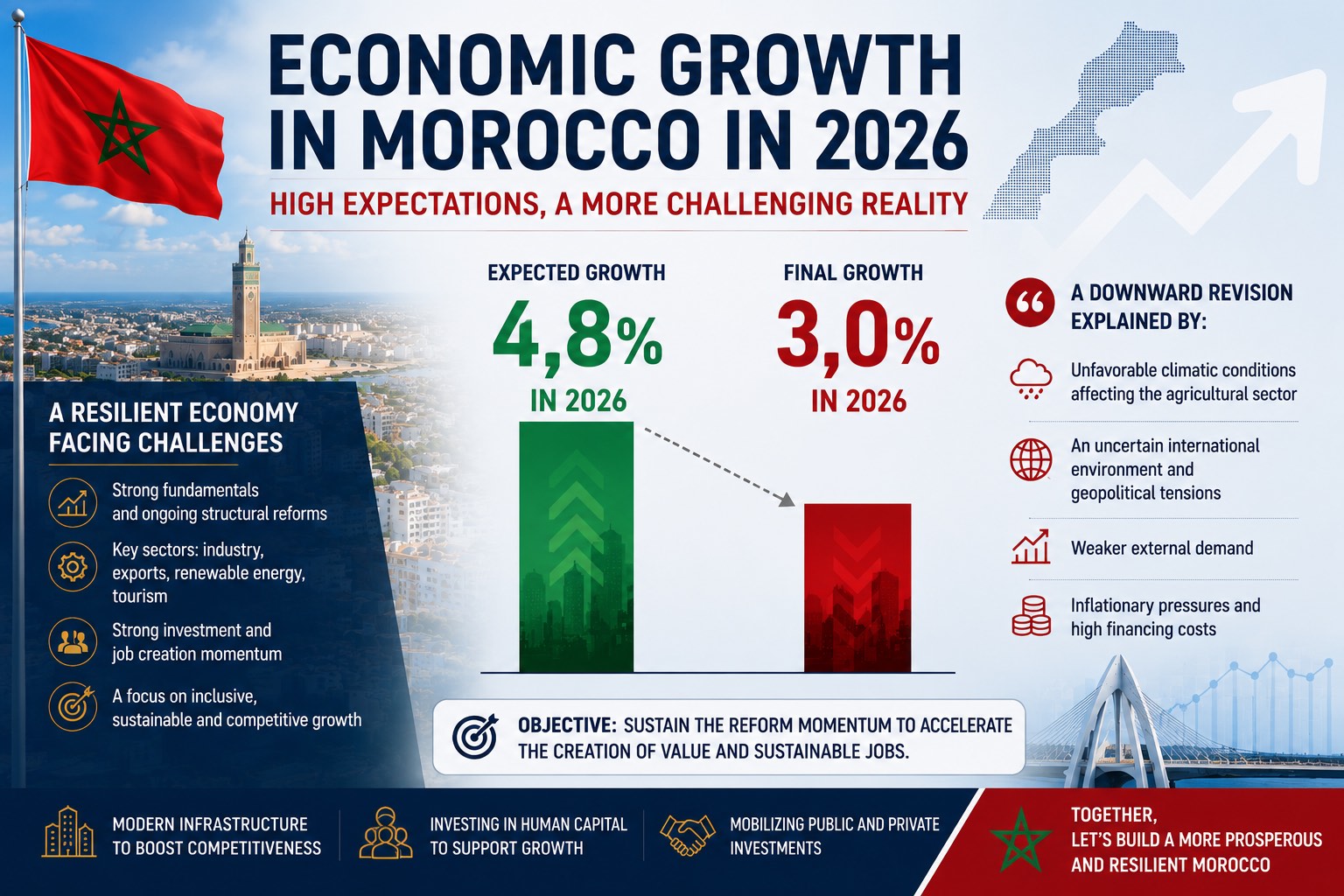
Morocco’s economy appeared set for a particularly dynamic year in 2026. At the beginning of the year, several forecasts projected economic growth of up to 4.8%, driven by an agricultural recovery, easing inflation, record public investment, and the strong performance of export-oriented industries. However, as the year progressed, these projections were gradually revised downward, converging toward a growth rate of around 3%.
This adjustment does not reflect a weakening of the Moroccan economy, but rather the impact of a more challenging international environment and several structural constraints that continue to weigh on the Kingdom’s growth potential.
The first factor is the slowdown in global demand. European economies, Morocco’s main export markets, have experienced moderate growth, limiting the performance of Moroccan industrial exports. Although the automotive, aerospace, phosphate and global business sectors continue to expand, their contribution has not been sufficient to offset weaker external demand.
The second explanation lies in an agricultural season that fell short of expectations. Despite improved rainfall compared with previous drought years, agricultural value added remained below initial forecasts. Although agriculture’s share of GDP has gradually declined, it still plays a decisive role in economic growth, rural employment and household consumption.
The Exploratory Economic Budget released by Morocco’s High Commission for Planning (HCP) also highlights that domestic demand remains the economy’s main growth engine. Household consumption has benefited from lower inflation and wage increases, while major public investment projects continue to support economic activity. However, stronger domestic demand has also led to faster import growth than exports, reducing the contribution of foreign trade to overall GDP growth.
Investment nevertheless remains one of Morocco’s greatest strengths. Infrastructure programs, industrial projects, investments linked to the 2030 FIFA World Cup, and the implementation of the new Investment Charter are creating strong momentum. However, many of these projects are expected to generate their most significant economic impact only from 2027 onwards. In other words, spending is taking place today, while its full contribution to national wealth will materialize gradually.
The international geopolitical environment has also played a role. Persistent tensions in the Middle East, global trade uncertainties and energy price volatility have reduced investor confidence. Several companies postponed investment decisions, while logistics costs remained relatively high despite recent improvements.
Nevertheless, the slower growth rate does not call into question Morocco’s economic fundamentals. According to the HCP, non-agricultural sectors continue to gain momentum. Manufacturing, market services, tourism, renewable energy and construction remain on a solid growth path, confirming Morocco’s gradual transformation toward a more diversified and industrialized economy.
Macroeconomic fundamentals also remain sound. Inflation is under better control, public finances continue to improve thanks to tax reforms, government revenues are increasing, and public debt remains on a sustainable trajectory. This provides Morocco with the financial capacity to continue investing in major strategic infrastructure and development projects.
Ultimately, the decline from an expected 4.8% growth rate to around 3% reflects less an economic setback than a more realistic assessment of global economic conditions. Morocco continues its transition toward a development model driven by industry, services and high-value-added investment, although this transformation naturally requires time to deliver its full benefits.
The real challenge is therefore no longer simply to accelerate growth, but to make it more resilient, more inclusive and less dependent on climatic conditions and international economic cycles. If industrial investments materialize as expected, the major projects associated with the 2030 FIFA World Cup deliver their anticipated multiplier effects, and European demand gradually recovers, Morocco could return to growth rates exceeding 4% in the coming years. The downward revision should therefore be viewed as a temporary adjustment within an overall positive long-term economic transformation.