



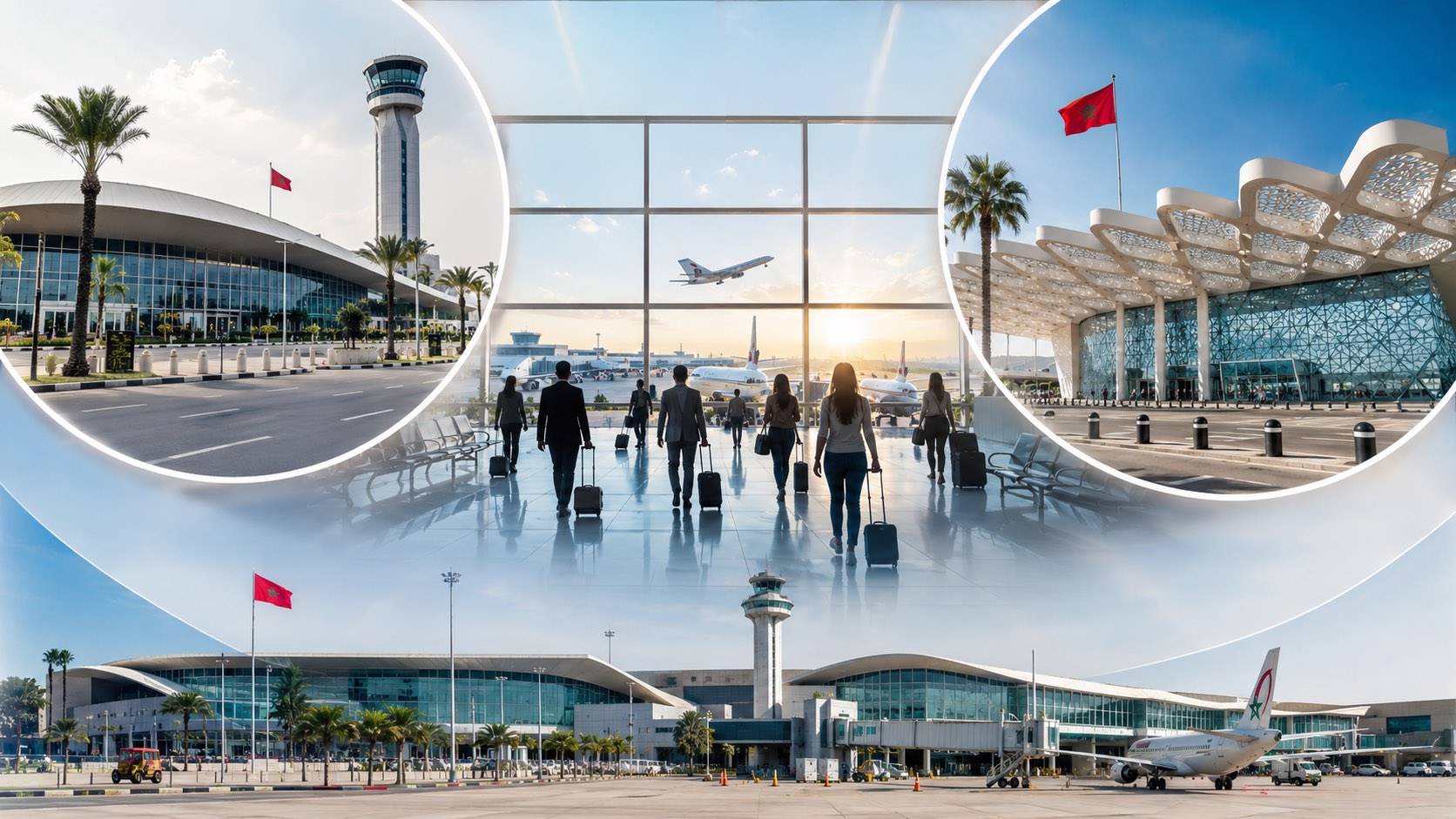

Moroccan airports confirmed their strong momentum during the first half of 2026. According to data from the National Airports Office (ONDA), the country’s airports recorded 18,831,461 passengers by the end of June 2026, representing an 8.83% year-on-year increase. International traffic accounted for the vast majority of flows, with 16,835,752 passengers, up 8.86%, while domestic traffic reached 1,995,709 passengers, an increase of 8.6%. These figures reflect sustained demand for air transport and reinforce the growing role of airports in Morocco’s tourism, economic attractiveness and territorial development.
Marrakech Strengthens Its Air Connectivity
Among regional airports, Marrakech-Ménara stands out with particularly strong performance. The airport handled 5,636,776 passengers during the first half of 2026, an increase of 10.41% year-on-year. Marrakech is therefore consolidating its position as Morocco’s second-largest air gateway, benefiting from strong tourism demand, expanding hotel capacity and the growing number of international routes connecting the destination with major source markets.
Agadir, Tangier and Rabat Continue to Grow
The country’s other major regional airports also recorded significant passenger volumes. Agadir-Al Massira handled 1,878,974 passengers, while Tangier-Ibn Battouta recorded 1,402,756 passengers and Rabat-Salé welcomed 1,217,574 travellers. Agadir is benefiting primarily from tourism growth, while Tangier is supported by its industrial and economic positioning and close links with European markets. Rabat, meanwhile, is accompanying the expansion of the capital and its surrounding economic area.
Mid-Sized Airports Gain Momentum
The growth is not limited to the largest airports. ONDA data also show significant increases in passenger traffic at several mid-sized platforms, including Béni Mellal, Errachidia, Nador, Essaouira, Dakhla and Laâyoune. This trend is strategically important because it demonstrates that air-traffic growth is gradually spreading beyond Morocco’s main hubs. Air connectivity is increasingly becoming a tool for tourism development, economic integration and improved accessibility for regional territories.
Essaouira, Dakhla and Laâyoune Strengthen Their Position
Essaouira-Mogador Airport handled 157,902 passengers during the first half of 2026, representing an 11.86% year-on-year increase. In Dakhla, passenger traffic reached 176,388, up 11.2%, while Laâyoune-Hassan I Airport recorded growth of 10.54%, reaching 159,002 passengers. These performances demonstrate the growing potential of regional destinations and their ability to benefit from expanding international tourism flows.
Europe Remains the Main Driver
A large part of the increase in air traffic is linked to international travel. Europe remains Morocco’s largest aviation market, accounting for more than 14 million passengers during the first half of the year. However, growth is becoming increasingly diversified. Traffic with Africa rose by 15.23%, North American traffic increased by 15.46%, while traffic with Maghreb countries grew by 11%. South American traffic recorded an especially strong increase of 34.31%, although volumes remain relatively modest compared with the European market. This diversification is strategically important for Morocco as it approaches 2030.
52 New International Routes
Passenger growth is also being driven by the expansion of air connectivity. According to figures released by the Moroccan National Tourism Office (ONMT), 52 new international routes were launched during the first half of 2026. New airline bases were also developed in Rabat, Marrakech and Tetouan. The objective is to strengthen Morocco’s international connectivity, diversify tourism source markets and enable more regions to benefit from the country’s tourism expansion.
Tourism Drives Air Traffic
This aviation momentum comes against a highly favorable tourism backdrop. Morocco welcomed 4.3 million tourists during the first quarter of 2026, representing a 7% year-on-year increase. By the end of May, the country had already recorded 7.7 million tourist arrivals, also up 7%. Travel receipts increased by 21%, while overnight stays in classified accommodation establishments rose by 9%. Air transport is therefore benefiting directly from sustained tourism demand.
Marrakech and Agadir at the Heart of Tourism Growth
Regional airport performance is closely linked to tourism trends. By the end of May 2026, overnight stays had increased by 10% in Marrakech and 13% in Agadir. Other destinations also recorded significant gains, including Ouarzazate (+24%), Rabat (+18%), Casablanca (+12%), Tangier (+8%), Fez (+7%) and Essaouira (+6%). This creates a virtuous cycle between air connectivity, tourism, hotels, restaurants, transport and local economic activity.
Moroccans Abroad: A Key Summer Driver
The summer season is another major factor supporting passenger growth. The return of Moroccans living abroad (MREs) generates substantial annual air traffic. During the summer of 2025, Morocco welcomed 4.6 million tourists in July and August, including approximately 3 million MREs. In 2026, airports in Marrakech, Agadir, Tangier, Rabat, Fez, Oujda, Nador and Tetouan are expected to benefit significantly from this seasonal demand.
7.74 Million Seats for Summer 2026
The outlook for the summer season is strengthened by increased airline capacity. For summer 2026, contracted air capacity has reached 7.74 million seats, representing a 13% increase compared with the previous summer. This increase is an important indicator of airlines’ confidence in demand for the Moroccan market. It should help absorb additional demand from international tourists and MREs while improving connectivity to several regional airports.
Air Cargo Also Records Strong Growth
Growth is not limited to passenger traffic. During the first half of 2026, Moroccan airports handled approximately 57,828 tonnes of air cargo, an increase of 12.3%. This trend reflects the growing importance of air transport for trade, particularly for high-value products, time-sensitive goods, selected agricultural products and international supply chains. The simultaneous growth of passenger traffic and air freight strengthens the economic role of Morocco’s airport network.
Regional Airports Become Development Engines
Regional airports are gradually becoming much more than transport facilities. Marrakech, Agadir, Tangier, Rabat, Fez, Essaouira, Dakhla, Laâyoune, Nador, Oujda and Errachidia are increasingly acting as drivers of territorial attractiveness. Improved air connectivity facilitates tourist arrivals, increases investor access, brings companies closer to international markets and supports the emergence of new economic activities.
2030 Accelerates Airport Investment
This momentum comes as Morocco prepares a new phase of airport infrastructure development. The Airports 2030 strategy aims to accommodate expected traffic growth, modernize infrastructure, improve the passenger experience and increase airport capacity. The strategy is particularly important ahead of the 2030 FIFA World Cup, which Morocco will co-host with Spain and Portugal and which is expected to generate additional international passenger flows.
Market Diversification as a Strategic Priority
Morocco is also seeking to diversify its tourism and aviation markets. The ONMT is placing increasing emphasis on high-potential markets such as China, India, Latin America and several African markets. New direct air routes to these markets could enable regional airports to capture additional international traffic while reducing their relative dependence on a limited number of traditional European markets.
Summer 2026 Points to Continued Growth
As the peak season begins, the main indicators remain positive: 18.83 million passengers by the end of June, an 8.83% increase in passenger traffic, 16.84 million international passengers, 7.74 million seats scheduled for summer, 52 new international routes and a 7% increase in tourist arrivals by the end of May. These figures point to a structural expansion that goes beyond a simple post-pandemic recovery. Morocco is now entering a new phase in the development of its air connectivity.
A New Cycle for Regional Airports
Passenger traffic during July and August could further strengthen the annual performance of regional airports. The key challenge will now be to transform traffic growth into economic value and territorial development, generating more tourism, investment, employment, trade, services and exports. As Morocco approaches 2030, regional airport performance is becoming a major indicator of territorial competitiveness. With 18.83 million passengers in just six months, Morocco is demonstrating that its airport network has entered a new phase of growth and that regional airports will be at the heart of the country’s next stage of tourism and economic development.