




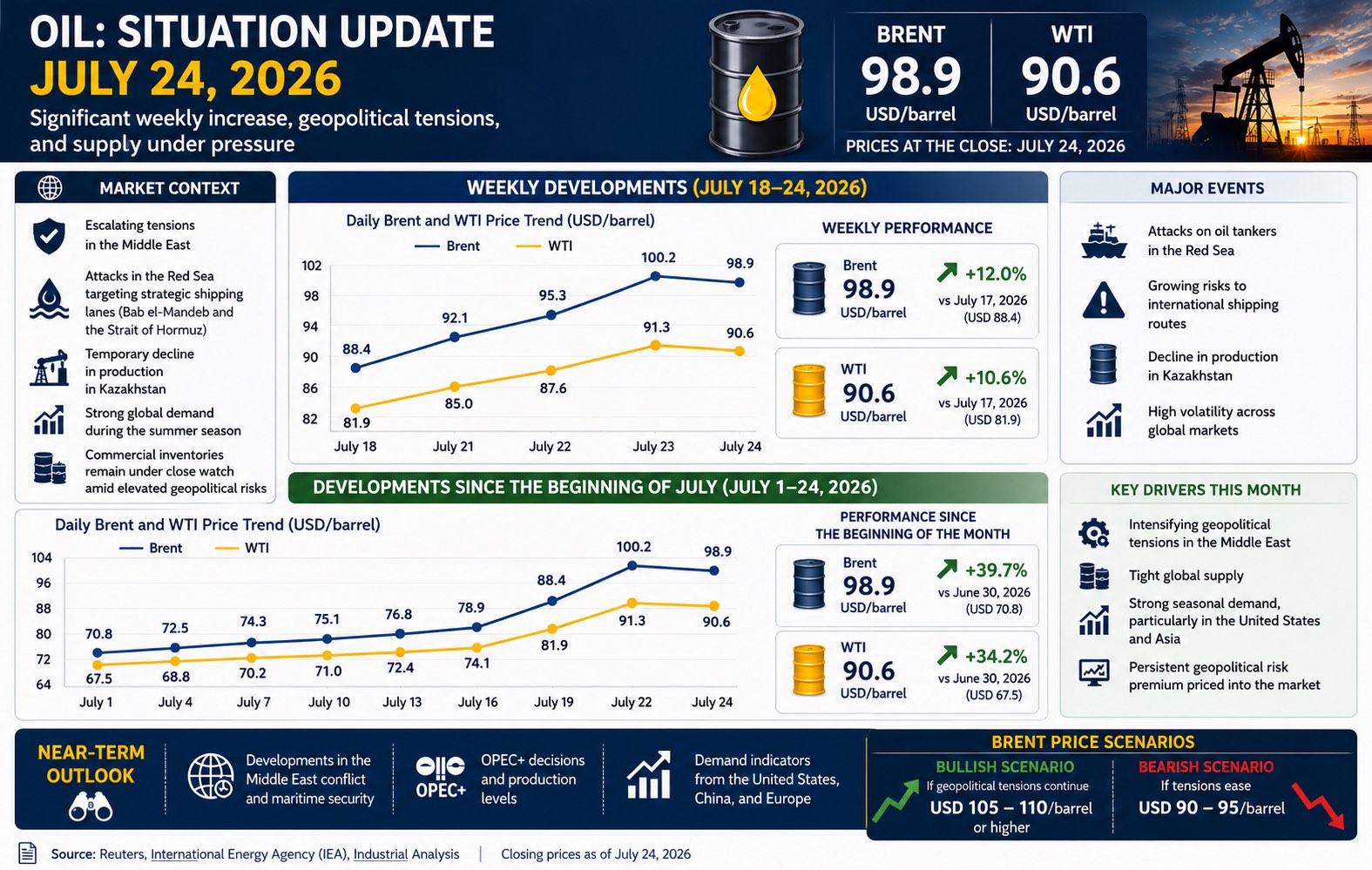
As trading closed for the week ending July 24, 2026, the global oil market remained heavily influenced by geopolitical risks. After briefly surpassing the psychological threshold of $100 per barrel, Brent crude settled around $98.9 per barrel, while West Texas Intermediate (WTI) traded near $90.6 per barrel. Despite a slight pullback at the close, Brent recorded a weekly gain of approximately 12%, while WTI advanced nearly 10%, making it one of the strongest weekly performances of the year.
Investors remain particularly concerned about the escalation of tensions in the Middle East. Attacks targeting oil tankers in the Red Sea, coupled with growing threats to key maritime shipping routes—particularly the Bab el-Mandeb and Strait of Hormuz—have renewed fears of prolonged disruptions to global oil supplies. At the same time, a temporary decline in oil production in Kazakhstan has added to concerns over the availability of supply.
This sharp rise in oil prices comes as global demand remains relatively robust during the summer season, while commercial inventories continue to be closely monitored. Market participants are now pricing in a significant geopolitical risk premium, which explains the heightened volatility observed throughout the week.
What Lies Ahead?
Over the coming days, oil prices will primarily depend on three key factors:
- The evolution of the conflict in the Middle East and the security of global shipping routes;
- Potential production decisions by major oil producers, particularly within the OPEC+ alliance;
- Demand indicators from the United States, China, and Europe.
Should geopolitical tensions persist or intensify, many analysts believe that Brent crude could quickly move back above $100 per barrel, targeting a range of $105 to $110, or even higher if exports through major energy corridors face prolonged disruptions.
Conversely, a military de-escalation or an improvement in maritime security could bring prices back toward the $90–95 per barrel range.
Implications for Morocco
For Morocco, a net importer of hydrocarbons, Brent remaining close to $100 per barrel means increasing pressure on the country’s energy import bill, transportation costs, and domestic fuel prices. If sustained over the coming weeks, this environment could also revive inflationary pressures, even though competitive dynamics within Morocco’s domestic fuel market continue to influence pump prices.