


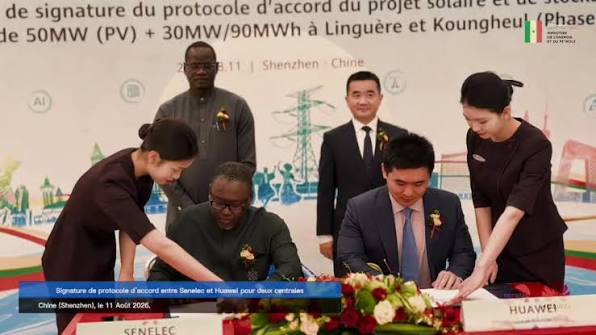
Senegal’s national electricity company, Senelec, and Huawei are advancing a project combining 100 MW of solar photovoltaic capacity with battery energy storage systems. The partnership marks a new stage in Senegal’s power-sector transformation: the country is not only seeking to expand renewable electricity generation, but also to make solar power more stable and better integrated into the national grid in order to meet growing electricity demand.
The agreement between Senelec and Huawei covers two 50 MW photovoltaic plants, located in Linguère and Koungheul, bringing total solar capacity to 100 MW. Each facility is expected to be equipped with a large-scale battery storage system with an announced capacity of 30 MW/90 MWh, bringing the combined storage capacity to 60 MW/180 MWh. The choice of these two locations also reflects Senegal’s objective of expanding energy infrastructure beyond the country’s main urban centres. The projects aim not only to increase electricity supply, but also to improve access to electricity and raise the share of renewable energy in the national energy mix.
The industrial significance of the project is equally important. Solar power offers the advantages of being clean, renewable and increasingly competitive, but its intermittent nature remains a major challenge for large-scale grid integration. Energy storage makes it possible to store part of the electricity generated during periods of strong sunshine and release it when demand increases, thereby improving the dispatchability of solar power. For Senegal, combining solar generation with storage could reduce pressure on the grid, improve electricity quality and move the energy transition into a new phase focused not only on generation capacity, but also on system stability and flexibility.
This development could have a direct impact on Senegal’s industrialisation. Modern industries require abundant, reliable and competitively priced electricity to expand production lines, develop digital infrastructure and deploy automated equipment. By investing in solar and storage facilities, Senegal is seeking to create an energy environment that is better suited to the needs of industrial companies. Huawei’s involvement also illustrates the growing presence of Chinese technology companies in Africa’s energy infrastructure. As renewable generation and storage capacity increase, Senegal could further strengthen its industrial competitiveness while reducing its dependence on fossil fuels.