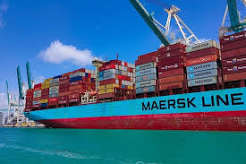
Danish logistics group Maersk is strengthening its operations in Morocco with a rail service connecting Tangier and Casablanca. By combining maritime and rail transport, the service is designed to streamline freight movements, improve delivery predictability and strengthen the connection between international trade routes and the Kingdom’s main industrial and commercial hub.
As trade volumes grow and supply chains become increasingly complex, logistics operators are adapting their transport strategies in Morocco. Against this backdrop, Maersk is leveraging the Tangier–Casablanca rail corridor to offer customers a more integrated transport solution, from the arrival of goods by sea to their onward movement to inland destinations.
The service builds on the complementary roles of Tanger Med, a major port platform connected to international shipping routes, and Casablanca, a leading centre for industrial, commercial and financial activity.
Goods unloaded in northern Morocco can be transported by rail to Casablanca, giving businesses an additional option for managing their supply chains. The objective is to provide regular departures, greater visibility over transit times and more predictable logistics planning.
An Answer to Growing Port and Transport Pressures
The reorganisation of freight flows comes amid increasing pressure on port infrastructure. According to figures from Morocco’s National Ports Agency cited by Maersk, the Port of Casablanca handled 17 million tonnes of cargo in the first half of 2026. June alone accounted for 3.53 million tonnes, representing a year-on-year increase of 32%.
These volumes underline the importance of port infrastructure to Morocco’s economy, while highlighting the need to maintain efficient cargo handling, ensure adequate capacity and improve coordination between different modes of transport.
By incorporating rail into its maritime offering, Maersk aims to diversify freight-routing options and reduce reliance on a single logistics gateway. This approach can help companies plan procurement more effectively, manage inventories and organise deliveries with greater certainty.
The service also forms part of an end-to-end logistics approach. Beyond maritime and rail transport, the group may provide additional services, including customs clearance, inland storage and road delivery to final destinations, depending on customers’ requirements and the nature of the goods.
A Competitiveness Challenge for Moroccan Industry
For industrial companies, logistics performance is an important determinant of competitiveness. Procurement lead times, delivery reliability and transport costs directly affect production planning, working-capital requirements and the ability to fulfil customer orders.
The Tangier–Casablanca connection can therefore provide an additional solution for businesses whose goods arrive by sea before being distributed across Morocco’s main economic hub. It also strengthens the link between port infrastructure and the needs of companies operating in Casablanca and its surrounding region.
The economic benefits of the service will depend on several operational factors, including departure frequency, actual transit times, total transport costs, available capacity and coordination between rail terminals, customs procedures and final delivery. The suitability of the service for different categories of freight will also be important.
For Maersk, the initiative expands its ability to offer customers an integrated logistics solution. For Morocco, it illustrates the growing role of intermodal transport in organising trade flows and improving supply-chain efficiency.
The Tangier–Casablanca rail connection reflects the evolution of freight transport in Morocco. By linking the Kingdom’s international maritime connectivity in the north with Casablanca’s industrial and commercial base, Maersk is pursuing a more coordinated, predictable and business-oriented logistics model. The key challenge will be to translate this operational integration into measurable improvements in transit times, reliability and competitiveness for Moroccan businesses.