


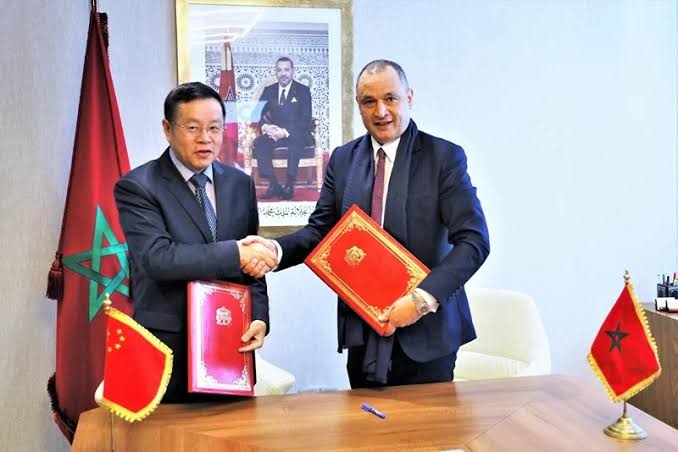
As global value chains are being reshaped, Morocco has a strategic opportunity to become a platform from which Chinese companies manufacture, innovate and export to Europe and African markets. With bilateral trade reaching $10.96 billion in 2025, industrial projects in electric vehicle batteries, textiles and automotive components, and the development of the Mohammed VI Tangier Tech City, the Kingdom can turn its geographical position, infrastructure and trade agreements into lasting industrial advantages.
The question is no longer simply whether Chinese companies are interested in investing in Morocco. The real challenge is how the Kingdom can transform these investments into productive capacity, skilled employment, technology transfer and broader access to African markets.
As global supply chains are reorganised, Morocco offers several complementary advantages: its position between Europe and Africa, its port and logistics infrastructure, its automotive industry, its established industrial ecosystems and its network of trade agreements. This combination can appeal to Chinese groups seeking to diversify their international operations and bring part of their production closer to their target markets.
Bilateral Trade Reaches a New Scale
Economic relations between China and Morocco have reached an important milestone. According to data published by Chinese authorities and reported by Xinhua, bilateral trade reached $10.96 billion in 2025, compared with $9.04 billion in 2024, representing growth of approximately 21.2%. China has thus become Morocco’s third-largest trading partner and its leading partner in Asia.
This expansion nevertheless reveals a significant trade imbalance. In 2025, Chinese exports to Morocco reached $9.88 billion, while Chinese imports from Morocco amounted to $1.08 billion. The bilateral trade deficit therefore stood at approximately $8.8 billion.
This imbalance represents both a challenge and an opportunity. It highlights the need to strengthen Morocco’s export capacity while encouraging Chinese investments that integrate more local suppliers and manufacture goods for third-country markets.
The strategic objective is to transform the bilateral relationship from a model primarily based on importing manufactured products into one centred on local production, industrial processing and exports.
Tangier Tech: A Showcase for a New Industrial Geography
Mohammed VI Tangier Tech City is one of the most emblematic projects underpinning this ambition. Developed through a Moroccan-Chinese partnership, it aims to host industrial activities, services, logistics infrastructure and integrated urban facilities.
The project covers a planned total area of 2,167 hectares, including 947 hectares earmarked for an industrial acceleration zone. The first development phase represents an investment of 2.4 billion dirhams over the 2024–2028 period, according to Tanger Med.
The ambition extends beyond creating another industrial zone. It involves building an ecosystem capable of hosting manufacturers, subcontractors, logistics providers and service companies while facilitating connections with ports and international markets.
According to Xinhua, by March 2026 Tangier Tech had signed agreements with 42 companies, including 34 Chinese firms, involving planned investments of approximately $3.5 billion. These commitments demonstrate Chinese operators’ interest in the Moroccan platform, although announced investment amounts should not be confused with funds already deployed.
The priority is now to turn these commitments into operational facilities, effective production capacity and sustainable jobs.
Electric Vehicle Batteries: Morocco Enters a Strategic Value Chain
The battery industry illustrates the potential of this cooperation particularly well.
In March 2024, Chinese group BTR New Material Group signed an investment agreement for a plant producing cathode materials for lithium-ion batteries. The project represents an investment exceeding 3 billion dirhams and provides for an installed capacity of 50,000 tonnes per year, as well as 2,448 jobs, including 504 direct jobs by 2027, according to Morocco’s Ministry of Economy and Finance.
The project’s timetable and actual production volumes must be assessed against its implementation progress. Nevertheless, the investment illustrates Morocco’s potential to enter technological segments further upstream from automotive assembly.
Another major development involves Gotion High-Tech. In July 2026, the African Development Bank approved a €100 million loan to support the development of a battery gigafactory in Morocco, with an initial investment estimated at approximately $1.3 billion. The Bank also plans to mobilise up to an additional €141 million from financial partners. The project is intended to cover several stages of the lithium iron phosphate battery value chain, from active materials to cells, with production largely destined for export to Europe.
These investments could help establish an ecosystem encompassing materials, components, engineering, maintenance, recycling and logistics. They could also strengthen links between Morocco’s available resources, Chinese technological capabilities and international demand for electric mobility solutions.
To maximise domestic benefits, Morocco will need to develop local suppliers progressively, train specialised technicians and increase the share of activities performed within the country.
From Textiles to Electric Mobility: Diversifying Investment
Chinese interest is not limited to batteries. Textiles represent another sector with potential for integrated investment.
In March 2025, the Moroccan government signed an agreement with Chinese group Sunrise covering an investment programme worth 2.3 billion dirhams in textiles and clothing. Projects planned in Skhirat and Fez are expected to create 8,500 direct and indirect jobs, according to Moroccan authorities.
This type of investment can strengthen spinning, fabric manufacturing and garment production while bringing manufacturing facilities closer to European markets. It also offers development opportunities for raw-material suppliers, transport companies and industrial service providers.
In electric mobility, Chinese group Broad-Ocean Motor confirmed in July 2025 the establishment of an industrial facility in Tangier Automotive City. The project represents an investment of 1.245 billion dirhams and covers a site of 161,058 square metres. It focuses on the design, manufacture and assembly of electric and hybrid motors.
The complementarity between these activities is crucial. Morocco should not become dependent on a single sector or investor, but should instead build a diversified industrial base capable of withstanding fluctuations in international demand.
Why Morocco Can Serve as a Gateway to Africa
Morocco’s potential rests on a combination of geographical, logistical and industrial advantages.
The Port of Tanger Med is central to this strategy. It connects maritime supply chains with northern Morocco’s industrial zones and facilitates trade with Europe, Asia and other regions. Its links with the Tanger Free Zone, Tanger Automotive City and Tangier Tech reinforce the coherence of the country’s investment proposition.
For a Chinese company, establishing operations in Morocco can make it possible to combine local manufacturing, access to European markets and commercial expansion across Africa. The Kingdom also offers an established industrial environment in automotive manufacturing, aerospace, textiles and logistics.
However, the African opportunity involves more than simply re-exporting goods. To turn Morocco into a genuine continental hub, companies must develop distribution networks, after-sales services, partnerships with African operators and financing capabilities adapted to their target markets.
The African Continental Free Trade Area (AfCFTA) could create additional opportunities. Companies must nevertheless comply with applicable rules of origin, customs duties, customs procedures and the regulations governing each target market. The competitiveness of a Moroccan base will therefore depend on its ability to generate local value rather than simply on its geographical location.
The Decisive Issue: Industrial Benefits for Morocco
Attracting capital is only the first step. Securing lasting benefits requires a coherent industrial policy.
The first priority is local content. Chinese projects should contribute to the emergence of Moroccan suppliers in components, metalworking, electronics, packaging, industrial maintenance and technical services. The growth of these local companies would spread economic benefits beyond the industrial sites themselves.
The second priority is skills development. Investments in batteries, electric motors and industrial equipment require specialised expertise in automation, electrochemistry, engineering, quality control and maintenance. Closer cooperation between manufacturers, universities and vocational training institutions will be essential.
The third priority concerns research and technology transfer. A sustainable industrial presence should not be limited to importing equipment and assembling products. It can also support the development of engineering offices, applied research centres, testing laboratories and local design capabilities.
Finally, Morocco must closely monitor changes in international trade policy. Chinese investments in the Kingdom have raised questions in Europe concerning product origin, subsidies and competitive conditions. Compliance with applicable rules of origin and trade requirements will therefore be essential, alongside rigorous traceability of manufacturing processes.
Conclusion: From Investment Attractiveness to Industrial Strength
The figures show that economic cooperation between Morocco and China is reaching a new scale. Bilateral trade amounted to $10.96 billion in 2025, while announced investments in batteries, textiles and electric mobility illustrate the progressive diversification of industrial relations.
For Morocco, the next step is not simply to attract more Chinese companies. It is to turn these industrial operations into drivers of productive transformation, exports and skills development.
For Chinese companies, the Kingdom can serve as a manufacturing and services base connecting Asian, European and African markets. For the Moroccan economy, however, the success of this strategy will depend on locally generated value added, skilled job creation, the integration of domestic suppliers and the development of technological capabilities within the country.
The true measure of the Morocco-China partnership will therefore be not the number of projects announced, but their ability to transform Morocco into a competitive industrial platform, integrated into global value chains and firmly connected to African markets.