

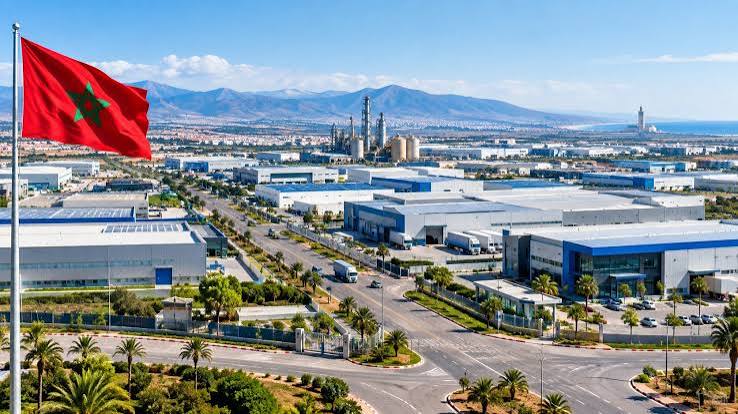
Morocco is strengthening its industrial land supply with the creation of the Bouknadel 2 Industrial Acceleration Zone, covering 42.64 hectares, and the redrawing of the boundaries of the Jorf zone in El Jadida Province, whose total area reaches approximately 501.64 hectares. Both measures form part of efforts to organise land for productive activities and create favourable conditions for attracting industrial investment.
The supply of land for industrial investment in Morocco is undergoing a new phase following the publication of two decrees concerning the Bouknadel and Jorf Industrial Acceleration Zones. The first establishes a new industrial zone in the Rabat-Salé-Kénitra region, while the second specifies the boundaries and areas of the plots within the zone located in the commune of Moulay Abdallah, in El Jadida Province.
These measures are particularly relevant to industrial companies and investors seeking land to establish new production facilities or expand existing operations. The texts define the legal and geographical framework for land earmarked for investment. However, it is important to distinguish between the official designation of a zone and the actual availability of plots for sale, allocation and development.
Bouknadel 2: An Additional 42.64 Hectares for Industry
The new Bouknadel 2 Industrial Acceleration Zone is located in the commune of Sidi Bouknadel, in Salé Prefecture, and covers an area of 42.64 hectares. Its creation is provided for under Decree No. 2.26.593, approved by the Government Council on 10 September 2026.
The project expands the development of the Bouknadel industrial hub, whose first zone was established under Decree No. 2.21.957, dated 23 December 2021, with an initial area of 24.26 hectares.
The zone is designed to accommodate a range of industries, including textiles and leather, agri-food processing, chemicals, automotive manufacturing and aerospace. It also covers activities related to renewable energy, construction materials, and the metallurgical, mechanical, electrical, electronics and plastics industries.
The additional industrial land could create new opportunities for companies seeking to establish production facilities or strengthen their presence near urban markets and major industrial centres in the Rabat-Salé-Kénitra region.
However, the extent to which these opportunities can be realised will depend on progress in site development, the availability of infrastructure and utilities, and the conditions governing the allocation and marketing of plots.
Jorf: An Industrial Zone Covering More Than 501 Hectares
In the Casablanca-Settat region, the new regulatory provision concerns the Jorf Industrial Acceleration Zone, located in the commune of Moulay Abdallah, in El Jadida Province. Decree No. 2.26.98 amends the previous text, published on 29 March 2024, to specify the total area and geographical boundaries of the land included in the zone.
The total area amounts to 501 hectares, 63 ares and 84 centiares, equivalent to approximately 501.64 hectares. The land is divided into three plots: the first covers around 200.91 hectares, the second 94.10 hectares, and the third 206.63 hectares.
The zone borders the industrial complex of the OCP Group, Morocco’s phosphate producer, to the north, while agricultural land surrounds it to the east, south and west. This location places the zone within one of the main industrial environments in El Jadida Province.
Jorf’s industrial focus includes the chemical and para-chemical industries, the manufacture of electric batteries and their components, as well as the metallurgical, mechanical, electrical, electronics and automotive industries. Services associated with these activities are also included.
Electric Batteries Strengthen Jorf’s Industrial Role
Jorf is particularly significant in the context of the development of industries linked to electric batteries and their components. One of the projects established in the area is COBCO, a company created through a partnership between Morocco’s Al Mada Group and China’s CNGR Group. In June 2025, the company inaugurated its first production line for nickel-manganese-cobalt (NMC) cathode material precursors.
The management and development of the zone’s first plot were awarded to COBCO under Decree No. 2.24.721, dated 2 August 2024. In May 2025, specific internal regulations for that plot were also approved.
The presence of this project strengthens Jorf’s position within the industrial ecosystem associated with batteries and their components, sectors closely connected to industrial and technological value chains.
Nevertheless, a distinction must be made between projects already under development and the total area legally designated for the zone. The fact that the zone covers 501.64 hectares does not mean that all plots are immediately available to new investors.
Site Development and Infrastructure Will Be Decisive
For industrial investors, the legal designation of land is not enough to determine whether to establish a new project. The attractiveness of these zones also depends on land prices, the availability of electricity and water, telecommunications networks, road and port connections, plot allocation conditions and the time required to obtain the necessary permits.
These factors are particularly important for projects requiring large areas or specialised technical facilities, such as chemical industries, battery manufacturing and automotive component production.
In Bouknadel and Jorf, the pace of site development and the availability of infrastructure will determine the ability of the newly designated areas, or those whose boundaries have been revised, to meet actual industrial demand.
Information on plot marketing and costs will be essential to assessing the real opportunities available to domestic companies and international investors.
Both measures confirm Morocco’s continued strategy of organising and developing its industrial land supply. Their economic impact, however, will depend on transforming legally designated areas into fully serviced and operational sites capable of attracting productive investment, creating jobs and strengthening the national industrial base.