
The Moroccan automotive market recorded historic growth in 2025, with 235,372 passenger cars and light commercial vehicles registered, representing a 33.4% year-on-year increase. Passenger cars alone accounted for 208,848 units, up 32.9%, confirming the strong recovery in demand for new vehicles.
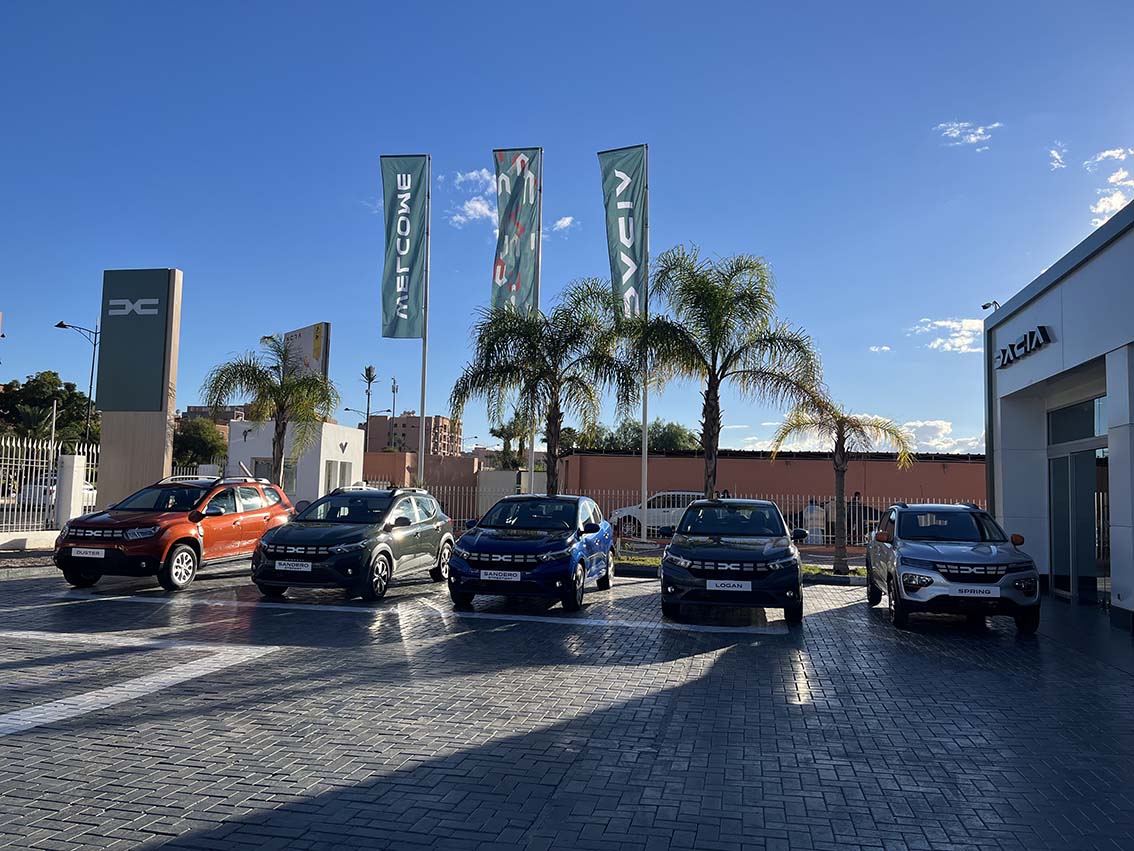
In this rapidly expanding market, Dacia maintained its leading position, selling 47,887 vehicles and achieving a 20.3% market share. The brand’s sales increased by 21.8% compared with 2024, consolidating its position as Morocco’s best-selling car brand for the sixteenth consecutive year.
Renault ranked second with 41,050 units and a 17.4% market share, recording strong growth of 44.8%. Together, Dacia and Renault sold 88,937 vehicles, representing approximately 37.8% of the Moroccan market.
Hyundai ranked third with 16,996 units, followed by Peugeot with 14,657 vehicles, while Volkswagen took fifth place with 14,011 units.
| Rank | Brand | 2025 Sales | Market Share | Growth |
|---|---|---|---|---|
| 1 | Dacia | 47,887 | 20.3% | +21.8% |
| 2 | Renault | 41,050 | 17.4% | +44.8% |
| 3 | Hyundai | 16,996 | ≈8.1% | +29.9% |
| 4 | Peugeot | 14,657 | ≈7.0% | +46.1% |
| 5 | Volkswagen | 14,011 | ≈6.7% | +20.3% |
| 6 | Opel | 12,879 | ≈6.2% | +33.2% |
| 7 | Citroën | 12,423 | ≈5.9% | +19.2% |
| 8 | Toyota | 11,876 | ≈5.7% | +25.9% |
| 9 | Fiat | 10,654 | ≈5.1% | +28.7% |
| 10 | Kia | 10,030 | ≈4.8% | +25.4% |
Source: Ranking of the ten best-selling automotive brands in Morocco in 2025, based on market data published by specialized media, including Auto News and Bourse News, drawing on industry statistics.
Dacia’s leadership is primarily explained by its competitive pricing strategy, which is particularly well suited to a market where purchasing power remains a decisive factor when buying a new vehicle. The brand also benefits from simple and robust models, relatively low maintenance costs and good availability of spare parts.
The Dacia Logan ranked first among the best-selling models, with 18,282 units, ahead of the Sandero, with 17,572 units. The Duster also continues to strengthen Dacia’s presence in the SUV segment.
Renault, for its part, benefits from a strong historical presence in Morocco, an extensive sales and after-sales network, and a range of models adapted to the needs of households and businesses. Models such as the Clio, Express and Kardian are making a significant contribution to this momentum.
Renault’s strength is further reinforced by its industrial footprint in Morocco. In 2025, Renault’s Moroccan plants produced approximately 394,474 vehicles, of which 82% were exported to 63 international markets, further strengthening Morocco’s role in global automotive value chains.
Behind the Renault-Dacia duo, Asian and European manufacturers are strengthening their positions. Hyundai is benefiting from growing demand for SUVs, while Toyota relies on its international reputation for reliability and its expanding range of hybrid vehicles.
Peugeot, meanwhile, recorded one of the strongest growth rates among the top ten brands, with a 46.1% increase, demonstrating that competition in the Moroccan market is no longer limited to the traditional dominance of Renault and Dacia.
The structure of demand also explains much of this ranking. Urban and compact vehicles account for around 43% of sales, while urban SUVs represent approximately 20%. As a result, the balance between price, fuel consumption, vehicle size and running costs has become a decisive factor for Moroccan consumers.
However, the Moroccan market is undergoing a rapid transformation. Consumers are increasingly looking for advanced equipment, connectivity, safety systems, and hybrid and electric powertrains.
The arrival of new models, particularly in the urban SUV and electrified vehicle segments, is expected to intensify competition further in the coming years.
The Moroccan automotive market is therefore entering a new phase. Dacia and Renault continue to dominate the market in terms of volume, but Hyundai, Peugeot, Toyota, Volkswagen, Opel, Citroën, Fiat and Kia have growing potential to gradually reshape the competitive landscape.