




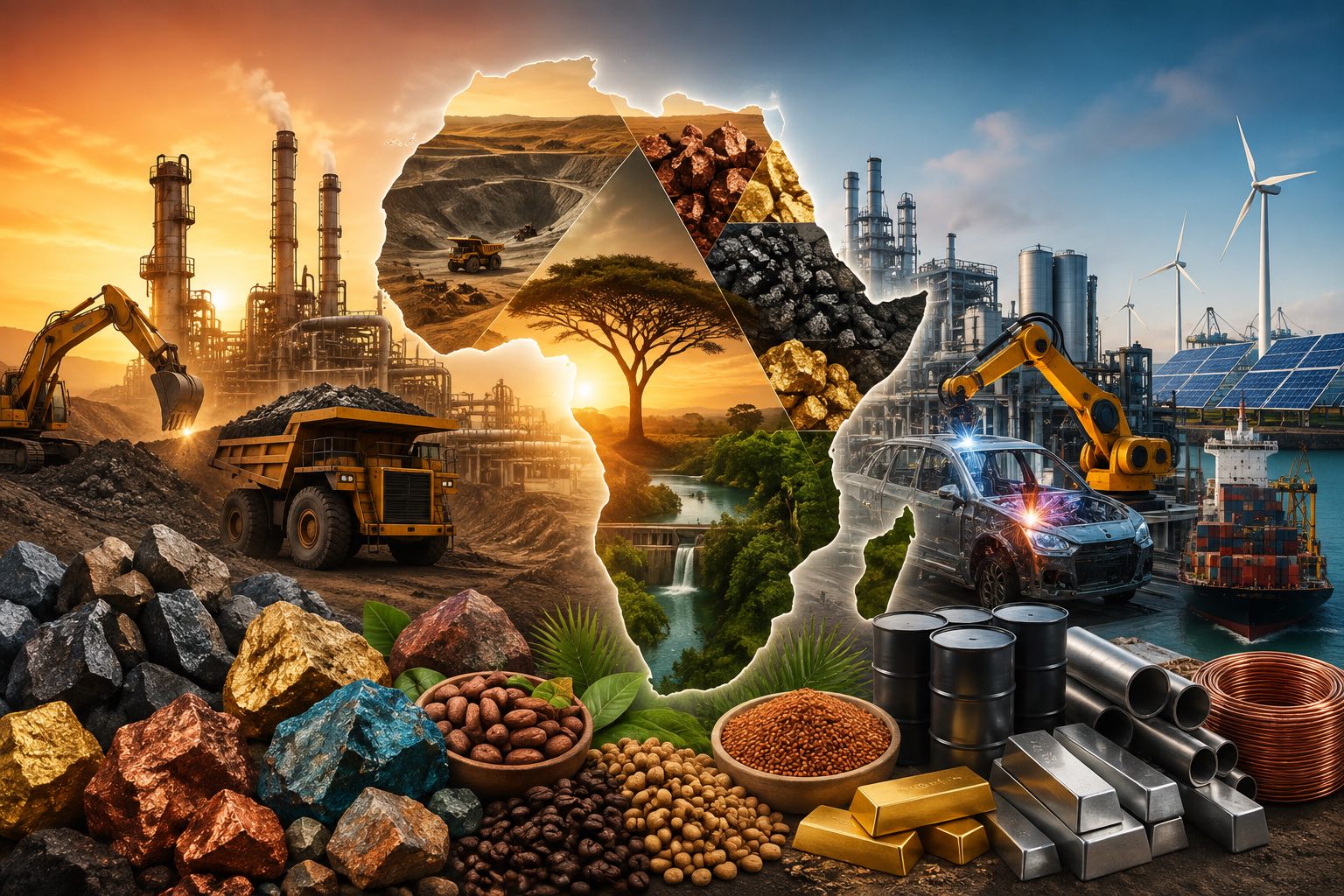

Africa possesses one of the world’s largest reserves of natural resources, yet this wealth has not translated into industrial power commensurate with its potential. In 2025, Africa’s manufacturing value added reached approximately $351 billion, compared with $285 billion in 2020, according to the African Development Bank’s Africa Industrialization Index 2025. Yet the continent still accounts for less than 2% of global manufacturing output and only around 1.4% of global manufactured exports.
Africa’s problem is therefore not a lack of raw materials, but the limited capacity to process them locally and the fragmentation of supply chains. Africa exports cobalt, copper, manganese, graphite, lithium, iron ore, phosphate, bauxite, oil, gas and a wide range of agricultural commodities, while importing a large share of the finished industrial products, equipment, inputs and components needed for its own development.
This creates a major African industrial paradox: the continent supplies the world with some of the raw materials essential to modern industry, yet it still lacks sufficient capacity to transform these resources domestically into high-value-added industrial products.
The United Nations Conference on Trade and Development (UNCTAD) considers an economy to be commodity-dependent when commodities account for more than 60% of its merchandise exports.
Key figures summarizing Africa’s industrial paradox
| Indicator | Latest figure | Source |
|---|---|---|
| Africa’s manufacturing value added, 2025 | $351 billion | African Development Bank |
| Manufacturing value added, 2020 | $285 billion | African Development Bank |
| Africa’s share of global manufacturing output | <2% | African Development Bank |
| Africa’s share of global manufactured exports | 1.4% | African Development Bank |
| Africa’s share of global GDP | 3.2% | UNIDO |
| Africa’s share of global manufacturing value added | ≈2% | UNIDO |
| Africa’s estimated share of global cobalt reserves | >50% | African Union/UNCTAD |
| Africa’s share of global manganese resources | ≈40% | African Union/UNCTAD |
| DRC’s share of global cobalt production, 2025 | 74% | UNCTAD |
| Projected increase in global lithium demand, 2024–2040 | +353% | UNCTAD |
| Additional investment required in critical minerals by 2040 | >$500 billion | World Bank |
Sources: African Development Bank, United Nations Industrial Development Organization (UNIDO), UNCTAD, African Union and World Bank.
The case of critical minerals illustrates this paradox particularly well. Africa possesses major resources of cobalt, manganese, graphite, lithium, nickel, rare earth elements and platinum-group metals. The African Green Minerals Strategy, adopted by the African Union in 2025, considers these resources a strategic lever for industrialization, electrification, energy transition and economic transformation.
The geographical concentration of production is striking. In 2025, the Democratic Republic of the Congo accounted for approximately 74% of global cobalt mine production, while China controlled a very large share of global natural graphite production. Australia, Chile and China are also among the world’s leading lithium producers.
This places several African countries at the heart of the new global industrial competition. Cobalt is essential to several battery technologies, copper is indispensable for electricity grids, graphite is a key battery material, manganese is used in several energy-storage technologies, while platinum-group metals have numerous industrial and energy applications.
Global demand for these resources is expected to increase sharply. According to UNCTAD, global lithium demand could rise by 353% between 2024 and 2040, while graphite demand could increase by 131%. At the same time, the World Bank estimates that demand for several minerals essential to the energy transition could nearly double by 2040, requiring more than $500 billion in additional investment in critical minerals to meet future needs.
The strategic question for Africa is therefore clear: Will the continent continue exporting raw minerals, or will it build the industrial capacity required to process these resources domestically?
The second challenge concerns agricultural raw materials and industrial inputs. African industries remain heavily dependent on external supply chains for many types of equipment, chemicals, fertilizers, machinery, electronic components and intermediate goods.
The fertilizer sector is a particularly strategic example. The African Development Bank stresses the direct link between agricultural production, fertilizer availability, financing, local production and industrial development.
In 2024, the African Development Bank’s African Fertilizer Financing Mechanism helped distribute 18,448 tonnes of fertilizer, improve access to fertilizers for 115,535 farmers, and train more than 70,000 farmers and 730 agricultural distributors.
This demonstrates that supply security extends far beyond mining. Building a strong African industrial base requires securing supplies of minerals, energy, fertilizers, chemicals, construction materials, components and industrial equipment simultaneously.
This is where the African Continental Free Trade Area (AfCFTA) can become a major industrial instrument. Its real potential lies not simply in increasing trade between African countries, but in creating integrated regional value chains: copper and cobalt extracted in the DRC or Zambia, mineral processing in Southern Africa, components manufactured in another African country, regional assembly and distribution across the African market.
The African Union’s strategy is moving precisely in this direction. The African Commodities Strategy seeks to transform Africa from a mere supplier of raw materials into a continent capable of creating greater value, retaining a larger share of economic revenues and integrating more deeply into global value chains.
The African Green Minerals Strategy, launched by the African Union in 2025, also emphasizes local processing, integrated value chains, industrial production and job creation.
This represents a major shift in African economic thinking: the objective is no longer simply to use mineral exports to finance African economies, but to make these minerals the foundation of African industrialization.
International financial institutions are increasingly supporting this approach. In 2026, multilateral development banks called for the development of value chains extending from mining to processing, industrial transformation and recycling, together with corridors connecting mining regions to industrial hubs and regional markets.
The real challenge: moving from the mine to the factory
| Stage | Traditional model | Target industrial model |
| Resources | Extraction | Responsible and sustainable extraction |
| Initial processing | Raw exports | Local concentration and processing |
| Metallurgy | Imports | Regional production |
| Components | Imports | African manufacturing |
| Assembly | Outside Africa | African industrial hubs |
| Market | Raw exports | African market + exports |
| Value added | Limited | High |
| Employment | Mainly extractive | Industrial, technological and logistics jobs |
Source: African Union, African Development Bank, UNCTAD and World Bank.
Africa also possesses a strategic advantage that is often underestimated: its large domestic market. With more than 1.2 billion consumers in Sub-Saharan Africa, a young population and the world’s largest continental free-trade area, Africa has the foundations for creating regional industrial demand capable of supporting integrated value chains.
The main obstacle, however, is the ability to finance infrastructure, energy, logistics, skills, technology and industrial capacity.
Financing remains one of the biggest challenges. Mining projects require substantial capital, but processing and manufacturing facilities also need long-term financing, guarantees, stable markets and coherent industrial policies.
Africa must also avoid a new trap: replacing raw-mineral exports with the export of concentrates without genuinely developing metallurgy, chemicals, component manufacturing and final production. Value added must progressively extend across the entire industrial chain within Africa.
This challenge is particularly urgent in the context of the global energy transition. Batteries, electric vehicles, electricity grids, solar panels and digital technologies will increase demand for critical minerals.
If Africa controls the resources but leaves refining, component manufacturing and final assembly to other regions, it risks reproducing the historical model of economic dependence.
Conversely, a coordinated strategy could turn African mineral resources into the foundation of a new generation of industries: batteries manufactured in Africa, copper transformed into cables, aluminium into industrial products, phosphate into fertilizers, oil and gas into petrochemicals, iron ore into steel, and agricultural commodities into processed food products with high added value.
The message from African institutions is increasingly clear: the objective is no longer simply to export more, but to process and manufacture more within Africa.
The future of African industry will therefore depend on its ability to secure supplies, regionalize value chains and, above all, retain a much larger share of the value created from its own natural resources within the continent.
The African paradox can thus become a strategic advantage: the continent possesses the raw materials the global economy needs; the next challenge is to build the factories Africa needs to transform this wealth into industrial production, jobs, technology, exports and industrial sovereignty.