




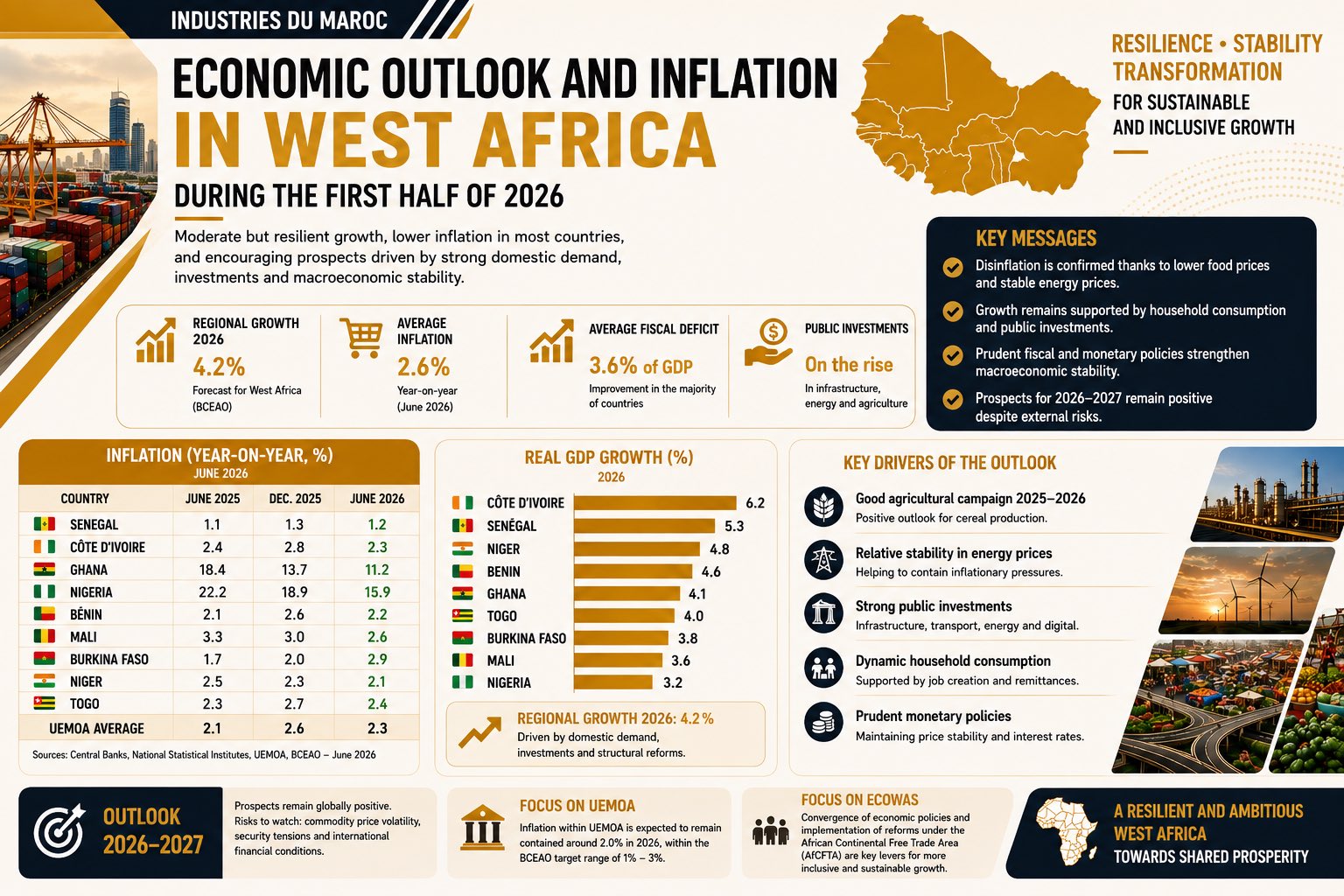

During the first half of 2026, West Africa’s economy remained broadly resilient, supported by domestic demand, investment, services, industry and agriculture. In the West African Economic and Monetary Union (WAEMU), real GDP growth reached 6.1% in the first quarter of 2026, compared with 6.5% in the previous quarter, while the Central Bank of West African States (BCEAO) forecasts growth of 6.1% for the full year 2026, following 6.6% in 2025.
This momentum continues to be driven by extractive and manufacturing industries, trade and services, alongside favorable prospects for agricultural production. However, this performance is taking place against an international backdrop marked by geopolitical tensions, commodity-price volatility and disruptions to supply chains. West African economies remain particularly exposed to fluctuations in energy, grain, fertilizer and transport prices. In June 2026, the BCEAO reported an 8.5% increase in the prices of major imported food products, highlighting the region’s continued vulnerability to external shocks.
Inflation: A Real Easing, but Risks Remain
One of the most significant developments during the first half of 2026 has been the clear easing of inflationary pressures. In the WAEMU region, inflation remained low, reaching 0.4% in May 2026, after 0% in April. This development was driven in particular by improved food supply, the stabilization of certain prices and better availability of agricultural products. The BCEAO expects annual inflation to stand at around 1.6% in 2026, within the Union’s target range of 1% to 3%. This decline in inflation provides important support for household purchasing power, consumption and macroeconomic stability. However, the improvement should not conceal persistent risks linked to energy prices, maritime freight, geopolitical tensions, climate conditions and insecurity in certain areas. Reducing dependence on imported food, energy and manufactured goods has therefore become a strategic priority for strengthening the region’s resilience.
Investment, Public Finances and Outlook: The Next Test
Public investment remains a key driver of economic activity, particularly in infrastructure, energy, transport, digitalization and agriculture. At the same time, WAEMU countries are continuing their efforts to consolidate public finances, with the overall fiscal deficit expected to decline from 3.3% of GDP in 2025 to 3.2% in 2026, before reaching 2.9% in 2027. Economic financing is also expected to strengthen, with credit to the economy projected to increase by 7.4% in 2026, creating greater opportunities for the private sector. Despite these positive signals, the region remains exposed to security, climate, geopolitical and financial risks, as well as fluctuations in commodity prices. The second half of 2026 will therefore be crucial in confirming the strength of this trajectory. The challenge is now to transform cyclical resilience into sustainable, inclusive and job-creating growth. For West Africa, the real challenge is therefore to consolidate a new path of productive transformation, economic sovereignty and regional integration.