




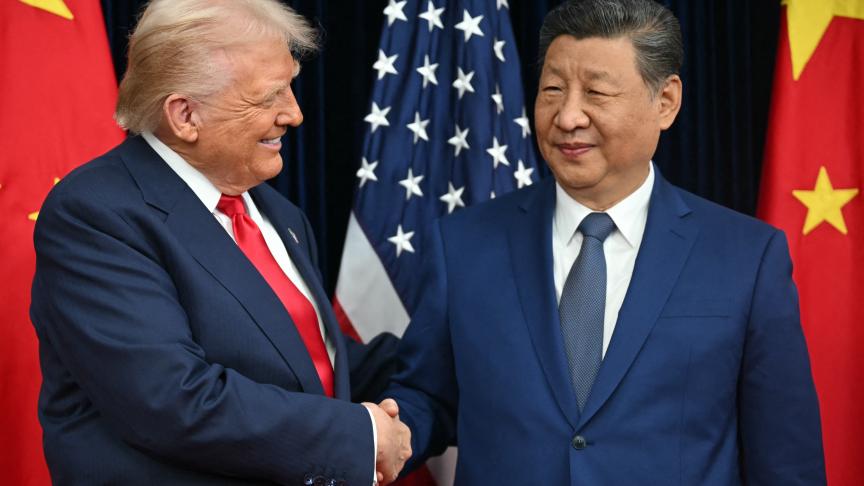
Chinese President Xi Jinping and his American counterpart Donald Trump on Thursday expressed their willingness to stabilize relations between their countries despite ongoing disagreements over trade, strategic technologies and the war in Iran.
During a meeting held at the Great Hall of the People in Beijing, Donald Trump praised what he described as a relationship destined to become “better than ever,” speaking alongside Xi Jinping of a “fabulous future” for both global powers.
For his part, the Chinese president stressed the importance of Beijing and Washington acting as “partners rather than rivals,” arguing that cooperation benefits both sides while confrontation harms them.
Xi Jinping also stated that common interests between the two nations outweigh their differences, calling stable China-US relations beneficial for the world and advocating for “a new path of coexistence between major powers.”
Closed-door talks between the two leaders focused largely on trade tensions, market access for American companies in China, US technology restrictions and the geopolitical situation in the Middle East.
The summit unfolded under a carefully orchestrated state ceremony near Tiananmen Square, where Donald Trump was welcomed with a red carpet, military anthems, cannon salutes and rows of children waving Chinese and American flags.
The meeting came one day after economic discussions between Chinese and American officials in South Korea, following the trade truce reached last October after months of tariff disputes.
Washington hopes to secure progress in sectors such as agriculture, aviation and broader access to the Chinese market for US companies. Donald Trump was accompanied by several major American business figures, including the CEO of Boeing Kelly Ortberg, as well as Elon Musk and executives from Apple and Nvidia.
Before leaving for Beijing, the US president urged China to further open its economy.
The war in Iran also emerged as a major topic during the summit. Washington wants Beijing to exert more pressure on Tehran in an effort to encourage de-escalation in the Gulf, as tensions around the Strait of Hormuz continue to unsettle energy markets.
For China, the world’s largest importer of Iranian oil, stability in Gulf maritime routes remains strategically important amid slowing domestic demand and increasing external pressure.
Despite the conciliatory tone displayed by both leaders, few observers expect a major breakthrough. Beijing and Washington appear primarily focused on preventing a new escalation as their strategic rivalry continues to shape the global balance of power.