




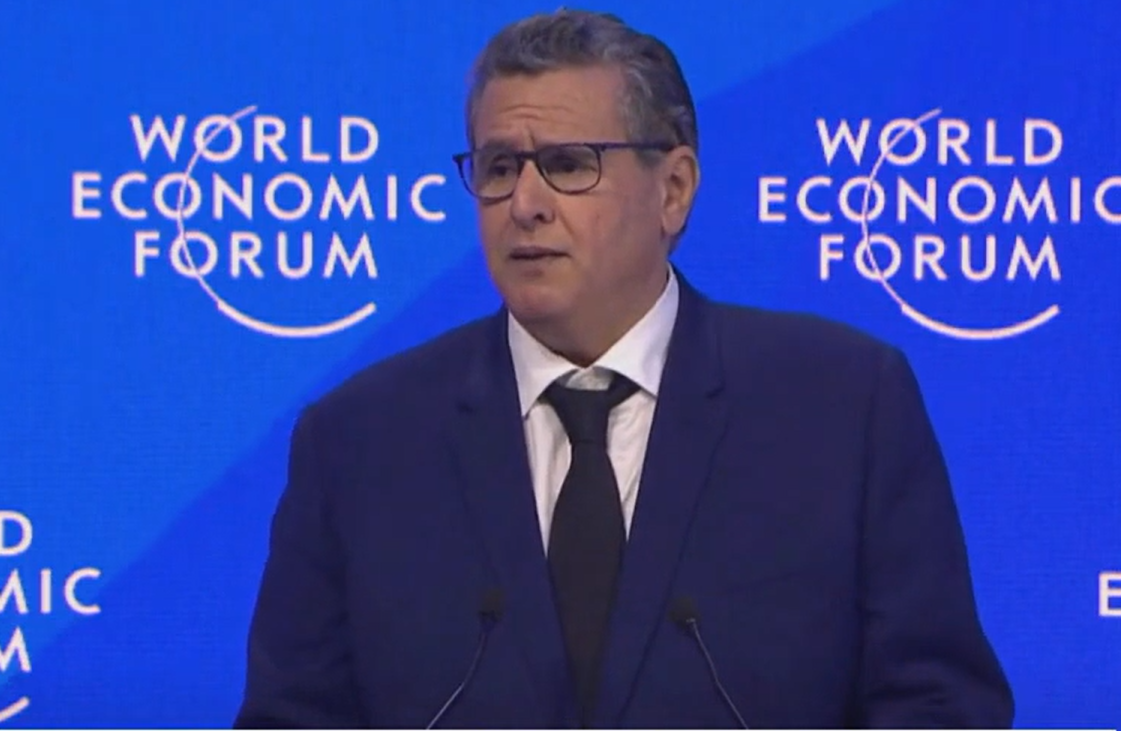
Head of Government Aziz Akhannouch arrived in Switzerland on Monday to represent Morocco at the 56th Annual Meeting of the World Economic Forum (WEF), taking place in Davos until January 23, with the participation of around 400 high-level political leaders, including nearly 65 heads of state and government.
Mr. Akhannouch is leading a delegation that includes the Minister of Economy and Finance, Nadia Fettah, and the Director General of the Moroccan Investment and Export Development Agency (AMDIE), Ali Sadiki.
Held under the theme “A Spirit of Dialogue,” this edition of the Davos Forum brings together nearly 3,000 participants from more than 130 countries, against a backdrop of profound geopolitical, technological and societal upheavals.
The meeting features the participation of six G7 leaders, as well as 55 ministers of economy and finance, 33 foreign affairs ministers, 34 trade ministers and 11 central bank governors, marking the highest level of government participation in the Forum’s history.
Political leaders will engage alongside nearly 850 CEOs and chairpersons of the world’s largest companies, as well as around 100 unicorn founders and technology pioneers.
Positioning itself as an impartial platform for dialogue, collaboration and action, the Forum seeks to foster open exchanges among public officials, business leaders, civil society representatives, international organizations and academia to deliver concrete responses to global challenges.
The 2026 program, rooted in over five decades of public-private dialogue, aims to generate long-term solutions to interconnected challenges, while opening new avenues for growth, resilience and impact.
Discussions will focus in particular on renewing international cooperation amid contested norms, strained alliances and eroding trust, as well as on new models of collaboration in response to shifting notions of security, sovereignty and global integration.
They will also address geopolitical risk management, economic uncertainty, the responsible use of innovation, especially breakthrough technologies such as generative artificial intelligence, and pathways to competitiveness and inclusive growth.
The human dimension of transformation will be central to the discussions, with emphasis on skills investment, workforce adaptation and well-being, alongside efforts to rebuild prosperity within planetary boundaries through more sustainable energy, natural and water systems.