





Fuel prices in Morocco have risen significantly over the past decade, with a fresh surge in October 2026. Diesel is approaching MAD 16 per litre, while gasoline has exceeded MAD 15. Historical comparisons confirm a substantial increase, although its exact magnitude depends on the fuel type and the dates used as reference points. Behind this trend lie Morocco’s dependence on imports, market liberalization, international oil prices, taxation and persistent questions about competition in the domestic market.
Fuel prices have become one of the most sensitive indicators of the cost of living in Morocco. For households that rely on private vehicles, transport operators, farmers and industrial companies, fuel price movements directly affect budgets and operating costs.
According to available figures, on October 16, 2026, diesel was priced at around MAD 15.90 per litre, while unleaded gasoline stood at approximately MAD 15.60 per litre. These figures are indicative averages, as prices displayed at service stations may vary depending on the distributor, station and city.
From 2016 to 2026: A Price Surge Reshaping Household and Business Expenditure
The situation in 2016 was considerably different. Historical data from Bank Al-Maghrib, based on figures from the Compensation Fund, indicate that the average price of diesel stood at MAD 8.50 per litre in 2015, a year during which prices remained regulated for part of the period. Gasoline averaged MAD 10.10 per litre. These figures provide a historical reference point but should not be confused with certified annual averages for 2016.
To illustrate the scale of the increase, consider a reference diesel price of MAD 8.50 per litre. A rise to MAD 15.90 represents an increase of MAD 7.40, or approximately 87%. For gasoline, moving from MAD 10.10 to MAD 15.60 represents an increase of approximately 54%. These calculations are indicative rather than an exact measurement of the change between two comparable annual averages.
The statement that “fuel prices have doubled in ten years” therefore reflects a genuine perception of sharply rising costs, but it does not apply uniformly to both products. Establishing an exact doubling would require reliable annual average prices for 2016 and 2026, calculated using the same methodology.
Why Have Fuel Prices Increased So Sharply?
The first factor is structural: Morocco relies heavily on imports of refined petroleum products. Domestic prices are therefore exposed to international benchmark prices, procurement costs, maritime transport, storage expenses and fluctuations in the dirham’s exchange rate against the US dollar.
In March 2026, Morocco’s Competition Council highlighted how this dependence makes the country particularly vulnerable to geopolitical disruptions and tensions affecting supply chains.
The second factor is institutional. December 1, 2015, marked the full liberalization of diesel and gasoline prices. Since then, the government has no longer directly set prices at the pump. Distributors determine their prices according to procurement costs and commercial policies, within the framework of competition regulations.
Subsidies for these two fuels had been eliminated in 2014. Liquefied petroleum gas, commonly known as butane, remains subsidized and regulated.
This reform transferred a significant share of international price volatility to consumers. When international quotations rise, domestic prices come under upward pressure. When quotations fall, however, the adjustment may be gradual and may not occur at the same pace.
The third factor is taxation. According to the Competition Council, diesel is subject to an internal consumption tax of MAD 242.20 per hectolitre, equivalent to MAD 2.422 per litre. Gasoline is subject to a rate of MAD 376.40 per hectolitre, or MAD 3.764 per litre.
Value-added tax is levied at 10% on the purchase cost plus the internal consumption tax. These parameters explain the structural weight of taxation in the final retail price, although taxes alone do not account for all price increases.
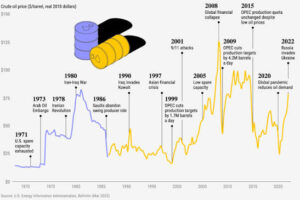
International oil prices constitute a fourth major determinant. In 2016, the average price of Brent crude stood at USD 42.8 per barrel, compared with USD 50.8 in 2015. In 2022, the energy crisis, particularly in the wake of Russia’s invasion of Ukraine, triggered a sharp increase in international prices. In 2026, renewed geopolitical tensions again disrupted supplies, according to the Competition Council.
Finally, domestic competition deserves particular attention. Liberalization does not automatically guarantee rapid price reductions or ensure that international price movements are passed through symmetrically.
In an analysis published in April 2026, the Competition Council noted that changes in international quotations were passed through progressively and unevenly, while also referring to compensation mechanisms between products. These findings support the need for rigorous market monitoring, but they do not establish that every price increase results from collusion or unlawful practices.
Morocco, Algeria, Tunisia and Senegal: Significant Price Differences
Regional comparisons reveal that pump prices depend as much on public policy as on international market conditions. International data available for October 2026 indicate substantial differences between several African countries.
| Country | Indicative diesel price per litre | Pricing system |
|---|---|---|
| Morocco | MAD 15.30, approximately USD 1.57 | Liberalized prices |
| Algeria | Approximately USD 0.23 | Regulated prices, substantially below Morocco |
| Tunisia | Approximately USD 0.74 | Administratively set or regulated prices |
| Senegal | Approximately CFAF 755, equivalent to USD 1.29 | Regulated prices |
Sources: GlobalPetrolPrices, data dated October 5 and 12, 2026. Dollar-denominated figures facilitate comparison but remain indicative and may vary according to collection dates and national pricing arrangements.
Algeria benefits from a significant advantage thanks to its hydrocarbon resources and its policy of regulating domestic fuel prices. Its prices are therefore not directly comparable with Morocco’s, where imports account for a substantial share of petroleum requirements.
Tunisia also maintains stronger government intervention in price formation. Senegal, for its part, operates under a regulated pricing system. On October 12, 2026, diesel was priced at CFAF 755 per litre, while gasoline stood at CFAF 990.
These differences do not necessarily mean that countries with lower fuel prices are more efficient. Subsidies can immediately ease the burden on motorists, but they carry a fiscal cost and may disproportionately benefit households that consume the most fuel.
Conversely, liberalized prices reduce direct government intervention but expose consumers more directly to international market shocks.
An Economic Burden That Extends Far Beyond Filling a Fuel Tank
The impact of rising fuel prices is not limited to motorists. Diesel powers a large share of road freight transport, agricultural activities and industrial logistics.
Higher diesel prices can increase delivery costs, raise business operating expenses and, depending on the sector, push up the final prices of goods and services.
Consider a truck consuming 30 litres of diesel per 100 kilometres. At MAD 8.08 per litre, the price recorded in April 2016, fuel costs amount to MAD 242.40 for every 100 kilometres.
At MAD 15.90 per litre, the expense rises to MAD 477, an additional MAD 234.60 per 100 kilometres, representing an increase of approximately 97%.
For a motorist consuming 50 litres per month, the monthly bill rises from MAD 404 to MAD 795 using the same reference prices. The difference amounts to MAD 391 per month, or MAD 4,692 per year.
These calculations illustrate the potential impact of higher fuel prices. However, they do not measure the exact evolution of average household expenditure, which also depends on kilometres travelled, vehicle fuel efficiency and driving habits.
The Real Challenge: Competition, Transparency and Energy Sovereignty
The debate cannot be reduced to a choice between regulated and free prices. For Morocco, three priorities stand out: greater transparency in price formation, closer monitoring of how international price movements are passed through to the domestic market, and a gradual reduction in energy vulnerability.
The first priority is to publish regular, comparable data on import costs, distribution margins, taxes and prices charged by different distributors.
The second is to ensure effective competition in the domestic market and penalize any proven anti-competitive practices.
The third concerns energy diversification, transport efficiency and the development of alternatives that reduce dependence on fossil fuels.
In March 2026, the Competition Council announced that it would strengthen its monitoring activities through exceptional monthly surveillance of fuel prices and the transmission of international price movements to the domestic market.
Ultimately, rising fuel prices are no longer merely a matter of the cost of filling a vehicle’s tank. They have become an economic and strategic issue affecting household purchasing power, business competitiveness, production costs and Morocco’s ability to achieve greater and more sustainable energy security.