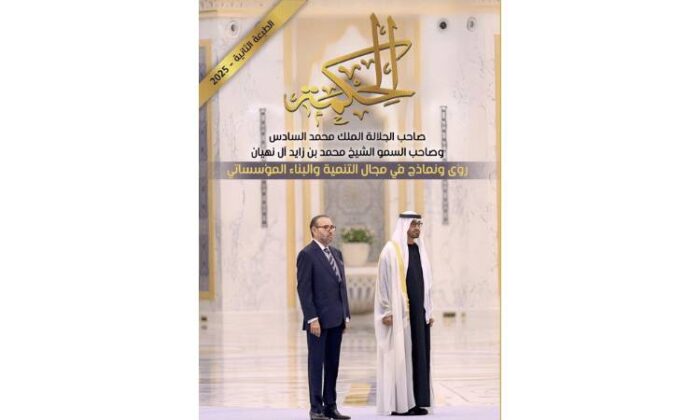
Published in its second edition in 2025, the 437-page book, structured into five chapters, is the result of scientific collaboration between Morocco’s Royal Institute for Strategic Studies (IRES) and the Office of the Vice Chairman of the Board of Directors of the Emirates Center for Strategic Studies and Research (ECSSR).
The publication brings together contributions from a group of prominent Moroccan and Emirati intellectuals, researchers and academics, including Jamal Sanad Al-Suwaidi, Vice Chairman of the Board of Directors of the ECSSR, and Mohamed Tawfik Mouline, Director General of IRES.
The book offers a comparative analysis of development and institution-building experiences in Morocco and the United Arab Emirates, drawing on the strategic visions promoted by the leaders of both countries.
In an address delivered on the occasion, Mr. Al-Suwaidi stressed that the publication provides an in-depth analysis of Moroccan-Emirati relations and their various stages of development, while highlighting the visions and development policies that have shaped the trajectories of both countries and supported their progress and prosperity.
He noted that this experience is grounded in a leadership vision based on consultation, consensus and the promotion of common interests, as well as shared values and principles that enable both nations to address cultural, intellectual and civilizational changes and challenges.
The book also documents various development achievements and humanitarian initiatives undertaken under the leadership of the two countries. Furthermore, it traces the historical roots of the fraternal relations between Morocco and the UAE, whose foundations were laid during the reigns of the late Sheikh Zayed bin Sultan Al Nahyan and the late His Majesty King Hassan II.
These relations have continued to grow stronger over the decades, based on trust, solidarity and mutual understanding, evolving into an exemplary model of Arab partnership founded on sustained cooperation and converging strategic visions.
According to Mr. Al-Suwaidi, the significance of this publication goes beyond documenting bilateral relations, as it highlights a shared leadership experience that places people at the heart of development priorities and links institution-building with strengthening stability and promoting the values of peace and tolerance.
The publication also sheds light on the constitutional experiences of both countries, the factors underpinning their political and institutional stability, and the governance mechanisms that have accompanied their respective development processes.
In particular, the analysis examines the specific features of Morocco’s constitutional experience and the role of constitutional practice in consolidating the foundations of governance, while also addressing the pillars of development, security and stability in the United Arab Emirates.
Positioned as an academic and strategic reference, the book seeks to contribute to a better understanding of institution-building models in the Arab world and encourage further reflection on the development challenges and cultural issues facing the region.