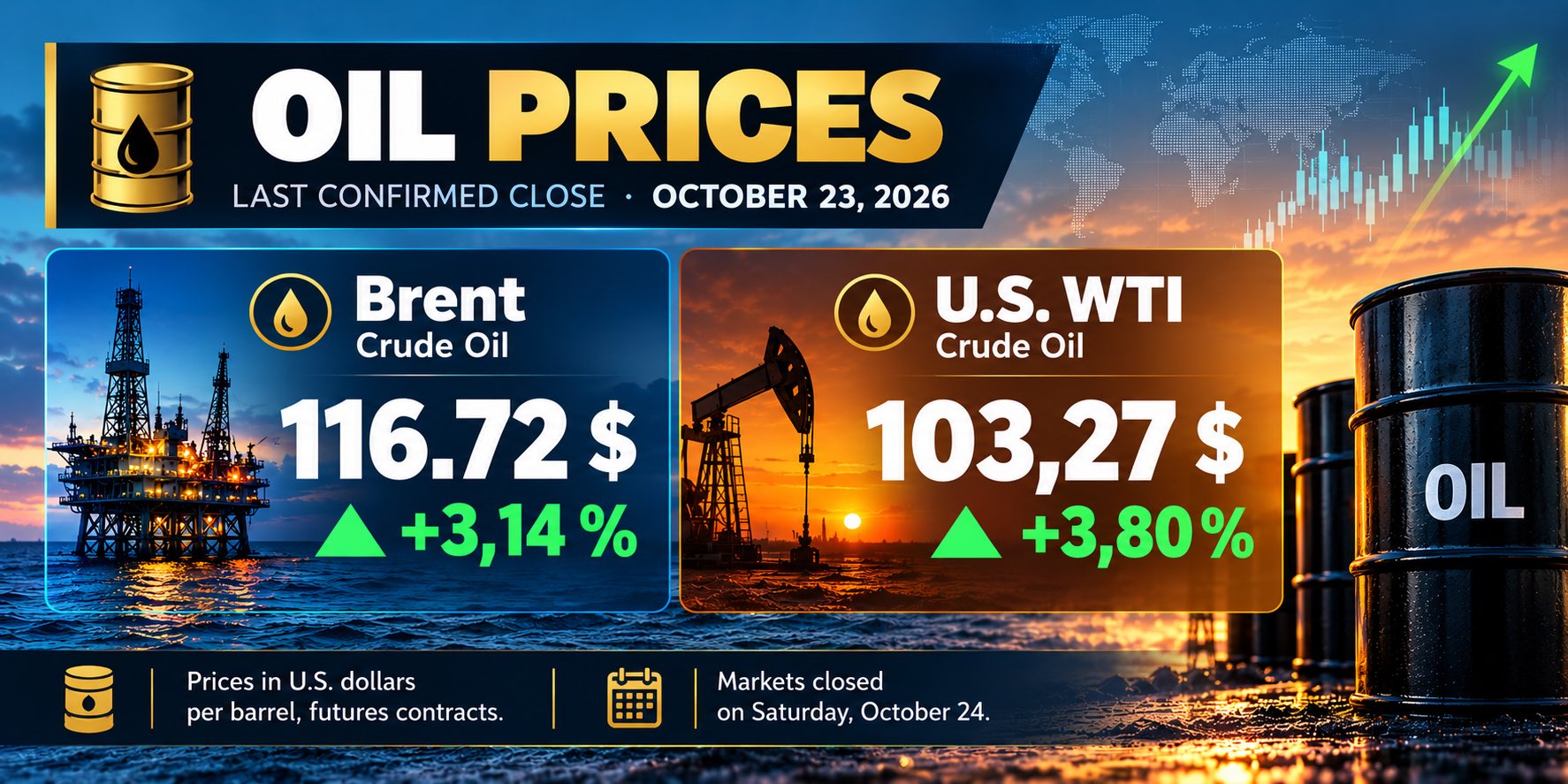
Global oil markets are heading into the final week of October 2026 amid escalating geopolitical tensions and persistent concerns over energy supply security. At the close of trading on Friday, October 23, Brent crude stood at $116.72 per barrel, while US West Texas Intermediate (WTI) settled at $103.27.
The sharp increase reflects the renewed influence of Middle Eastern supply risks on international energy prices, raising concerns about inflation, transportation costs, and global economic growth. For the week of October 26–30, markets are expected to remain volatile as investors closely monitor regional developments and changes in the global oil supply-demand balance.
International oil markets ended the week with a substantial increase in prices. On Friday, October 23, Brent crude gained $3.55 to reach $116.72 per barrel, marking one of its highest closing levels in recent months. US West Texas Intermediate also advanced by $3.80, settling at $103.27 per barrel.
Over the week, the two benchmarks recorded gains of approximately 6% for Brent and 2.3% for WTI, highlighting the renewed impact of geopolitical risk premiums on global energy pricing.
These developments come against a backdrop of heightened security tensions in the Middle East, particularly growing concerns about the safety of oil infrastructure and the reliability of crude export routes.
Risks surrounding energy facilities in the Gulf region continue to unsettle market participants, given the area’s strategic importance in supplying major economies with oil and natural gas.
The Strait of Hormuz remains one of the most sensitive points in the global energy system, serving as a vital corridor for international oil trade. Any prolonged disruption to maritime traffic could increase shipping and insurance costs, delay deliveries, and intensify upward pressure on prices.
Global Supply Imbalances Continue to Support Higher Prices
The latest price increases coincide with persistent fragility in the balance between global oil production and consumption, despite ongoing efforts to stabilize supply.
According to the International Energy Agency’s October 2026 estimates, global oil supply reached approximately 102.3 million barrels per day in September, following a monthly increase of around 2.5 million barrels per day.
However, this recovery remains vulnerable to geopolitical developments and potential disruptions affecting production facilities and export infrastructure.
The agency expects average global production to reach approximately 100.7 million barrels per day in 2026, representing a decline of 5.8 million barrels per day compared with the previous year.
Meanwhile, global demand is projected to fall by approximately 2.6 million barrels per day to around 102.4 million barrels daily, reflecting the impact of higher energy prices and slower economic activity in several markets.
Despite weakening demand, continued supply constraints could keep the market in deficit for the remainder of the year, maintaining upward pressure on crude prices.
Oil inventories represent another important factor influencing market trends. Estimates indicate that observed global oil stocks declined by approximately 509 million barrels between the end of February and the end of September 2026.
This reduction limits the market’s ability to absorb unexpected supply shocks, particularly if major production facilities or trade routes experience further disruptions.
Outlook for October 26–30: Three Possible Market Scenarios
Investors will closely monitor security developments in the Middle East, export volumes from major oil-producing countries, and upcoming economic indicators from the United States and China.
The first scenario involves a continued increase in oil prices if regional tensions escalate or additional supply disruptions occur. Under such conditions, Brent crude could move beyond its latest closing level of $116.72 per barrel.
The second scenario points to relative price stabilization if no major new disruptions emerge. However, volatility could remain elevated as uncertainty continues to dominate market sentiment.
The third scenario involves a potential decline in prices if credible signs of de-escalation emerge and oil flows improve, allowing the geopolitical risk premium to ease.
OPEC+ production decisions will also remain an important factor in market expectations, particularly following the decision to maintain planned production levels for November ahead of the alliance’s next meeting in early November.
Morocco Faces Growing Pressure on Its Energy Import Bill and Household Purchasing Power
For Morocco, which remains heavily dependent on imported petroleum products, persistently high oil prices represent a direct economic challenge because of their potential effects on the trade balance, production costs, and domestic inflation.
Any sustained increase in international oil prices could raise the country’s energy import bill, increase demand for foreign currency, and place additional pressure on external accounts.
These effects are particularly significant for road transportation, logistics, agriculture, fisheries, and manufacturing, where fuel represents an essential component of operating and production costs.
Higher fuel prices can also gradually translate into increased prices for goods and services through rising transportation costs for raw materials and finished products.
Moroccan businesses consequently face a difficult choice: absorb part of the additional costs at the expense of profit margins or pass them on to consumers, potentially weakening domestic demand.
These developments are especially relevant in the context of Morocco’s draft 2027 Finance Law, which aims to strengthen household purchasing power through tax reforms and income-support measures.
Persistently high energy prices could partially offset the expected benefits of lower income taxes if they translate into higher transportation, consumer goods, and essential service costs.
However, the actual impact on the Moroccan market will depend on several factors, including international refined petroleum product prices, the US dollar–Moroccan dirham exchange rate, distribution margins, and the time required for global price changes to affect domestic fuel prices.
Energy Security and Economic Competitiveness Become Strategic Priorities
These developments have once again placed energy security at the center of discussions about economic stability and industrial competitiveness.
Sharp fluctuations in international markets underline the importance of diversifying energy supply sources, expanding renewable energy capacity, and improving energy efficiency across productive sectors.
They also highlight the need to strengthen Morocco’s ability to withstand external shocks through improved energy infrastructure and more effective management of import-related risks.
These priorities are becoming increasingly important as Morocco seeks to expand its industrial base and attract investment in automotive manufacturing, aerospace, food processing, and logistics.
Stable energy costs are a critical factor in investment decisions, particularly for energy-intensive industries and businesses integrated into international supply chains.
A Decisive End to October for Global Oil Markets
The outlook for oil prices over the coming days remains highly uncertain, reflecting the interaction between geopolitical risks and broader economic and financial developments.
In projections released in early October, the US Energy Information Administration expected Brent crude to average approximately $105 per barrel during the final quarter of 2026.
However, the latest price increases demonstrate the market’s sensitivity to developments affecting supply and underline the possibility that forecasts may need to be revised as conditions evolve.
The week of October 26–30 will therefore represent another important test of the market’s ability to regain stability, pending greater clarity on regional tensions, production levels, and global demand.
With Brent crude reaching $116.72 per barrel, oil has once again emerged as a major risk factor for the global economy. For Morocco, the implications extend well beyond fuel prices, affecting industrial competitiveness, inflation, trade balances, and household purchasing power. Continued instability in international oil markets reinforces the need to accelerate the energy transition and strengthen the national economy’s resilience to external shocks. In an increasingly uncertain global environment, energy security has become a fundamental requirement for sustainable economic growth.