




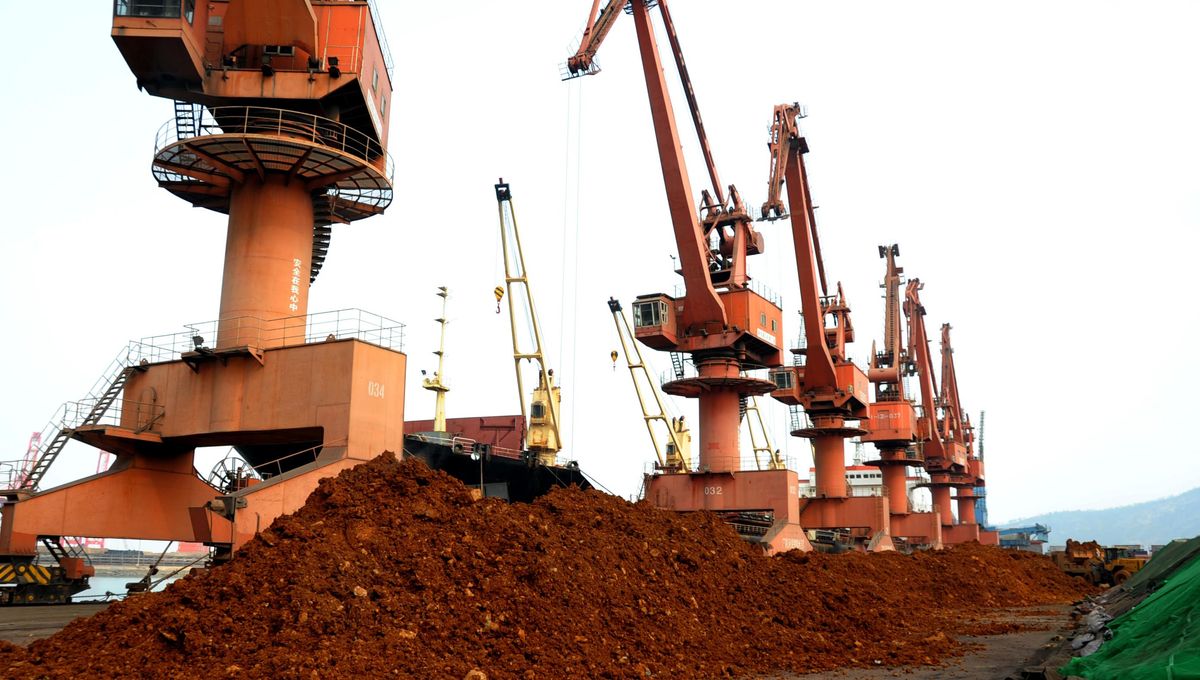

The fragility of rare earth supplies is prompting aerospace industry suppliers to reassess materials that were used several decades ago. In the United States, the needs of defense, civil aviation and advanced technologies are increasing the urgency of securing industrial supply chains, from mining to component manufacturing.
Rare earths have now become a major industrial issue for the United States. These materials are used in the production of numerous aerospace, military and electronic systems, while their extraction, refining and processing remain heavily concentrated in a limited number of countries, particularly China. This dependence exposes U.S. manufacturers to trade restrictions, geopolitical tensions and supply disruptions.
In the aerospace industry, the consequences concern, in particular, protective coatings for turbines and certain components exposed to extreme temperatures. Faced with uncertainty over material availability, several suppliers are reassessing ceramic formulations developed decades ago. The objective is to identify solutions capable of reducing rare earth use without compromising the performance and safety requirements of jet engines.
U.S. NEEDS EXTEND BEYOND THE AEROSPACE SECTOR
The vulnerability of the United States is not limited to mineral imports. It also involves separation, refining, metallurgical processing and finished-product manufacturing. This distinction is essential: having mineral resources within the country is not enough to guarantee industrial autonomy when processing and production capacities remain dependent on foreign suppliers.
Rare earths are used across a range of high-technology sectors, including defense systems, electronic equipment, electric motors, energy infrastructure and industrial applications. The U.S. military particularly relies on permanent magnets, guidance systems, sensors, communications equipment and certain aerospace components.
The U.S. Department of Defense is therefore seeking to develop a domestic supply chain extending from mineral extraction to magnet manufacturing. This approach, often referred to as “mine-to-magnet,” aims to strengthen processing capabilities and reduce vulnerabilities arising from the concentration of industrial activities overseas.
U.S. demand is also expected to be supported by the development of electric vehicles, energy technologies and advanced manufacturing equipment. Rare earths are therefore not simply a resource for the military sector: they are essential to several industrial value chains whose domestic production capacity the United States is seeking to strengthen.
TURBINE COATINGS AT THE HEART OF RESEARCH
Supply pressures are prompting thermal-coating manufacturers to reassess materials that had gradually been replaced by rare-earth-enriched formulations. Research is focusing in particular on ceramics based on zirconium dioxide and other oxides capable of withstanding the thermal stresses encountered in jet engines.
The National Research Council of Canada is examining, together with industrial partners, the possibility of improving certain formulations used during the 1970s and 1980s. Advances in research equipment, manufacturing processes and engineering capabilities could make it possible to reassess the performance of these materials.
The challenge is to determine whether these coatings can provide sufficient protection against high temperatures, oxidation and wear. Their potential adoption must nevertheless take into account the qualification and certification requirements specific to the aerospace industry.
Meanwhile, Oerlikon Metco is developing rare-earth-free thermal-coating solutions, including zirconia-based formulations incorporating magnesium oxide and calcium oxide. U.S. suppliers are also exploring alternative materials for specific applications, while recycling coating overspray provides another avenue for reducing pressure on raw materials.
WASHINGTON SEEKS TO REBUILD AN INTEGRATED INDUSTRIAL SUPPLY CHAIN
The development of substitute materials is part of a broader effort to secure U.S. supplies. Washington is seeking to strengthen domestic processing capabilities and support the establishment of industrial facilities capable of producing metals, alloys and magnets from rare earths.
In June 2026, the U.S. Department of Commerce announced an agreement with USA Rare Earth involving federal incentives of up to $277 million and a potential $1.3 billion loan. The program notably targets the development of extraction and processing capacity in Texas, as well as the production of metals, alloys and magnets in Oklahoma and South Carolina.
These investments address a specific industrial need: establishing domestic capabilities covering several stages of the value chain. Mineral processing, alloy production and magnet manufacturing are critical links for the defense, aerospace and advanced-technology sectors.
However, rebuilding a complete supply chain cannot be achieved within a few months. It requires substantial investment, specialized skills, appropriate infrastructure and sufficiently durable industrial demand to support new production capacity.
DIVERSIFICATION WILL TAKE TIME
The development of alternative coatings and the strengthening of U.S. processing capabilities can help reduce supply risks. However, they cannot eliminate dependence on Chinese industrial supply chains in the short term.
In aerospace, replacing an existing material must meet stringent technical requirements. Manufacturers must assess its resistance to high temperatures, durability, compatibility with manufacturing processes and ability to maintain the performance of the components concerned. The availability of a less expensive or more accessible raw material is therefore not sufficient to justify its adoption in the most sensitive applications.
Suppliers will also have to demonstrate their ability to produce these materials consistently and at industrial scale. This constraint applies both to coating formulations and to other components that use rare earths.
Diversification of supply sources, recycling and the development of substitute materials are therefore complementary tools. For the United States, securing rare earth supplies requires a combination of investment in extraction, refining, processing and manufacturing. For the aerospace industry, it means maintaining technical performance while reducing exposure to disruptions in international markets.
Rare earth dependence thus highlights the limitations of a fragmented value chain. Strengthening U.S. industrial capabilities and developing alternative materials represent two responses to the same challenge: ensuring production continuity in defense and high-technology sectors in an environment shaped by trade and geopolitical tensions.